Table of Contents
Midnight Blueberry Mirror Glaze Dream Domes – A Stunning Blueberry Dessert
I still remember the first time I made a mirror glaze dome — it was during my pastry training in Paris, and my chef insisted on perfection. The way the glaze flowed like liquid silk over the frozen mousse felt almost magical. These Midnight Blueberry Mirror Glaze Dream Domes bring back that wonder every single time. With a deep midnight hue achieved using navy blue, black, and violet gel food coloring, and a luscious blueberry mousse dome recipe at the center, this dessert is as dramatic as it is delicious. I’ve refined this version over years of testing in my tiny NYC kitchen, and I’m so excited to share it with you.
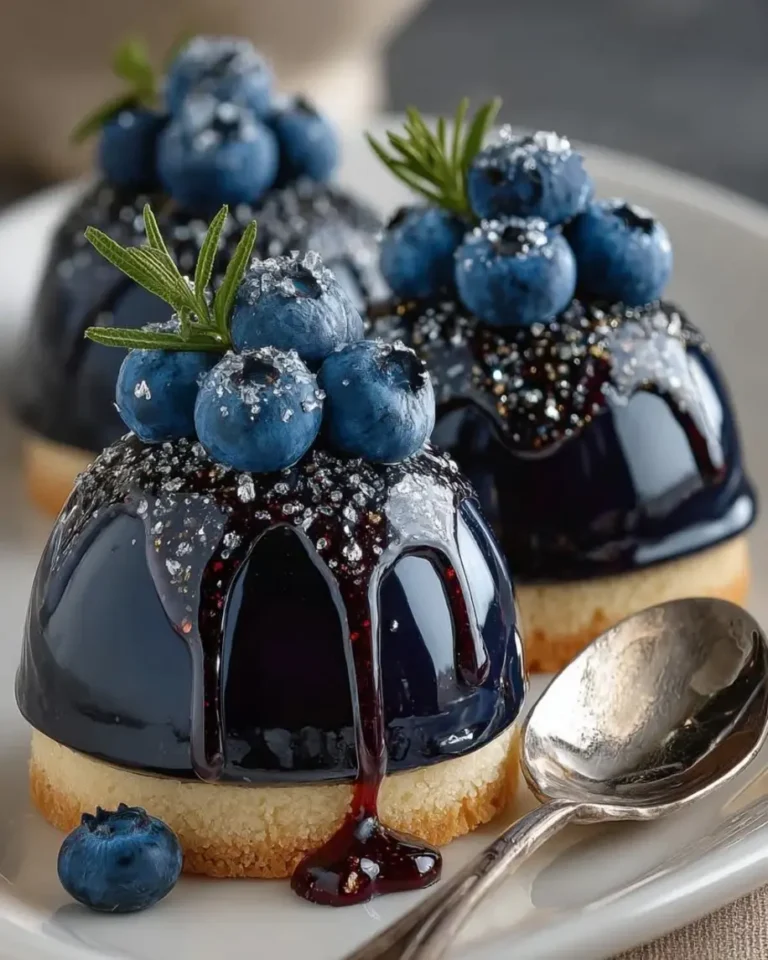
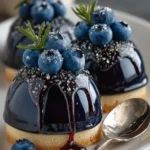
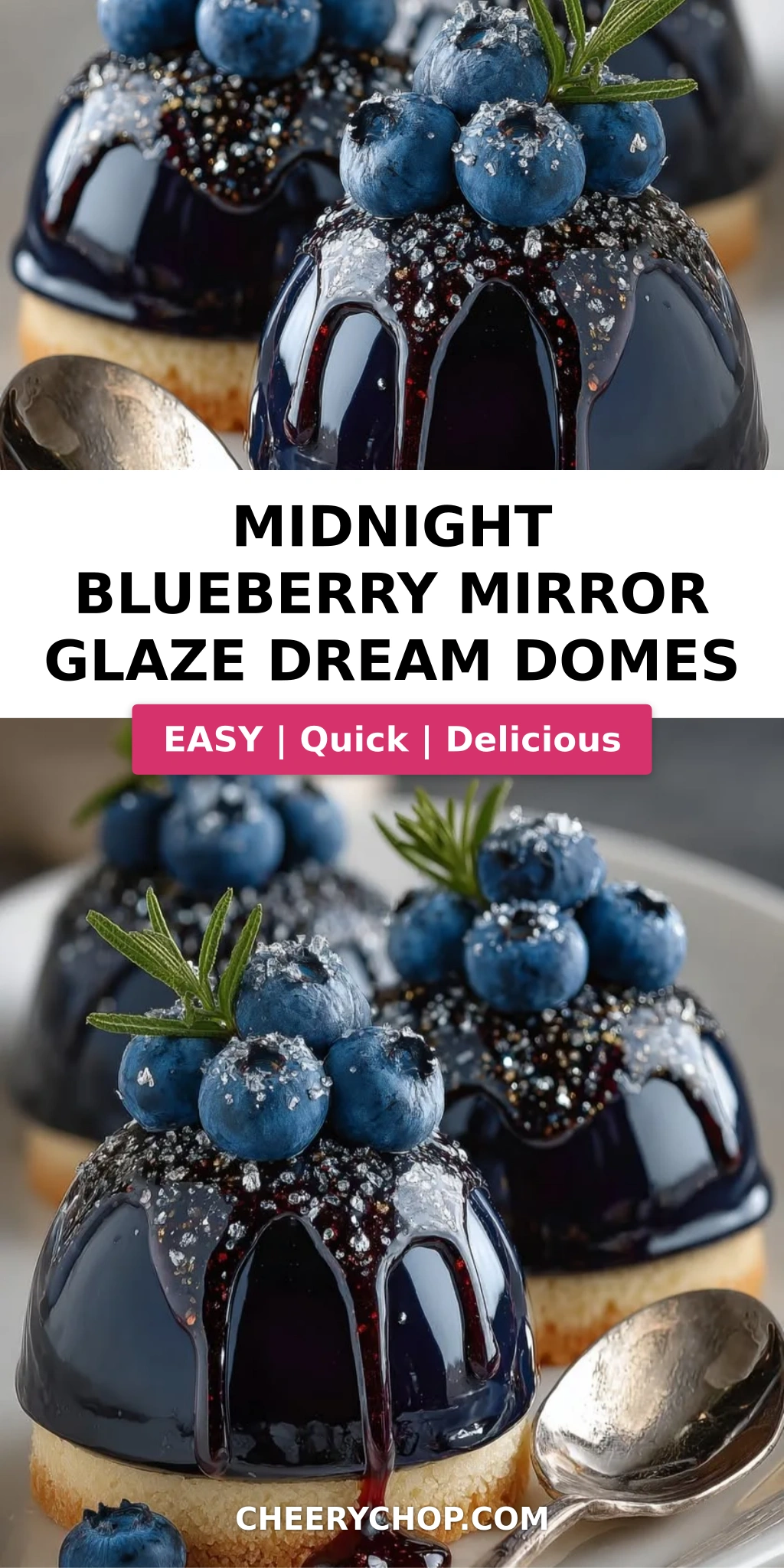
Picture this: a perfectly smooth, glossy mirror glaze in the deepest midnight blue, coating a creamy, tangy-sweet blueberry mousse that sits atop a tender vanilla cake base. The first spoonful cracks through the glaze with a delicate resistance, then gives way to an airy, fruit-forward mousse that melts on your tongue. The blueberries lend a natural tartness that balances the sweetness of the white chocolate-based glaze, while the cake base adds just enough structure. It’s a dessert that looks like it belongs in a French pâtisserie window but is entirely achievable in your home kitchen — especially with a few of my tried-and-true tricks.
I’ve taken my Parisian training in mirror glaze technique and paired it with the bold, fruit-forward flavors I grew up with in Morocco. My version of these mirror glaze cake domes uses a foolproof gelatin-stabilized mousse and a glaze that’s calibrated for the perfect pour every time. One common mistake I see home cooks make is pouring the glaze at the wrong temperature — I’ll show you exactly how to nail that sweet spot. By the end of this post, you’ll have the confidence to create show-stopping blueberry dessert recipe domes that will wow your guests.
Why This Blueberry Mirror Glaze Domes Recipe Is the Best
The flavor secret lies in the blueberry mousse. Instead of using artificial flavorings, I simmer fresh or frozen blueberries with sugar and lemon juice until they burst, then blend them into a silky purée. This concentrated fruit base gives the mousse a bright, authentic blueberry taste that cuts through the richness of the mirror glaze. Growing up in Morocco, my mother always taught me to let fruit speak for itself — and that principle is front and center here. The lemon juice brightens the berries without making them sour, creating a balanced, sophisticated flavor profile.
Perfected texture is what sets these domes apart. The mousse is stabilized with just the right amount of gelatin — enough to hold its shape when unmolded, but not so much that it becomes rubbery. The whipped cream is folded in gently to preserve airiness, resulting in a cloud-like mousse that feels luxurious on the palate. The mirror glaze, meanwhile, is cooled to exactly 90–95°F before pouring. This temperature window is critical: too warm and the glaze runs off too thin, too cool and it thickens and clumps. I learned this precision technique during my time at culinary school in Paris, and it’s the key to that flawless, glass-like finish.
Foolproof and fast — despite the elegant presentation, this recipe is surprisingly approachable for home bakers. I’ve broken down every step with clear visual cues and timing, so you’ll know exactly what to look for. The cake base is a simple vanilla sponge that comes together in minutes, and the mousse requires no cooking beyond simmering the berries. The glaze looks fancy but is essentially a poured mixture of white chocolate, condensed milk, and gelatin. With my detailed instructions and pro tips, even first-timers can achieve professional-looking blueberry mirror glaze domes that taste as incredible as they look.
Blueberry Mirror Glaze Domes Ingredients
I source my blueberries from the Union Square Greenmarket in Manhattan when they’re in season — the small wild blueberries have the most intense flavor. In winter, I rely on frozen organic blueberries, which work beautifully. The white chocolate for the glaze should be a good-quality brand like Valrhona or Callebaut; avoid white chocolate chips, which often contain stabilizers that can affect the glaze’s smoothness. Let me walk you through everything you’ll need.
Ingredients List
- For the Blueberry Mousse: 2 cups fresh or frozen blueberries, 1/4 cup granulated sugar, 1 tbsp lemon juice, 2 tsp powdered gelatin, 2 tbsp cold water, 1 1/4 cups heavy cream (chilled), 1 tsp vanilla extract
- For the Vanilla Cake Base: 1/2 cup all-purpose flour, 1/2 tsp baking powder, 1/8 tsp salt, 1/4 cup granulated sugar, 1 large egg, 2 tbsp unsalted butter (melted), 2 tbsp whole milk, 1/2 tsp vanilla extract
- For the Midnight Blueberry Mirror Glaze: 1/2 cup water, 3/4 cup granulated sugar, 1/2 cup sweetened condensed milk, 2 tbsp light corn syrup, 2 1/2 tsp powdered gelatin, 3 tbsp cold water, 6 oz white chocolate (finely chopped), 1/2 tsp blueberry extract, 1/2 tsp navy blue gel food coloring, 1 drop black gel food coloring, 1 drop violet gel food coloring
- For Garnish (optional): Fresh blueberries, edible silver leaf flakes, small mint leaves
Ingredient Spotlight
Blueberries: The star of the show. Fresh or frozen both work — frozen berries are often sweeter and more affordable. If using frozen, do not thaw them first; add them directly to the saucepan. Wild blueberries offer a more intense, tangy flavor that stands up beautifully to the sweet glaze.
White Chocolate: This is the base of the mirror glaze. Use a couverture-style white chocolate with at least 30% cocoa butter for the smoothest, shiniest finish. Chopping it finely ensures it melts evenly when the hot liquid is poured over it. I recommend Valrhona Ivoire or Ghirardelli white chocolate bars.
Gelatin: Powdered gelatin is used in both the mousse and the glaze. It provides structure without altering flavor. For the mousse, it gives the dome its ability to hold shape when unmolded. For the glaze, it creates that signature mirror-like finish. Always bloom gelatin in cold water for 5 minutes before using — this step is non-negotiable for proper hydration.
Gel Food Coloring: The midnight blue color comes from a combination of navy blue, black, and violet gel colors. Gel colors are concentrated and won’t thin the glaze like liquid food coloring would. I use Americolor brand, which I’ve found to be the most reliable for achieving deep, vibrant shades without altering the glaze’s consistency.
| Original Ingredient | Best Substitution | Flavor / Texture Impact |
|---|---|---|
| Fresh blueberries | Frozen blueberries (unthawed) | Slightly more intense sweetness; same texture |
| White chocolate (couverture) | High-quality white chocolate chips (e.g., Guittard) | May yield slightly less glossy finish; still delicious |
| Powdered gelatin | Sheet gelatin (use same bloom strength, about 4 sheets per 2 tsp) | Slightly clearer set; identical functionality |
| Light corn syrup | Glucose syrup or golden syrup | Glucose yields same gloss; golden syrup adds slight caramel note |
| Heavy cream | Coconut cream (chilled, solid part only) | Lighter texture with mild coconut flavor; dairy-free option |
How to Make Midnight Blueberry Mirror Glaze Dream Domes — Step-by-Step
Trust me — if you follow these steps and pay attention to temperatures and timing, you’ll be rewarded with stunning, professional-looking domes. I’ve included visual cues for every stage so you’ll know exactly what to look for.
Step 1: Bloom the Gelatin for the Mousse
In a small bowl, sprinkle 2 tsp powdered gelatin over 2 tbsp cold water. Let it sit for about 5 minutes until the gelatin absorbs the water and becomes a firm, jiggly mass. This process, called blooming, hydrates the gelatin so it dissolves smoothly into the warm blueberry purée later.
💡 Sara’s Pro Tip: Always use cold water for blooming — warm water will cause the gelatin to dissolve prematurely and clump. If your gelatin doesn’t set firmly after 5 minutes, your water may have been too warm. Start fresh with colder water.
Step 2: Simmer the Blueberry Mixture
In a medium saucepan, combine 2 cups blueberries, 1/4 cup sugar, and 1 tbsp lemon juice. Cook over medium heat for 6–8 minutes, stirring occasionally, until the berries break down and release their juices. The mixture should be bubbling gently and thickened slightly. Remove from heat and blend using an immersion blender or regular blender until smooth. For a perfectly seedless mousse, strain the purée through a fine-mesh sieve.
⚠️ Common Mistake to Avoid: Don’t skip the straining step if you prefer a silky mousse — blueberry seeds can be distracting in an otherwise smooth dessert. If you don’t mind a bit of texture, it’s optional.
Step 3: Dissolve Gelatin into Purée
While the blueberry purée is still warm (but not boiling), add the bloomed gelatin and stir until fully dissolved. This should take about 1 minute. Let the mixture cool to room temperature — you can speed this up by placing the bowl over an ice bath and stirring occasionally. Do not let it set completely; it should remain liquid but no longer hot.
💡 Sara’s Pro Tip: If the purée is too hot, it can weaken the gelatin’s setting power. Check with a clean finger — it should feel warm but not hot. About 95°F is ideal.
Step 4: Whip the Cream and Fold
In a large chilled bowl, whip 1 1/4 cups heavy cream to soft peaks — the cream should hold a slight shape but still be billowy. Add 1 tsp vanilla extract and whip briefly to combine. Gently fold the cooled blueberry mixture into the whipped cream using a spatula, being careful not to deflate the cream. The mousse should be uniform in color and light in texture.
⚠️ Common Mistake to Avoid: Over-whipping the cream is a common error. Stop as soon as the cream forms soft peaks that fold over gently when the whisk is lifted. Over-whipped cream can make the mousse grainy.
Step 5: Make the Cake Base
Preheat your oven to 350°F (175°C). In a mixing bowl, whisk together 1/2 cup flour, 1/2 tsp baking powder, 1/8 tsp salt, and 1/4 cup sugar. Add 1 large egg, 2 tbsp melted butter, 2 tbsp milk, and 1/2 tsp vanilla extract. Mix until smooth and fully combined. Pour the batter into a lined 8×8-inch baking pan and bake for 12–15 minutes, until golden and a toothpick inserted in the center comes out clean. Cool completely, then use a round cutter slightly smaller than your dome molds to cut out 8 circles.
💡 Sara’s Pro Tip: For an extra moist cake base, brush the cake rounds with a simple syrup made from equal parts sugar and water before placing them in the molds. This adds sweetness and prevents the cake from drying out during freezing.
Step 6: Assemble and Freeze the Domes
Fill silicone dome molds halfway with the blueberry mousse. Press one cake round gently onto each dome, making sure it sits flush with the surface. Smooth the bottoms with an offset spatula to remove any gaps. Freeze the domes for at least 6 hours or overnight — this is critical for achieving a clean unmold and a smooth glaze application.
⚠️ Common Mistake to Avoid: Rushing the freezing step. If the domes are not frozen solid, they may collapse when unmolded or the glaze may not adhere properly. Patience here pays off.
Step 7: Prepare the Mirror Glaze
Bloom 2 1/2 tsp gelatin in 3 tbsp cold water for 5 minutes. In a saucepan, heat 1/2 cup water, 3/4 cup sugar, 1/2 cup condensed milk, and 2 tbsp corn syrup over medium heat until steaming — do not boil. Remove from heat, add the bloomed gelatin, and stir until dissolved. Pour the hot mixture over 6 oz finely chopped white chocolate in a heatproof bowl. Let stand for 2 minutes, then blend with an immersion blender until completely smooth. Add 1/2 tsp blueberry extract, 1/2 tsp navy blue gel, 1 drop black gel, and 1 drop violet gel. Blend again until the color is uniform and deep midnight blue. Cool the glaze to 90–95°F (32–35°C) before using.
💡 Sara’s Pro Tip: Use an immersion blender to eliminate air bubbles in the glaze. If you see small bubbles on the surface, tap the bowl on the counter or pass a kitchen torch over the top just before pouring.
Step 8: Glaze the Domes
Unmold the frozen domes and place them on a wire rack set over a baking tray lined with parchment. Pour the mirror glaze evenly over each dome in one continuous motion, starting from the top and letting it flow down the sides. Work quickly — the glaze sets fast on contact with the frozen surface. Once all domes are coated, carefully transfer them to serving plates using a thin spatula. Refrigerate for 1–2 hours to allow the glaze to fully set before serving.
⚠️ Common Mistake to Avoid: Pouring the glaze over domes that are too cold can cause the glaze to seize and crack. Let the frozen domes sit at room temperature for about 2–3 minutes before glazing — just enough to take the extreme chill off.
Step 9: Garnish and Serve
Garnish each dome with fresh blueberries, a few edible silver leaf flakes, and a small mint leaf. The silver leaf adds a gorgeous metallic contrast to the midnight blue glaze, while the mint provides a fresh herbal note. Serve immediately or keep refrigerated until ready to serve.
💡 Sara’s Pro Tip: For the cleanest cut, use a warm knife. Run a sharp chef’s knife under hot water, wipe it dry, then slice through the dome in one smooth motion. Wipe and re-warm the blade between cuts.
| Step | Action | Duration | Key Visual Cue |
|---|---|---|---|
| 1 | Bloom gelatin for mousse | 5 min | Firm, jiggly mass forms |
| 2 | Simmer blueberries | 6–8 min | Berries burst and release juices |
| 3 | Dissolve gelatin into purée | 1 min | Gelatin fully dissolved, no lumps |
| 4 | Whip cream and fold | 3–4 min | Soft peaks form; mixture is uniform |
| 5 | Bake cake base | 12–15 min | Golden top; toothpick comes out clean |
| 6 | Assemble and freeze domes | 6+ hrs / overnight | Firm to touch, no give when pressed |
| 7 | Prepare mirror glaze | 10–12 min | Deep midnight blue; 90–95°F |
| 8 | Glaze the domes | 2–3 min per dome | Smooth, even coating; no bald spots |
| 9 | Garnish and serve | 5 min | Glaze set and shiny; garnishes fresh |
Serving & Presentation
These midnight blueberry domes are a showstopper on any dessert table. I love serving them on simple white plates to let the deep blue color pop. For an extra touch, drizzle a little extra blueberry coulis on the plate and drag a knife through it for a dramatic swoosh. The edible silver leaf reflects the light and adds a celestial, starry-night vibe that’s perfect for celebrations. Fresh blueberries and mint leaves add color contrast and freshness.
If you’re entertaining, these domes can be plated individually before guests arrive — they hold beautifully in the refrigerator for up to 2 hours after glazing. In Morocco, we often serve fruit-based desserts with mint tea, and I find a fragrant green mint tea pairs wonderfully here. For a New York touch, I sometimes serve them alongside a small glass of late-harvest Riesling or a sparkling rosé. The mousse’s tangy blueberry flavor is lovely with something bubbly.
When I trained in Paris, my chef always said that a great dessert engages all the senses. The first glance at the glossy, midnight-blue surface draws you in. The crack of the glaze as your spoon breaks through is deeply satisfying. And then the flavor — sweet-tart blueberry mousse meets buttery vanilla cake — is pure comfort. These blueberry mousse dome recipe domes deliver on every level.
| Pairing Type | Suggestions | Why It Works |
|---|---|---|
| Side Dish | Fresh berry salad, vanilla bean ice cream, crème anglaise | Complements the blueberry flavor without competing |
| Sauce / Dip | Lemon curd drizzle, white chocolate ganache, raspberry coulis | Adds acidity or extra richness to balance the sweetness |
| Beverage | Mint tea, late-harvest Riesling, sparkling rosé, espresso | Tea and wine echo the fruit; espresso cuts the sweetness |
| Garnish | Fresh blueberries, silver leaf, mint, edible flowers, gold leaf | Adds visual drama and a touch of elegance |
Make-Ahead, Storage & Reheating
As a busy mom and food blogger in NYC, I’m all about make-ahead strategies. These domes are actually perfect for prepping ahead of time — the components can be made separately and assembled when you’re ready. The mousse and cake can be prepared a day in advance, and the domes can be frozen for up to 2 weeks before glazing. This makes them ideal for holiday entertaining or dinner parties where you want to minimize last-minute stress.
| Method | Container | Duration | Reheating Tip |
|---|---|---|---|
| Refrigerator | Airtight container, layered with parchment | Up to 3 days (glazed) | Serve cold; do not reheat |
| Freezer | Sealed freezer bag or container, separated by parchment | Up to 2 weeks (unglazed) | Thaw in refrigerator 2 hrs before glazing |
| Make-Ahead | Mousse and cake separate in fridge | Up to 1 day in advance | Assemble, freeze, then glaze on serving day |
When storing glazed domes in the refrigerator, cover them loosely with plastic wrap to prevent the glaze from absorbing fridge odors. Do not stack them — the glaze is delicate and can smudge. If you’re transporting them, place each dome in its own cupcake liner or small box to keep them stable. These domes are best enjoyed within 24 hours of glazing, when the glaze is at its shiniest and the mousse is perfectly creamy.
Variations & Easy Swaps
One of the things I love most about this recipe is how adaptable it is. Over the years, I’ve experimented with different fruits, flavor profiles, and dietary needs. Here are some of my favorite variations — each one tested and approved in my own kitchen.
| Variation | Key Change | Best For | Difficulty Impact |
|---|---|---|---|
| Raspberry & Rose | Replace blueberries with raspberries; add 1 tsp rose water to mousse | Floral, romantic desserts | Same difficulty |
| Gluten-Free | Use a gluten-free 1:1 flour blend for the cake | Gluten-free guests | Same difficulty |
| Midnight Blackberry | Replace blueberries with blackberries; use violet gel only | Deeper, darker color | Same difficulty |
Raspberry & Rose Variation
This is my most-requested variation from friends in NYC. Swap the blueberries for an equal amount of fresh or frozen raspberries, and add 1 tsp of rose water to the mousse along with the vanilla. The rose water adds a delicate floral note that pairs beautifully with the tart raspberries. For the glaze, use a raspberry extract instead of blueberry, and tint the glaze with a mix of magenta and a tiny drop of violet for a gorgeous deep pink color. It’s like a bouquet in dessert form — perfect for Valentine’s Day or a spring celebration.
Gluten-Free Version
Making this recipe gluten-free is surprisingly simple. Substitute the all-purpose flour in the cake base with a high-quality gluten-free 1:1 baking flour blend, such as Bob’s Red Mill or Cup4Cup. These blends already contain xanthan gum, so no additional adjustments are needed. The texture of the cake will be slightly more tender and delicate, but it holds up perfectly under the mousse. I’ve tested this version multiple times, and it’s always a hit — even with guests who don’t need to avoid gluten. The mousse and glaze are naturally gluten-free, so only the cake needs swapping.
Midnight Blackberry Twist
For an even darker and more dramatic dome, swap blueberries for blackberries. Blackberries have a deeper, earthier sweetness that creates a stunning dark purple mousse. Use only violet gel food coloring (about 1/2 tsp) instead of the navy blue and black combination — the blackberries naturally lean darker, so you need less coloring. This version has a slightly more intense, almost wine-like flavor that pairs beautifully with a dark chocolate garnish. I sometimes add a thin layer of dark chocolate ganache on top of the cake base before adding the mousse for an extra decadent twist.
What is the best way to achieve a perfectly smooth mirror glaze for blueberry dream domes?
The key to a perfectly smooth mirror glaze lies in three critical factors: temperature, straining, and bubble removal. First, ensure your glaze is cooled to exactly 90–95°F (32–35°C) before pouring — too warm and it will run off too thin, too cool and it will thicken and clump. Second, always strain the glaze through a fine-mesh sieve before pouring to catch any undissolved gelatin or chocolate bits. Third, use an immersion blender to emulsify the glaze, which helps eliminate tiny air bubbles. If bubbles still appear on the surface, pass a kitchen torch over the top just before pouring. Finally, the domes must be frozen solid — at least 6 hours or overnight — so the glaze sets instantly on contact, creating that flawless, glass-like finish.
Can I use frozen blueberries instead of fresh for the blueberry mirror glaze?
Absolutely! Frozen blueberries are actually a fantastic choice for this recipe. I often use them myself during the winter months when fresh blueberries aren’t at their peak. There’s no need to thaw them first — simply add them directly to the saucepan with the sugar and lemon juice. Frozen berries tend to be slightly sweeter and more evenly flavored because they’re flash-frozen at peak ripeness. They also release more juice during cooking, which gives you a slightly more intense blueberry purée. Just be aware that frozen berries may produce a slightly deeper color in the mousse, which is a beautiful thing. If using frozen, you can skip the straining step if you prefer a more rustic texture, but I still recommend straining for the silkiest mousse.
How long do midnight blueberry mirror glaze dream domes need to set in the fridge before serving?
After glazing, the domes should be refrigerated for at least 1–2 hours to allow the mirror glaze to fully set and firm up. This resting time lets the glaze stabilize and develop that signature shiny, glass-like surface. During this period, the glaze also bonds properly to the frozen mousse, preventing any cracking or peeling when you cut into the dome. For the best texture and flavor experience, I actually recommend refrigerating the glazed domes for about 2 hours — the mousse will soften slightly to a creamy, mousse-like consistency while still holding its shape beautifully. If you refrigerate them for longer (up to 24 hours), the glaze will remain glossy and the mousse will be perfectly creamy. Just cover them loosely with plastic wrap to protect from fridge odors.
What can I substitute for gelatin in the mirror glaze to keep it vegetarian-friendly?
For a vegetarian-friendly mirror glaze, you can use agar-agar powder, a plant-based gelatin derived from seaweed. To substitute, use 1 tsp of agar-agar powder for every 2 1/2 tsp of powdered gelatin called for in the recipe. Keep in mind that agar-agar sets much firmer and at a higher temperature — around 100°F compared to gelatin’s 70°F. This means you’ll need to work slightly faster when pouring the glaze, as it will begin to thicken sooner. Also, agar-agar creates a slightly more brittle set than gelatin, so the glaze may crack more easily when cut. I’ve tested this substitution and it works best when the domes are served within a few hours of glazing. Another option is pectin (like Pomona’s Pectin), but it requires specific sugar and acid ratios to set properly, so I recommend agar-agar as the most reliable alternative.
Can I make the blueberry mousse without gelatin?
While gelatin is the traditional stabilizer for mousse domes because it provides a clean, firm set that holds its shape when unmolded, there are alternatives. For a gelatin-free mousse, you can use agar-agar (1 tsp powder per 2 tsp gelatin) or cornstarch slurry (2 tbsp cornstarch mixed with 3 tbsp cold water, then simmered into the purée). However, I want to be honest with you: the texture will be different. Agar-agar creates a slightly firmer, more custard-like set, while cornstarch yields a softer, pudding-like consistency that may not unmold as cleanly. For the best results with this specific recipe — where you need the domes to hold their shape for glazing — I strongly recommend using gelatin. If you’re making this for a vegetarian friend, the agar-agar option works, but do a test batch first to get familiar with the texture.
Why is my mirror glaze cracking after pouring?
Cracking in a mirror glaze is almost always caused by a temperature shock. If the frozen domes are too cold when the glaze is poured, the glaze sets too quickly and contracts, leading to cracks. Let the frozen domes sit at room temperature for 2–3 minutes before glazing to take the extreme chill off. Conversely, if the glaze itself is too hot when poured, it can melt the surface of the mousse, causing the glaze to slide off and crack as it cools. Always check that your glaze is between 90–95°F before pouring. Another common cause is pouring the glaze too thickly — if the glaze layer is too heavy, it can crack as it settles. Pour in a thin, even stream and avoid going over the same spot multiple times. Finally, ensure your domes are frozen solid (at least 6 hours) so they provide a stable, cold surface for the glaze to adhere to.
Can I use a different fruit instead of blueberries in this recipe?
Yes, this recipe is wonderfully adaptable to other fruits. The most successful substitutions I’ve tested are raspberries, blackberries, and strawberries. For raspberries and blackberries, use the same amount and follow the same procedure — the natural pectin in these berries helps the mousse set nicely. For strawberries, you may need to cook them slightly longer (about 10 minutes) to break them down fully, and consider adding an extra teaspoon of lemon juice to brighten the flavor. Keep in mind that different fruits have different water content and sweetness levels. Denser fruits like mango or peach will create a thicker purée and a slightly heavier mousse. If you’re using a very sweet fruit, reduce the sugar by 1–2 tablespoons. The midnight blue coloring is specific to the blueberry version, so if you’re using a different fruit, choose complementary food coloring shades — pink for strawberry, deep red for raspberry, or purple for blackberry.
Do I need a kitchen thermometer for the mirror glaze?
I highly recommend using a digital instant-read kitchen thermometer for the mirror glaze — it’s one of the few tools that truly makes a difference in achieving professional results. The glaze needs to be at exactly 90–95°F (32–35°C) when poured, and this temperature window is quite narrow. Without a thermometer, it’s very difficult to gauge by feel or sight alone. If the glaze is too warm, it will run off the domes and pool at the bottom, leaving a thin, uneven coating. If it’s too cool, it will thicken and clump before it can flow smoothly over the surface. A good thermometer costs about $10–15 and will pay for itself in saved ingredients and frustration. I use a Thermapen in my kitchen, but any reliable digital thermometer will work. If you really don’t have one, a rough test is to dip a clean finger into the glaze — it should feel slightly warm to the touch, not hot, and not cool.
How do I store leftover mirror glaze domes?
Leftover glazed domes can be stored in the refrigerator for up to 3 days, but they are best enjoyed within 24 hours when the glaze is at its shiniest. To store, place the domes in an airtight container with enough space between them so the glaze doesn’t touch. Line the bottom of the container with parchment paper to prevent sticking. Do not use plastic wrap directly on the glaze — it will stick and ruin the surface. If you need to stack them, place a sheet of parchment or wax paper between layers. Before serving leftover domes, let them sit at room temperature for about 5 minutes to take the chill off, which helps the flavor come through. The glaze may lose a bit of its initial mirror-like shine after refrigeration, but the flavor will still be excellent. If you haven’t glazed the domes yet, they can be frozen unglazed for up to 2 weeks — just wrap each dome individually in plastic wrap and store in a freezer bag. Glaze them fresh when you’re ready to serve.
What type of white chocolate should I use for the mirror glaze?
For the best mirror glaze, use a high-quality couverture white chocolate that contains at least 30% cocoa butter. Brands like Valrhona Ivoire, Callebaut, or Ghirardelli white chocolate baking bars are excellent choices. Avoid white chocolate chips or melting wafers, as they often contain stabilizers and less cocoa butter, which can prevent the glaze from achieving that smooth, glossy finish. The cocoa butter in couverture chocolate creates a fluid, pourable glaze that sets to a beautiful shine. If you can’t find couverture chocolate, look for white chocolate bars in the baking aisle that list cocoa butter as one of the first ingredients. Finely chop the chocolate before adding the hot liquid — this ensures even melting and a lump-free glaze. I’ve also used Lindt white chocolate bars with good results. The better the chocolate, the better the flavor and shine of your glaze.
Share Your Version!
I absolutely love seeing how these Midnight Blueberry Mirror Glaze Dream Domes turn out in your kitchen! If you make this recipe, I’d be so grateful if you’d leave a star rating and comment below — your feedback helps me create better recipes and helps other readers know what to expect. Tag me in your photos on Instagram or Pinterest @cheerychop, and I’ll share my favorites in my stories. I’m always curious: what flavor combination will you try? The raspberry and rose variation has been a huge hit, but I’m always experimenting with new twists. Drop a comment and let me know what fruit or flavor you’d love to see in a future dome recipe!
From my NYC kitchen to yours — I hope this recipe brings as much warmth to your table as it does to mine. — Sara 🧡
⭐ Loved this recipe? Rate it below and share your photos with us!
Your star rating and comments help other home bakers discover these midnight blueberry mirror glaze domes. And when you make them, tag @cheerychop — I can’t wait to see your gorgeous creations!
Love This Recipe? Save It to Pinterest!
If you enjoyed this Midnight Blueberry Mirror Glaze Dream Domes recipe, don’t let it get lost in your browser tabs! 😄 Pin it now so you can find it again anytime — and explore hundreds more tried-and-tested recipes waiting for you on my Pinterest boards.
👉 Follow Sara on Pinterest @chefrecipes2
📌 Pin this recipe · 🔁 Re-pin your favorites · 💬 Tag me when you make it — I love seeing your creations!
Midnight Blueberry Mirror Glaze Dream Domes
- Yield: 8 1x
Ingredients
- For the Blueberry Mousse:
- 2 cups fresh or frozen blueberries
- 1/4 cup granulated sugar
- 1 tbsp lemon juice
- 2 tsp powdered gelatin
- 2 tbsp cold water
- 1 1/4 cups heavy cream, chilled
- 1 tsp vanilla extract
- For the Vanilla Cake Base:
- 1/2 cup all-purpose flour
- 1/2 tsp baking powder
- 1/8 tsp salt
- 1/4 cup granulated sugar
- 1 large egg
- 2 tbsp unsalted butter, melted
- 2 tbsp whole milk
- 1/2 tsp vanilla extract
- For the Midnight Blueberry Mirror Glaze:
- 1/2 cup water
- 3/4 cup granulated sugar
- 1/2 cup sweetened condensed milk
- 2 tbsp light corn syrup
- 2 1/2 tsp powdered gelatin
- 3 tbsp cold water
- 6 oz white chocolate, finely chopped
- 1/2 tsp blueberry extract
- 1/2 tsp navy blue gel food coloring
- 1 drop black gel food coloring
- 1 drop violet gel food coloring
- For Garnish (optional):
- Fresh blueberries
- Edible silver leaf flakes
- Small mint leaves
Instructions
- Bloom the gelatin for the mousse in cold water for 5 minutes.
- Simmer the blueberries, sugar, and lemon juice for 6–8 minutes until softened. Blend until smooth and strain if desired.
- Stir the bloomed gelatin into the warm blueberry purée until dissolved. Let cool to room temperature.
- Whip the heavy cream to soft peaks. Fold the vanilla and cooled blueberry mixture into the whipped cream.
- Prepare the cake by mixing the flour, baking powder, salt, sugar, egg, melted butter, milk, and vanilla until smooth.
- Bake in a lined pan at 350°F (175°C) for 12–15 minutes. Cool completely and cut circles slightly smaller than the dome molds.
- Fill silicone dome molds halfway with blueberry mousse. Press a cake round onto each dome and smooth the bottoms. Freeze for at least 6 hours or overnight.
- Bloom the glaze gelatin in cold water.
- Heat the water, sugar, condensed milk, and corn syrup until steaming. Remove from the heat and stir in the gelatin.
- Pour the hot mixture over the white chocolate. Let stand for 2 minutes, then blend until smooth.
- Add the blueberry extract and gel food coloring until a deep midnight blue color is achieved. Cool the glaze to about 90–95°F (32–35°C).
- Unmold the frozen domes and place them on a wire rack over a tray.
- Pour the mirror glaze evenly over each dome in one continuous motion until fully coated.
- Transfer the glazed domes to serving plates and refrigerate for 1–2 hours before serving.
- Garnish with fresh blueberries, edible silver leaf flakes, and mint leaves.
Nutrition
- Calories: 395
- Sugar: 34 g
- Fat: 24 g
- Carbohydrates: 42 g
- Protein: 5 g
Tried This Recipe? Leave a Comment!
Did you make this recipe? I’d love to hear how it turned out! Please leave a comment and a rating below. Your feedback helps other home cooks and supports cheerychop.com!
For more delicious inspiration, follow me on Pinterest!