Table of Contents
Coconut Vanilla Aurora Spheres with Passionfruit Center – A Dessert That Dazzles
Growing up in Morocco, I spent countless afternoons in my mother’s kitchen where the scent of coconut and vanilla mingled with the warm breeze from the garden. That simple comfort is the soul of these coconut vanilla aurora spheres with passionfruit center — a dessert that feels like a hug and a celebration all at once. After training in Paris and now living in New York City, I’ve merged that childhood memory with French pastry precision and the city’s love for show-stopping sweets. This aurora mirror glaze cake approach turns a classic mousse into a shimmering, edible masterpiece. Let me show you how to create that dazzling finish at home — it’s easier than you think.
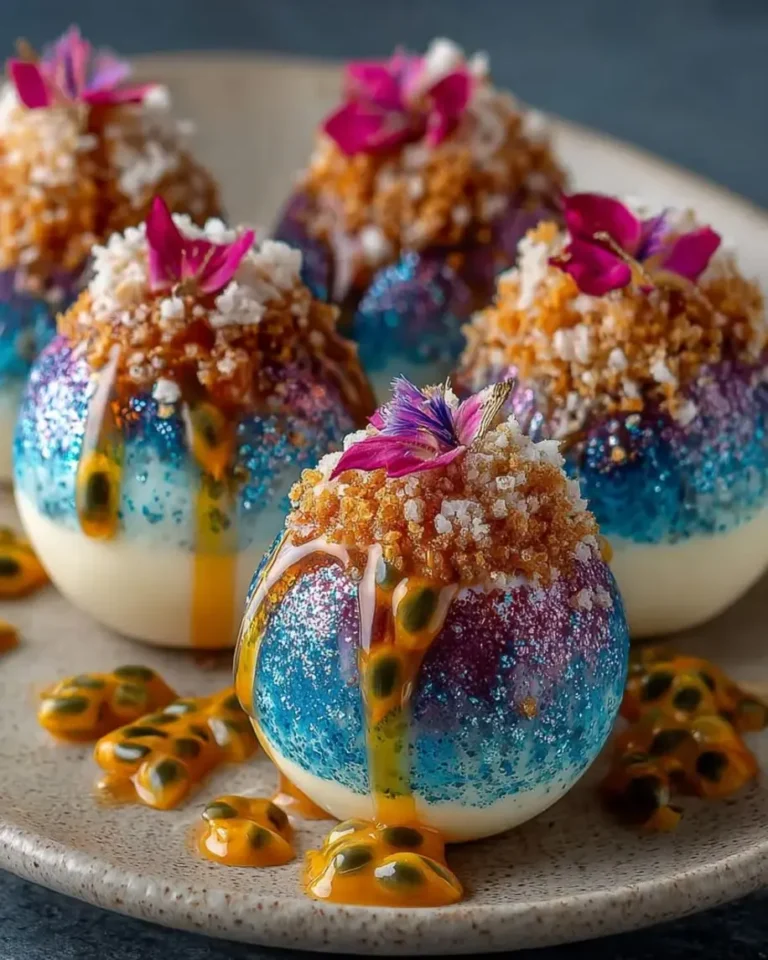
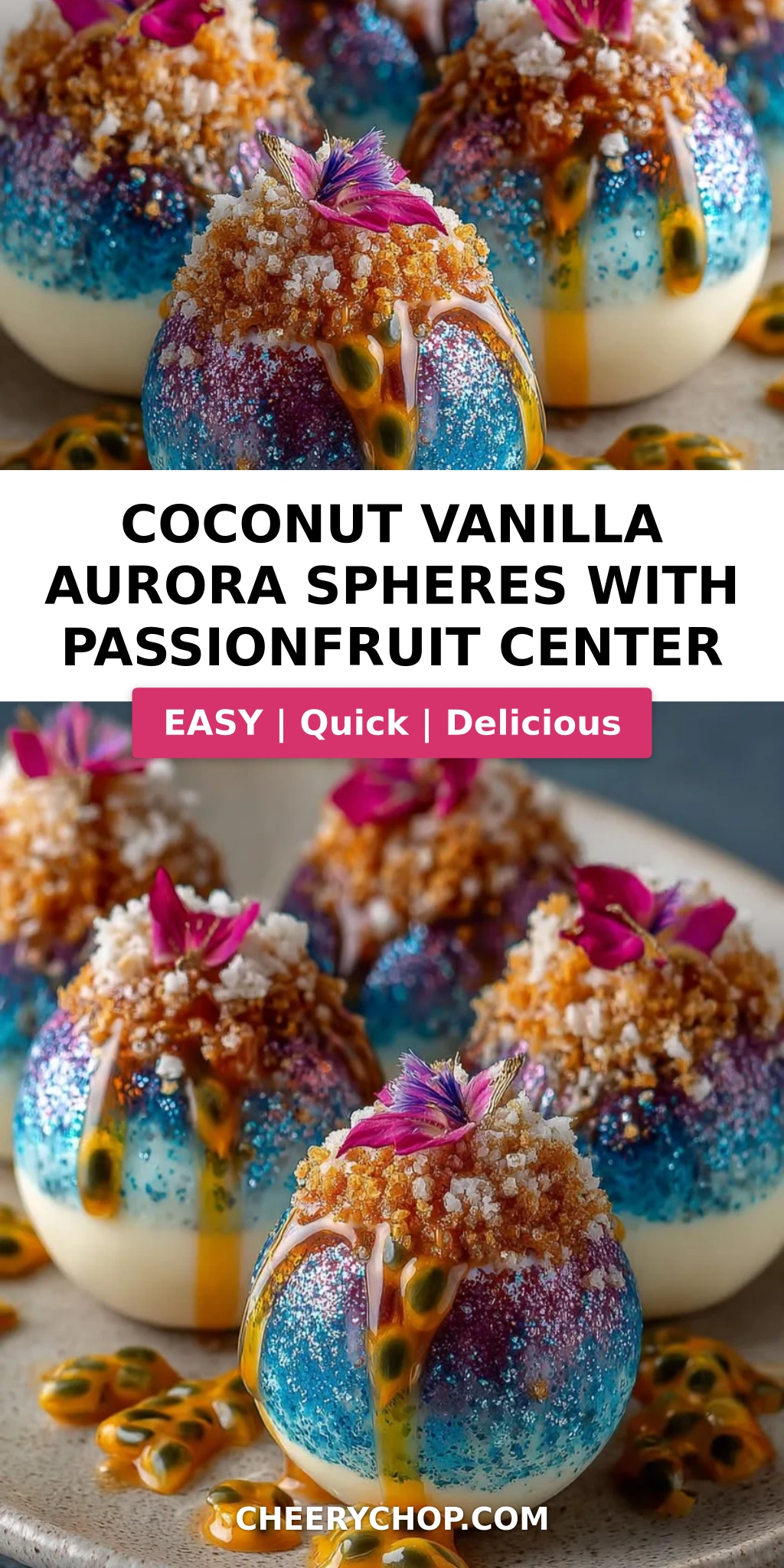
Imagine the first crack of a glossy shell giving way to a cloud of coconut vanilla mousse, then a burst of tangy passionfruit that cuts through the sweetness. The texture is pure silk — rich but not heavy, thanks to the coconut cream and cream cheese base. And that aurora glaze? It shimmers like the Northern Lights, with swirls of pink and blue reflecting the light. Every bite is a journey from the creamy, smooth mousse to the bright, frozen passionfruit center that slowly melts on your tongue. It’s the kind of dessert that turns a dinner party into an event.
Over the years, I’ve tested this recipe more times than I can count — tweaking the gelatin ratios, perfecting the glaze temperature, and nailing that liquid center that stays soft even after freezing. My version uses a smart trick: freezing the passionfruit core separately so it stays semi-liquid when the sphere is cut. 💡 Sara’s Pro Tip: Always bloom your gelatin in ice-cold water for a full five minutes to avoid lumps. One common mistake? Pouring the glaze when it’s too hot — it will slide right off and leave bare patches. Keep scrolling for my complete guide to making these coconut mousse spheres with confidence.
Why This Coconut Vanilla Aurora Spheres Recipe Is the Best
The Flavor Secret: I use full-fat coconut cream (not milk) for the mousse — that’s the Moroccan way. It gives a luscious, dairy-free richness that pairs perfectly with the tangy passionfruit. In Paris, I learned to balance sweet and acidic elements with precision; here, the sugar in the mousse is offset by the lemon juice in the core. It’s a harmony of contrasts that keeps you coming back for another bite.
Perfected Texture: The key is the gelatin. Too much and your mousse becomes rubbery; too little and it won’t hold its shape. I’ve tested this until the coconut mousse is firm enough to unmold but still melts on the tongue. The passionfruit center uses a separate gelatin set — just enough to hold its form while remaining spoon-soft at room temperature. That’s the French technique I bring to every recipe.
Foolproof & Fast: Even if you’re new to mirror glazes, this recipe walks you through every step. The glaze comes together in minutes and can be tinted to any color. I’ve streamlined the process so you can prep the spheres a day ahead and glaze them the day of serving. No special equipment needed beyond sphere molds and a hand mixer — your NYC kitchen is already ready.
Coconut Vanilla Aurora Spheres Recipe Ingredients
I pick up my coconut cream at the Union Square farmers market — the Thai brand in the can works beautifully. Passionfruit puree is a staple in my pantry; I find it frozen at Whole Foods or specialty markets. The white chocolate for the glaze should be high quality (I love Guittard or Lindt) because cheap chocolate can seize. Let me break down everything you need.
Ingredients List
- For the Coconut Vanilla Mousse:
- 2 cups coconut cream
- 1 cup heavy cream
- 8 oz cream cheese, softened
- ½ cup granulated sugar
- 1 tsp vanilla extract
- 2 tsp powdered gelatin
- 3 tbsp cold water
- For the Passionfruit Core:
- ¾ cup passionfruit puree
- 2 tbsp granulated sugar
- 1 tsp lemon juice
- 1 tsp powdered gelatin
- 1 tbsp cold water
- For the Biscuit Base:
- 1 cup digestive biscuits, finely crushed
- 3 tbsp melted butter
- For the Aurora Mirror Glaze:
- 1 cup granulated sugar
- ½ cup water
- ½ cup sweetened condensed milk
- 1 cup white chocolate, finely chopped
- 1 tbsp powdered gelatin
- 3 tbsp cold water
- 1 tsp vanilla extract
- 2–3 drops blue food coloring
- 2–3 drops pink food coloring
- For Garnish (optional):
- Toasted coconut flakes
- Passionfruit seeds
- Edible shimmer dust
Ingredient Spotlight
Coconut Cream: This is the heart of the mousse. Look for cans labeled “coconut cream” (not “coconut milk”) — it has a higher fat content that gives a silky texture. If you can’t find it, use full-fat coconut milk and reduce the water by ¼ cup. The mousse will be slightly lighter but still delicious.
Passionfruit Puree: I use unsweetened puree to control the sugar. Frozen puree works beautifully — just thaw and measure. If you have fresh passionfruit, scoop the pulp and seeds, strain out the seeds for the puree, and reserve some seeds for garnish. The acidity is crucial to balance the sweet mousse and glaze.
White Chocolate: For the mirror glaze, a good-quality white chocolate with cocoa butter (at least 28%) melts smoothly. Avoid white “baking chips” that often contain palm oil and result in a greasy glaze. Chopping the chocolate finely helps it melt evenly.
Gelatin: I use powdered gelatin (Knox brand is widely available). Vegetarian alternatives like agar-agar will set differently and change the texture — I don’t recommend them for this particular recipe unless you’re experienced.
| Original Ingredient | Best Substitution | Flavor / Texture Impact |
|---|---|---|
| Coconut cream | Full-fat coconut milk (reduce water by ¼ cup) | Slightly lighter mousse, still creamy |
| Heavy cream | Whipping cream (35% fat) | Same texture, slightly less rich |
| White chocolate | Good-quality white couverture | More stable glaze, shinier finish |
| Digestive biscuits | Graham crackers or shortbread cookies | Crunchier or buttery base |
How to Make Coconut Vanilla Aurora Spheres — Step-by-Step
Ready to create these stunning passionfruit dessert recipe gems? I’ll guide you through each stage, from the biscuit base to the final shimmer. Take your time and enjoy the process — it’s as rewarding as the final dish.
Step 1: Prepare the Biscuit Base
Mix the crushed digestive biscuits with melted butter until the texture resembles wet sand. Press about 1–2 tablespoons into the bottom of each sphere mold cavity (use a small glass or spoon to compact). Chill the molds for 15 minutes to set.
⚠️ Common Mistake to Avoid: Don’t press the crumbs too thin — a firm, even layer prevents the mousse from seeping through and creates a stable base.
Step 2: Make the Passionfruit Core
Bloom 1 tsp gelatin in 1 tbsp cold water for 5 minutes. Meanwhile, warm the passionfruit puree, sugar, and lemon juice in a small saucepan until just steaming (not boiling). Remove from heat, stir in the bloomed gelatin until fully dissolved. Pour into small hemisphere inserts (or a thin layer in a mini muffin tin) and freeze for at least 2 hours until firm.
💡 Sara’s Pro Tip: For a liquid center that oozes when cut, don’t over-freeze. The core should be firm but not rock hard — about 2 hours is perfect. If you freeze overnight, let it sit at room temperature for 5 minutes before assembling.
Step 3: Make the Coconut Vanilla Mousse
Bloom 2 tsp gelatin in 3 tbsp cold water for 5 minutes. In a large bowl, beat cream cheese, coconut cream, sugar, and vanilla until smooth and creamy. Warm about 2 tbsp of the heavy cream (reserve the rest) in a small pan and dissolve the bloomed gelatin into it. Stir that into the coconut base. In a separate bowl, whip the remaining heavy cream to soft peaks, then gently fold it into the coconut mixture until uniform.
⚠️ Common Mistake to Avoid: If the cream cheese isn’t fully softened, you’ll have lumps. Let it sit at room temperature for 30 minutes before starting, and beat it alone first until smooth.
Step 4: Assemble the Spheres
Spoon the mousse into each mold over the biscuit base, filling halfway. Gently press a frozen passionfruit core into the center of each. Cover with remaining mousse, smoothing the tops. Freeze for at least 6 hours — overnight is best.
💡 Sara’s Pro Tip: Use an offset spatula dipped in hot water to smooth the top of the mousse for a flat, even surface — this prevents the glaze from pooling unevenly.
Step 5: Make the Aurora Mirror Glaze
Bloom 1 tbsp gelatin in 3 tbsp cold water. In a saucepan, combine sugar, water, and condensed milk. Heat until steaming (do not boil). Remove from heat and stir in the gelatin and chopped white chocolate until smooth. Add vanilla extract and use an immersion blender to get rid of any air bubbles (blend without incorporating air — tilt the blender to avoid frothing). Divide the glaze into two bowls — tint one with blue, the other with pink. For the aurora effect, pour both colors into the same container and swirl gently with a toothpick — don’t overmix.
⚠️ Common Mistake to Avoid: Air bubbles are the enemy of a mirror glaze. After blending, let the glaze sit for 5 minutes; any surface bubbles will pop naturally. Also, the glaze must be exactly 90°F (32°C) — too hot and it runs off, too cold and it clumps.
Step 6: Glaze and Garnish
Unmold the frozen spheres (run the bottom of the mold under warm water for 5 seconds if stuck) and place on a wire rack over a baking sheet. Pour the aurora glaze evenly over each sphere, making sure it coats completely — work quickly. Let excess drip off for about 30 seconds, then transfer to a serving plate. Refrigerate for 30 minutes to set the glaze. Garnish with toasted coconut flakes, passionfruit seeds, and edible shimmer dust just before serving.
💡 Sara’s Pro Tip: For extra shimmer, brush a little edible gold dust on the glaze after it sets. It catches the light beautifully and adds a professional touch.
| Step | Action | Duration | Key Visual Cue |
|---|---|---|---|
| 1 | Biscuit base | 15 mins chill | Firm, compacted crumbs |
| 2 | Passionfruit core | 2 hrs freeze | Firm but not hard |
| 3 | Coconut mousse | 10 mins | Smooth, creamy, soft peaks |
| 4 | Assemble & freeze | 6+ hrs freeze | Completely solid to the touch |
| 5 | Aurora glaze | 10 mins + cool to 90°F | Glossy, bubble-free, swirl colors |
| 6 | Glaze & garnish | 30 mins set | Even coating, not sticky |
Serving & Presentation
These spheres are meant to be the centerpiece — no fussy plating needed. Place one on each plate, maybe with a small quenelle of coconut sorbet or a drizzle of passionfruit coulis. The contrast of the shiny glaze against the white plate is stunning. In Morocco, we’d serve something like this with mint tea; in Paris, a crisp Sauternes would be lovely. For a New York twist, pair it with an espresso or even a cold brew — the bitterness cuts through the sweetness.
I love using the passionfruit seeds and toasted coconut as garnish — they add texture and reinforce the flavors. Edible shimmer dust (available at baking stores or online) gives that extra wow factor. If you’re feeling fancy, add a thin chocolate disc or a tuile for height. Remember, the first bite is with the eyes!
| Pairing Type | Suggestions | Why It Works |
|---|---|---|
| Side Dish | Coconut sorbet, fresh fruit salad | Reinforces tropical notes |
| Sauce / Dip | Passionfruit coulis, mango puree | Adds tangy contrast |
| Beverage | Sauternes, mint tea, cold brew coffee | Balances sweetness |
| Garnish | Toasted coconut, passionfruit seeds, shimmer dust | Adds crunch and visual magic |
Make-Ahead, Storage & Reheating
In my busy NYC life, I almost always make these spheres a day or two ahead. The mousse assembly and freezing can be done up to 3 days before, and the glaze is best applied on serving day. Once glazed, they’ll hold in the fridge for up to 6 hours — perfect for dinner parties. Just don’t skip the final refrigeration step; the glaze needs that chill to set completely.
| Method | Container | Duration | Reheating Tip |
|---|---|---|---|
| Refrigerator | Sealed container | Up to 3 days (unglazed) | Glaze after bringing to chilled temp |
| Freezer | Wrap individually in plastic | Up to 1 month | Thaw overnight in fridge before glazing |
| Make-Ahead | Freeze mousse spheres | 3 days before | Assemble mousse and cores, freeze solid |
For reheating (if you want a slightly warmer center — though these are best served cold), you can microwave the plated sphere for 5–10 seconds on low power. The glaze may lose some shine, so it’s not my first choice. Instead, serve straight from the fridge for the perfect balance of cold mousse and soft passionfruit center.
Variations & Easy Swaps
I love experimenting with flavors depending on the season or what I find at the market. Here are some of my favorite twists on these coconut vanilla aurora spheres recipe.
| Variation | Key Change | Best For | Difficulty Impact |
|---|---|---|---|
| Chocolate Aurora | Replace white choc with milk choc in glaze; add cocoa to mousse | Chocolate lovers | Easy |
| Dairy-Free | Use vegan cream cheese & coconut cream for mousse; omit cream | Dairy-free guests | Medium |
| Mango-Passionfruit Summer | Replace half passionfruit puree with mango puree in core | Summer entertaining | Easy |
Chocolate Aurora
For a deeper, more decadent version, swap the white chocolate in the glaze for milk chocolate and add 2 tbsp of cocoa powder to the mousse. The aurora effect works with pink and gold swirls instead of blue and pink. It’s like a chocolate sunset — perfect for winter holidays.
Dairy-Free
To make this entirely dairy-free, use a plant-based cream cheese (like Kite Hill) and replace heavy cream with full-fat coconut cream (chill the can and scoop the solid part). The texture will be slightly denser but equally luscious. For the glaze, use a vegan white chocolate — just be sure to check the melting behavior. This version has become a hit at my dinner parties with lactose-intolerant friends.
Mango-Passionfruit Summer
When mangoes are in season at the NYC farmers market, I make a mango-passionfruit core. Use ½ cup mango puree and ¼ cup passionfruit puree; the sweetness of mango mellows the tartness. The amber color looks gorgeous under a blue-green aurora glaze. It’s my favorite summer entertaining recipe.
Can I use coconut cream instead of coconut milk for the sphere shell?
Absolutely — in fact, I recommend it. Coconut cream (the thick, solid part from a can of full-fat coconut milk) gives the mousse a richer, creamier texture that holds its shape better when frozen. If you only have coconut milk, you can still use it, but reduce the total liquid by about ¼ cup and expect a slightly softer mousse. The flavor will be the same, but the structural integrity of the sphere may be compromised, especially when you pour the warm glaze over it. For best results, stick with coconut cream.
How do you get a liquid passionfruit center inside the spheres without it freezing solid?
The trick is in the gelatin ratio and the freezing time. For the passionfruit core, I use just 1 teaspoon of gelatin per ¾ cup puree — that’s less than what you’d use for a firm jelly. The core is frozen for only 2 hours, so it sets to a soft, spoonable consistency rather than a hard ice cube. When you bite into the frozen sphere, the core has a slightly icy but still fluid texture that oozes beautifully. If you freeze the cores overnight, let them sit at room temperature for 5–10 minutes before inserting them into the mousse so they soften slightly.
What is the best way to temper the coating for Aurora Spheres to achieve a glossy finish?
The mirror glaze must be at exactly 90°F (32°C) when you pour it — this is the sweet spot. If it’s hotter, the glaze will be too thin and run off the frozen sphere, leaving bare patches. If it’s cooler, it will be too thick and clump, losing its mirror shine. I use an instant-read thermometer to check the temperature. Also, make sure the spheres are completely frozen (at least 6 hours) before glazing — a warm sphere will melt the glaze on contact. Finally, strain the glaze through a fine-mesh sieve before pouring to remove any lumps that could dull the finish.
How long do you need to freeze the spheres before serving for the right texture?
For the ideal texture — a creamy mousse that’s firm enough to hold the glaze but still melts in your mouth — freeze the assembled spheres for at least 6 hours, but overnight is even better. The longer freeze ensures the center is fully set so the warm glaze doesn’t cause cracks. When you’re ready to serve, the spheres should be eaten within 30 minutes of coming out of the freezer (after the 30-minute glaze set in the fridge they will be perfect). If they stay out too long, the mousse will soften and the glaze may become tacky. So plan your timing: glaze them, refrigerate for 30 minutes, then serve immediately.
What can I use instead of passionfruit puree for the center?
If you can’t find passionfruit puree, you can use any tart fruit puree — mango, raspberry, or even a mix of lemon juice and berry puree. The key is to maintain acidity to balance the sweet mousse. For a ¾ cup substitute, use ½ cup of your chosen puree plus 1 tablespoon of lemon or lime juice. Adjust sugar to taste, but keep the gelatin amount the same. Frozen purees work wonderfully; just thaw and strain if needed. I’ve made a raspberry-lime version that was a huge hit — the color also pairs beautifully with a pink aurora glaze.
Can I make these without gelatin (vegetarian)?
Gelatin gives these spheres the structure they need to hold their shape and support the mirror glaze. I don’t recommend using agar-agar or pectin as direct substitutes because they set at different temperatures and create a different texture — the mousse can become crumbly and the glaze may split. If you need a vegetarian version, I suggest looking for a dessert that uses a chilled mousse without the mirror glaze, like a coconut panna cotta with a passionfruit gel. That said, if you’re experienced with agar, you can experiment: use 1.5 tsp agar powder per 2 cups liquid for the mousse, but note the texture will be more jelly-like. For the glaze, agar often results in a matte finish.
Why did my mirror glaze crack or have bubbles?
Cracks usually happen if the frozen sphere is too cold — the thermal shock causes the glaze to contract and crack. Make sure the glaze is at 90°F and the sphere is not more than -10°F (straight from freezer). Let the sphere sit in the fridge for 5 minutes before glazing if it’s rock hard. Bubbles come from over-blending the glaze or incorporating air. Use an immersion blender at a low angle and avoid whipping air into it. After blending, let the glaze sit for a few minutes; you can pop surface bubbles with a toothpick or a quick pass of a kitchen torch. Always pour the glaze in a steady stream from the center outward for an even coat.
How can I adjust the color of the aurora glaze?
The aurora effect is all about color theory. I use blue and pink food coloring (gel-based works best for intense color without thinning). You can substitute any two colors — try purple and gold for a sunset, or teal and lavender for a magical look. To create the swirl effect, pour the two colored glazes into the same measuring cup and let a gentle swirl happen — do not stir. When you pour, the colors will marble naturally. If you want a more uniform aurora, you can pour one color first, then drizzle the second color over it and use a toothpick to create a pattern. Remember, the glaze will set quickly, so work fast.
Is it necessary to use a sphere mold, or can I use another shape?
Sphere molds give these desserts their iconic shape and allow the glaze to flow evenly around the surface. If you don’t have sphere molds, you can use a muffin tin lined with plastic wrap, or even small ramekins (though you’ll have to unmold carefully). For a dome shape, you can freeze the mousse in silicone hemisphere molds and then sandwich two halves with a layer of passionfruit core — but that’s a bit more work. Silicone molds are inexpensive and reusable; I recommend buying a set specifically for this recipe. The spheres look stunning and are easier to glaze evenly.
Can I skip the biscuit base?
Yes, you can omit the biscuit base if you prefer a purely mousse-centered sphere. The base adds a crunchy texture contrast and helps stabilize the bottom of the sphere so it sits flat. If you skip it, the mousse will be all that holds the shape — make sure you have a good layer of mousse at the bottom to prevent the passionfruit core from poking through. The biscuit base also helps absorb any weep from the frozen core. If you leave it out, consider serving the spheres on a crumb or a thin layer of crushed nuts for a similar effect. I always include the base because my Moroccan mother taught me that every good dessert needs a little crunch.
Share Your Version!
I’d love to see how your coconut vanilla aurora spheres turn out! Did you experiment with the colors? Did the passionfruit center ooze just right? Drop a star rating and a comment below — your feedback helps me continue to improve and inspires others in the community. Tag me on Instagram @cheerychop with your photos — I feature my favorites every week!
If you’re stuck on any step, ask away in the comments. I read every single one and answer within 48 hours. The most common question I get is about the glaze temperature — so double-check that with your thermometer! From my NYC kitchen to yours — I hope this recipe brings as much warmth to your table as it does to mine. — Sara 🧡
Love This Recipe? Save It to Pinterest!
If you enjoyed this Coconut Vanilla Aurora Spheres with Passionfruit Center recipe, don’t let it get lost in your browser tabs! 😄 Pin it now so you can find it again anytime — and explore hundreds more tried-and-tested recipes waiting for you on my Pinterest boards.
👉 Follow Sara on Pinterest @chefrecipes2
📌 Pin this recipe · 🔁 Re-pin your favorites · 💬 Tag me when you make it — I love seeing your creations!
💬 What’s your favorite way to serve a show-stopping dessert like this? Share your tips or ask a question below — I personally reply to every comment!
⬇️ Scroll down to leave a comment and tell me how your aurora spheres turned out!
Coconut Vanilla Aurora Spheres with Passionfruit Center
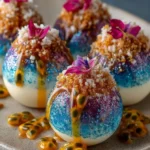
A stunning dessert featuring a creamy coconut vanilla mousse with a tangy passionfruit core, encased in a shimmering aurora mirror glaze.
- Yield: 8 1x
Ingredients
- For the Coconut Vanilla Mousse:
- 2 cups coconut cream
- 1 cup heavy cream
- 8 oz cream cheese, softened
- 1/2 cup granulated sugar
- 1 tsp vanilla extract
- 2 tsp powdered gelatin
- 3 tbsp cold water
- For the Passionfruit Core:
- 3/4 cup passionfruit puree
- 2 tbsp granulated sugar
- 1 tsp lemon juice
- 1 tsp powdered gelatin
- 1 tbsp cold water
- For the Biscuit Base:
- 1 cup digestive biscuits, finely crushed
- 3 tbsp melted butter
- For the Aurora Mirror Glaze:
- 1 cup granulated sugar
- 1/2 cup water
- 1/2 cup sweetened condensed milk
- 1 cup white chocolate, finely chopped
- 1 tbsp powdered gelatin
- 3 tbsp cold water
- 1 tsp vanilla extract
- 2–3 drops blue food coloring
- 2–3 drops pink food coloring
- For Garnish (optional):
- Toasted coconut flakes
- Passionfruit seeds
- Edible shimmer dust
Instructions
- Mix crushed biscuits with melted butter and press into sphere molds as a base layer. Chill for 15 minutes.
- Bloom gelatin for passionfruit core in cold water for 5 minutes.
- Heat passionfruit puree, sugar, and lemon juice until warm.
- Stir in gelatin until dissolved, then pour into small inserts and freeze until firm.
- Bloom gelatin for mousse in cold water for 5 minutes.
- Beat cream cheese, coconut cream, sugar, and vanilla until smooth.
- Warm a small portion of cream and dissolve gelatin, then mix into coconut base.
- Whip remaining cream to soft peaks and fold into mixture.
- Fill sphere molds halfway with mousse.
- Place a frozen passionfruit core in the center of each mold.
- Cover with remaining mousse and smooth the tops.
- Freeze for at least 6 hours until fully firm.
- Bloom gelatin for glaze in cold water.
- Heat sugar, water, and condensed milk until steaming.
- Remove from heat and stir in gelatin and white chocolate until smooth.
- Add vanilla extract and blend until glossy.
- Divide glaze and tint with blue and pink food coloring, then swirl lightly for aurora effect.
- Cool glaze to about 90°F (32°C).
- Unmold frozen spheres and place on a wire rack.
- Pour aurora mirror glaze evenly over each sphere until fully coated.
- Refrigerate for 30 minutes before serving.
- Garnish with toasted coconut flakes, passionfruit seeds, and shimmer dust.
Nutrition
- Calories: 350
- Sugar: 34 g
- Fat: 19 g
- Carbohydrates: 40 g
- Protein: 4 g
Tried This Recipe? Leave a Comment!
Did you make this recipe? I’d love to hear how it turned out! Please leave a comment and a rating below. Your feedback helps other home cooks and supports cheerychop.com!
For more delicious inspiration, follow me on Pinterest!