Table of Contents
Passionfruit Gold Crystal Cubes – A Jewel-Like Dessert with a Moroccan Soul
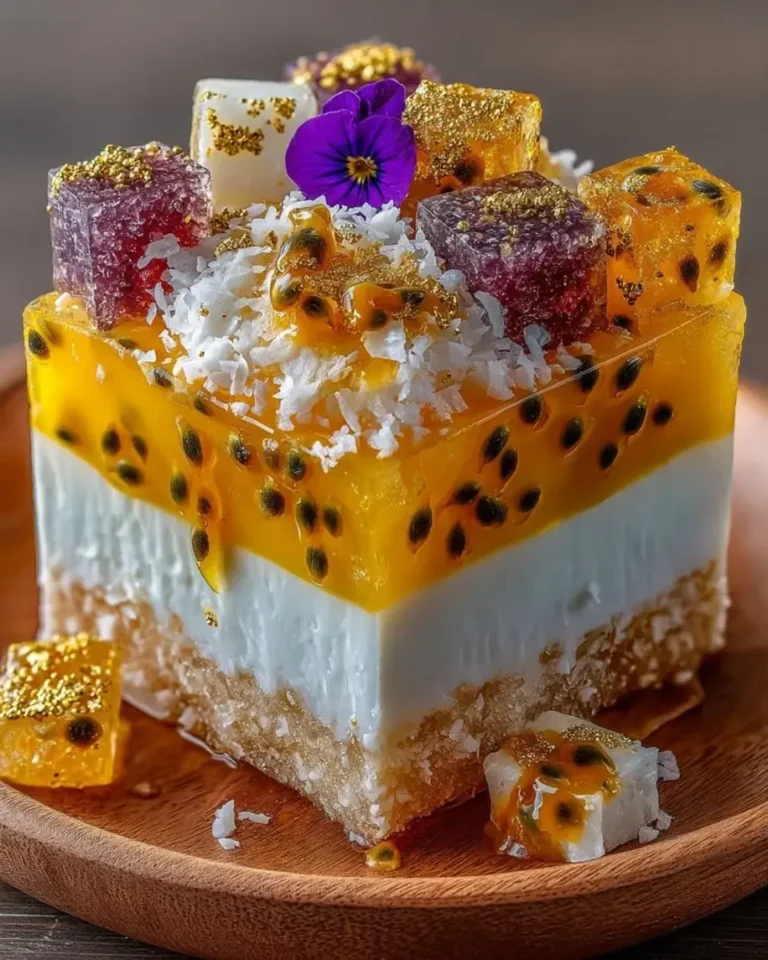
I still remember the first time I tasted passionfruit—I was a little girl in Marrakech, standing on my tiptoes in my mother’s kitchen, watching her slice open a wrinkled purple fruit I’d never seen before. The aroma hit me like sunlight: tropical, tart, sweet, and utterly intoxicating. She spooned the golden pulp over a simple yogurt and honey dessert, and I was hooked. Decades later, after training at Le Cordon Bleu in Paris and settling into my NYC kitchen, I’ve reimagined that childhood memory into something truly spectacular: Passionfruit Gold Crystal Cubes. This passionfruit dessert cubes recipe combines a bright, tangy passionfruit shell with a luscious coconut cream center, all draped in a shimmering gold crystal glaze that catches the light like a jewel.
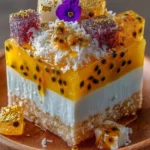
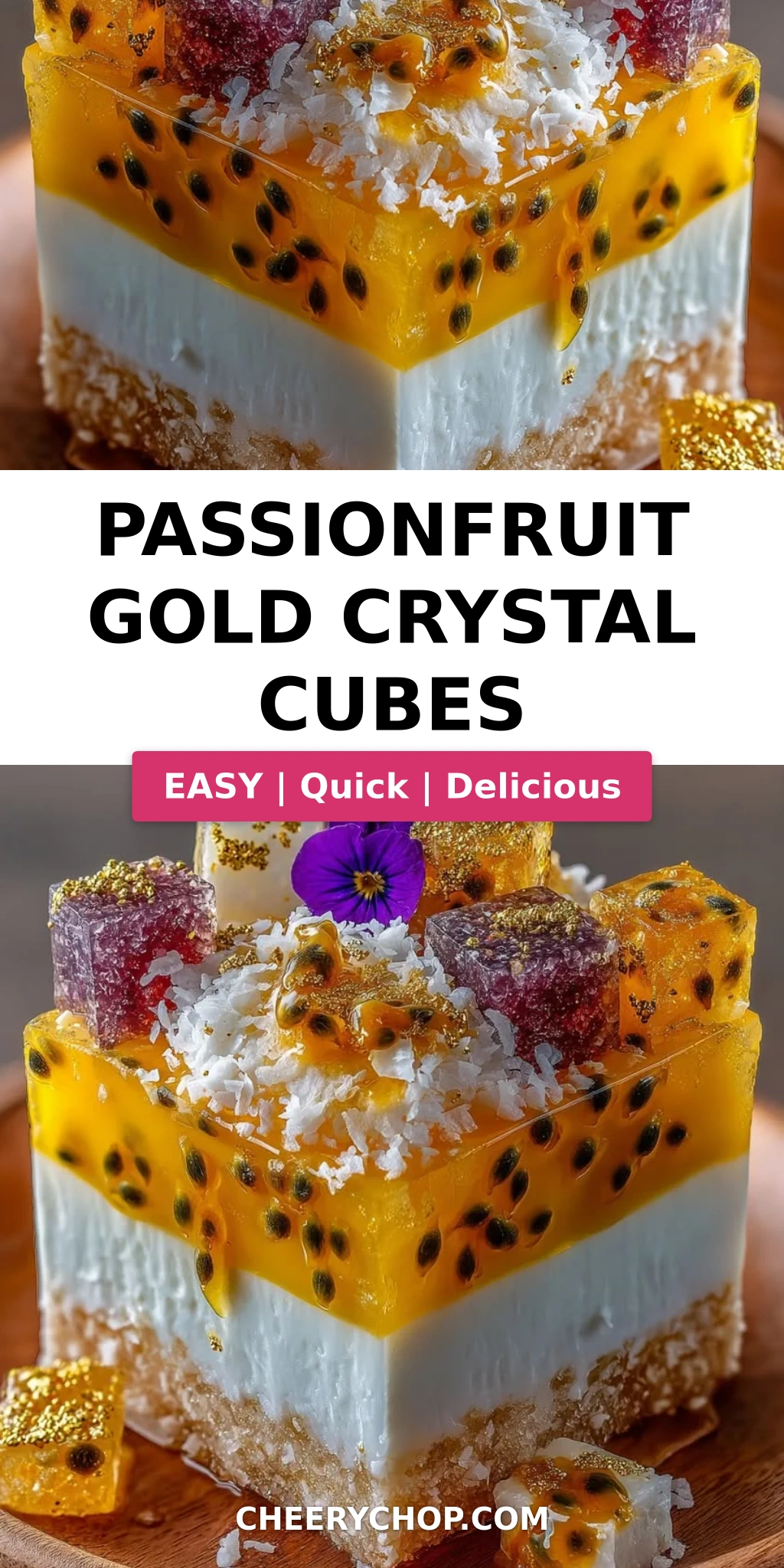
Each bite of these edible gold dessert recipe cubes delivers layers of texture and flavor. The outer shell has a delicate, jelly-like bite with the unmistakable zing of passionfruit—tart and tropical, balanced by a whisper of coconut milk and lime. Then comes the center: a cloud-like mascarpone and coconut cream filling that’s impossibly smooth and lightly sweet. But the real showstopper is the gold crystal glaze—a glossy, mirror-like coating infused with passionfruit puree, white chocolate, and a touch of edible gold luster dust. It shimmers like a geode cracked open. I finish mine with toasted coconut flakes and edible gold flakes for a dessert that feels like a treasure chest on a plate.
What sets my gold crystal glaze dessert apart is a technique I picked up in Paris: using a gelatin-based mirror glaze that sets to a brilliant, non-cloudy finish. So many home cooks struggle with cloudy glazes, but I’ll show you exactly how to avoid that pitfall. I also tested this recipe six times to get the perfect balance—the passionfruit provides enough acidity to cut through the richness of the coconut and mascarpone, while the gold glaze remains stable and stunning. Whether you’re making this for a birthday, a dinner party, or just because you want to treat yourself, these cubes are a labor of love that pays off in every sparkling bite.
Why This Passionfruit Gold Crystal Cubes Recipe Is the Best
The Flavor Secret: Growing up in Morocco, I learned that the best desserts balance sweet and tangy in a single bite. This recipe does exactly that. The passionfruit puree brings a bold, tropical tartness that cuts through the richness of the coconut cream center. The addition of lime juice in the shell brightens everything further. And the gold glaze? It’s not just for looks—the white chocolate adds a creamy sweetness that ties the whole cube together. This isn’t just a pretty dessert; it’s a perfectly balanced one.
Perfected Texture: I spent weeks in my NYC test kitchen getting the gelatin ratios just right. Too much gelatin and the cubes turn rubbery. Too little and they won’t hold their shape during glazing. The trick—which I learned from a pastry chef in Paris—is to bloom the gelatin in cold water for exactly 5 minutes and then dissolve it into a warm (not hot) liquid. This ensures a silky, bouncy texture that yields beautifully when you bite into it. The coconut cream center stays light and airy because I whip the mascarpone and cream just until soft peaks form—over-whipping leads to a dense, buttery filling.
Foolproof & Fast (Well, Mostly): I know this recipe has several steps, but I’ve broken it down so that even a confident beginner can succeed. The most important thing is patience: don’t rush the freezing time. Four hours in the freezer is non-negotiable—it ensures the cubes are solid enough to hold the warm glaze without melting. I also recommend using a silicone mold, which makes unmolding effortless. And if you’re short on time, you can make the components a day ahead and assemble the day of serving. I’ve tested every shortcut so you don’t have to.
Passionfruit Gold Crystal Cubes Recipe Ingredients
I source my passionfruit puree from a specialty market in NYC’s Chelsea Market—it’s flash-frozen and tastes just as bright as fresh. The coconut milk I use is full-fat from a can (never the light stuff!), and I buy my mascarpone from a little Italian shop in Brooklyn. Every ingredient has a purpose, and I’ll walk you through each one so you know exactly what to look for at your local grocery store.
Ingredients List
For the Passionfruit Cube Shells:
- 2 cups passionfruit puree
- ½ cup coconut milk (full-fat)
- ⅓ cup granulated sugar
- 1 tsp vanilla extract
- 2 tsp gelatin powder
- 2 tbsp cold water (for blooming gelatin)
- 1 tbsp lime juice
- Pinch of salt
For the Coconut Cream Center:
- 1 cup mascarpone cheese
- ½ cup heavy whipping cream
- 3 tbsp powdered sugar
- 1 tsp coconut extract
For the Gold Crystal Glaze:
- 1 cup white chocolate, finely chopped
- ½ cup sweetened condensed milk
- ¼ cup water
- 1 tbsp gelatin powder
- 3 tbsp cold water (for blooming gelatin)
- 2 tbsp passionfruit puree
- ½ tsp edible gold luster dust
- ¼ tsp edible pearl luster dust
- Yellow food coloring, as needed
For Garnish (optional):
- 2 tbsp toasted coconut flakes
- 1 tbsp crushed golden rock candy crystals
- Edible gold flakes
Ingredient Spotlight
Passionfruit Puree: This is the star of the show. I use frozen passionfruit puree from Goya or Perfect Puree—both are available at Whole Foods and online. Fresh passionfruit works too, but you’ll need about 10–12 fruits to get 2 cups of pulp. Strain out the seeds if you prefer a smoother texture, though I love the little crunch they add.
Mascarpone Cheese: This Italian cream cheese gives the coconut center its luxurious, silky texture. It’s richer than cream cheese and has a higher fat content, which means it whips into a cloud-like consistency. You can find mascarpone in the specialty cheese section of most US grocery stores—BelGioioso is a reliable brand.
Edible Gold Luster Dust: This is what gives the glaze its brilliant, crystal-like shimmer. Look for a brand that’s labeled “edible” and “non-toxic.” I use Rainbow Dust or The Sugar Art—both are available on Amazon. Pearl luster dust adds an extra layer of depth; it’s optional but I highly recommend it for that diamond-like finish.
Gelatin Powder: I use Knox gelatin powder, which is widely available in US supermarkets. The key is to bloom it in cold water (not warm or hot) for exactly 5 minutes. This ensures it dissolves evenly and gives you a smooth, lump-free texture. If you’re using sheet gelatin, you’ll need about 4 sheets for every 2 teaspoons of powder.
| Original Ingredient | Best Substitution | Flavor / Texture Impact |
|---|---|---|
| Passionfruit puree | Mango puree + 1 tbsp lime juice | Sweeter, less tart, still tropical |
| Mascarpone cheese | Full-fat cream cheese + 2 tbsp heavy cream | Slightly tangier, less smooth but still creamy |
| White chocolate | High-quality white chocolate chips (Ghirardelli) | Slightly less smooth melt, still glossy |
| Coconut milk | Full-fat canned coconut cream | Richer, thicker shell texture |
| Gelatin powder | Agar-agar powder (1 tbsp, vegan) | Firmer, less bouncy; needs different setting time |
How to Make Passionfruit Gold Crystal Cubes — Step-by-Step
Don’t let the number of steps intimidate you—I’ve organized this so each part flows naturally into the next. Work through it one stage at a time, and you’ll be amazed at what you create.
Step 1: Bloom the Gelatin
In a small bowl, sprinkle 2 teaspoons of gelatin powder over 2 tablespoons of cold water. Let it sit undisturbed for 5 minutes. It will absorb the water and turn into a firm, jiggly mass. This is called “blooming,” and it’s the foundation for a smooth, lump-free texture in your passionfruit shells.
💡 Sara’s Pro Tip: Use ice-cold water for blooming—warm water can cause the gelatin to dissolve unevenly and create lumps.
Step 2: Make the Passionfruit Shell Base
In a medium saucepan over medium-low heat, combine 2 cups passionfruit puree, ½ cup coconut milk, ⅓ cup sugar, 1 tbsp lime juice, 1 tsp vanilla extract, and a pinch of salt. Warm the mixture, stirring gently, until it’s warm to the touch and the sugar has fully dissolved—about 3 minutes. Do not let it boil, as high heat can weaken the gelatin later.
⚠️ Common Mistake to Avoid: If the mixture gets too hot (above 140°F), it can break down the gelatin’s setting power. Keep it at a gentle simmer, not a rolling boil.
Step 3: Dissolve the Gelatin
Remove the saucepan from the heat. Add the bloomed gelatin to the warm passionfruit mixture and whisk gently until the gelatin is fully dissolved and the mixture is smooth. This should take about 1 minute. You should see no lumps or streaks.
💡 Sara’s Pro Tip: If the gelatin isn’t dissolving completely, place the saucepan back over the lowest heat for 10–15 seconds while whisking—but no longer!
Step 4: Coat the Molds
Pour a thin layer of the passionfruit mixture into cube-shaped silicone molds, about ¼-inch deep. Use a small brush or your finger to spread the mixture up the sides of each mold cavity, coating them evenly. This forms the outer shell of the cubes. Place the molds in the refrigerator for 15–20 minutes, or until the mixture is partially set but still tacky to the touch.
⚠️ Common Mistake to Avoid: Don’t let the shell set completely before adding the center—it needs to be slightly sticky so the layers bond together. If it sets too hard, the cubes will separate later.
Step 5: Make the Coconut Cream Center
In a mixing bowl, combine 1 cup mascarpone cheese, ½ cup heavy whipping cream, 3 tablespoons powdered sugar, and 1 teaspoon coconut extract. Using a hand mixer or stand mixer with the whisk attachment, whip on medium speed until the mixture is light, fluffy, and holds soft peaks—about 2–3 minutes. Be careful not to over-whip, or the cream will turn buttery.
💡 Sara’s Pro Tip: Chill your mixing bowl and whisk for 10 minutes before whipping—this helps the cream reach soft peaks faster and more evenly.
Step 6: Fill the Molds
Spoon or pipe the coconut cream center into each mold cavity, filling it about three-quarters full. Leave a small border (about ¼ inch) around the edges so the top layer of passionfruit mixture can seal the cube. Gently tap the molds on the counter to release any air bubbles.
Step 7: Seal the Cubes
Pour the remaining passionfruit mixture over the coconut cream centers, covering them completely. Use a small spatula or your finger to smooth the tops, ensuring they’re level with the mold edges. This creates a sealed cube with the cream center fully enclosed.
⚠️ Common Mistake to Avoid: If the passionfruit mixture has thickened too much, gently reheat it over low heat for 10–15 seconds to make it pourable again.
Step 8: Freeze the Cubes
Place the filled molds in the freezer and freeze for at least 4 hours, or until the cubes are completely solid. This is crucial—the cubes need to be frozen solid to hold their shape when you pour the warm glaze over them. If they’re even slightly soft, they’ll collapse or melt into the glaze.
💡 Sara’s Pro Tip: Freeze the cubes overnight if possible. The longer they freeze, the easier they are to unmold and glaze cleanly.
Step 9: Make the Gold Glaze
In a small bowl, bloom 1 tablespoon of gelatin powder in 3 tablespoons of cold water for 5 minutes. In a small saucepan, heat ½ cup sweetened condensed milk and ¼ cup water until steaming—do not boil. Remove from heat and stir in the bloomed gelatin until dissolved. Pour this mixture over 1 cup of finely chopped white chocolate in a heatproof bowl. Whisk until smooth and glossy.
Step 10: Color and Season the Glaze
Add 2 tablespoons passionfruit puree, ½ teaspoon edible gold luster dust, ¼ teaspoon edible pearl luster dust, and a few drops of yellow food coloring to the glaze. Whisk until the color is uniform and the glaze has a brilliant, crystal-gold finish. Allow it to cool for 5–10 minutes, until it’s slightly thickened but still pourable—like warm honey.
💡 Sara’s Pro Tip: Test the glaze on a spoon—if it runs off in a smooth, continuous ribbon, it’s ready. If it’s too thick, add a teaspoon of warm water. If too thin, let it cool a bit longer.
Step 11: Unmold and Glaze
Remove the frozen cubes from the freezer and unmold them by gently flexing the silicone mold. Place the cubes on a wire rack set over a baking sheet (to catch drips). Pour the gold crystal glaze evenly over each cube, making sure all sides are coated. Let the excess glaze drip away. While the glaze is still tacky, sprinkle with crushed golden rock candy crystals.
⚠️ Common Mistake to Avoid: Work quickly when glazing! The frozen cubes will start to soften almost immediately. If the glaze sets too fast, reheat it gently over a double boiler for 10–15 seconds.
Step 12: Garnish and Serve
Transfer the glazed cubes to serving plates. While the glaze is still slightly tacky, sprinkle with toasted coconut flakes and edible gold flakes. Allow the coating to set for 2–3 minutes at room temperature, then serve immediately. These are best enjoyed chilled.
💡 Sara’s Pro Tip: For the most dramatic presentation, serve the cubes on a dark plate or mirror—the gold glaze will pop beautifully against a dark background.
| Step | Action | Duration | Key Visual Cue |
|---|---|---|---|
| 1 | Bloom gelatin for shells | 5 mins | Gelatin becomes firm, jiggly |
| 2 | Heat passionfruit mixture | 3 mins | Warm, fragrant, sugar dissolved |
| 3 | Dissolve gelatin into mixture | 1 min | Smooth, no lumps |
| 4 | Coat mold shells | 15–20 mins | Tacky, partially set |
| 5 | Whip coconut cream center | 2–3 mins | Soft peaks, fluffy |
| 6 | Fill and seal molds | 5 mins | Smooth tops, no air pockets |
| 7 | Freeze cubes | 4+ hours | Rock solid, no give when pressed |
| 8 | Make and apply glaze | 15 mins | Glossy, brilliant gold |
| 9 | Garnish and serve | 2–3 mins | Shimmering, jewel-like finish |
Serving & Presentation
These passionfruit dessert cubes are meant to be the centerpiece of any dessert table. I love serving them on a large white or black platter—the gold glaze pops dramatically against a dark background. Arrange the cubes in a single layer, leaving space between each one so they catch the light individually. For an extra touch of elegance, scatter edible flowers (like pansies or orchids) and a few extra gold flakes around the plate.
Growing up in Morocco, we always served sweets with mint tea—the combination of bright, tart passionfruit and fresh mint is divine. In my NYC kitchen, I pair these cubes with a sparkling passionfruit spritzer or a glass of chilled Prosecco. The bubbles cut through the richness of the coconut cream and echo the tropical notes of the passionfruit. For a non-alcoholic option, try a ginger-lime soda—the ginger adds a warm kick that complements the gold glaze beautifully.
If you’re feeling particularly French (and why not?), serve these cubes as part of a dessert trio: a small scoop of coconut sorbet, one gold crystal cube, and a delicate madeleine on the side. It’s the kind of presentation that makes people pause, pull out their phones, and say, “Wait, you made this?” Trust me—I’ve seen it happen at every dinner party I’ve hosted.
| Pairing Type | Suggestions | Why It Works |
|---|---|---|
| Side Dessert | Coconut sorbet, mango mousse, vanilla panna cotta | Complements tropical profile without overpowering |
| Sauce / Drizzle | Passionfruit coulis, caramel sauce, raspberry reduction | Adds acidity or sweetness to balance richness |
| Beverage | Prosecco, passionfruit spritzer, ginger-lime soda | Bubbles and citrus cut creamy texture perfectly |
| Garnish | Edible flowers, mint sprigs, toasted coconut, gold flakes | Adds visual drama and fresh aromatic notes |
Make-Ahead, Storage & Reheating
As a busy NYC food blogger, I love recipes that let me work ahead. These passionfruit coconut cubes are perfect for that. You can make the passionfruit shells and coconut cream center a day in advance, freeze them, and then glaze them the morning of your event. The glaze itself keeps well for a day, and the finished cubes stay gorgeous for up to 48 hours in the fridge—though I doubt they’ll last that long!
| Method | Container | Duration | Reheating Tip |
|---|---|---|---|
| Refrigerator | Airtight container in single layer | Up to 2 days | Serve chilled directly from fridge |
| Freezer (unglazed) | Freezer-safe bag, cubes separated | Up to 2 months | Glaze directly from frozen—do not thaw |
| Make-Ahead (fully assembled) | Baking sheet, then transfer to container | 1 day in fridge | Add garnishes just before serving to keep them crisp |
For the best texture, I recommend glazing the cubes the day you plan to serve them—the glaze stays glossy and the cubes maintain their perfect bouncy texture. If you’re storing glazed cubes in the fridge, place them in a single layer in an airtight container with a paper towel on the bottom to absorb any moisture. Don’t stack them, or the glaze may stick. And remember: these are meant to be served chilled, so no reheating needed!
Variations & Easy Swaps
| Variation | Key Change | Best For | Difficulty Impact |
|---|---|---|---|
| Mango Gold Crystal Cubes | Replace passionfruit puree with mango puree | Kids, sweeter palates | Same |
| Dairy-Free/ Vegan | Use coconut cream + vegan cream cheese, agar-agar | Vegan guests, lactose-intolerant | More advanced |
| Berry Gold Crystal Cubes | Use raspberry or strawberry puree instead | Berry lovers, Valentine’s Day | Same |
Mango Gold Crystal Cubes
This is my go-to variation when passionfruit isn’t in season. Replace the 2 cups of passionfruit puree with 2 cups of ripe mango puree (I use Alphonso mangoes from the Indian grocery store in NYC—they’re incredibly aromatic). The flavor is sweeter and less tart, so I add an extra tablespoon of lime juice to brighten it up. The color turns a warm, sunset gold instead of the bright yellow of the original. This version reminds me of the mango lassi my mother used to make during Moroccan summers.
Dairy-Free / Vegan Gold Crystal Cubes
I developed this version for a friend who’s vegan, and it’s become a favorite among my readers. Replace the mascarpone with coconut cream (the thick part from a can of full-fat coconut milk, chilled overnight) and use a high-quality vegan cream cheese for structure. Swap the gelatin with agar-agar powder (1 tablespoon, bloomed in the same way). The texture is a bit firmer and less bouncy, but still delicious. For the glaze, use a dairy-free white chocolate made with cocoa butter. I tested this three times—trust me, it works.
Berry Gold Crystal Cubes
This is a stunning Valentine’s Day or Fourth of July dessert. Use 2 cups of raspberry or strawberry puree in place of passionfruit. The tartness of raspberries is closest to passionfruit, while strawberries give a milder, sweeter flavor. Add a drop of pink or red food coloring to the glaze for a rosy gold effect. I like to garnish these with freeze-dried raspberry powder and rose petals for an extra romantic touch. I spotted this idea at a farmers market in Union Square and knew I had to try it.
Share Your Version!
I absolutely love hearing about your kitchen adventures—every photo you tag, every comment you leave, makes my day. These Passionfruit Gold Crystal Cubes are a labor of love, and I want to see how they turn out in your home! Did you try the mango version? Did the glaze come out perfectly? I read every single comment and do my best to answer questions within 48 hours.
⭐ If you made this recipe, please leave a star rating in the comments below!
📸 Share a photo on Instagram or Pinterest and tag @cheerychop — I love re-sharing your beautiful creations!
💬 Tell me: What’s your favorite tropical fruit? I’m always looking for new flavor ideas to test in my NYC kitchen!
From my NYC kitchen to yours — I hope this recipe brings as much warmth to your table as it does to mine. — Sara 🧡
How do you make passionfruit gold crystal cubes without turning them cloudy?
The key to a crystal-clear glaze is temperature control and patience. First, make sure your gelatin is fully bloomed in ice-cold water—this prevents undissolved particles that cause cloudiness. When heating the sweetened condensed milk and water, bring it only to a steaming point, not a boil. Boiling can create tiny air bubbles that get trapped in the glaze and scatter light. Second, whisk your glaze gently—vigorous whisking incorporates air, which leads to a cloudy, frothy finish. Finally, let the glaze cool to about 90°F (just slightly warm to the touch) before pouring it over the frozen cubes. This allows it to flow smoothly and evenly without shocking the gelatin into a cloudy state. If your glaze does turn cloudy, a quick reheat over a double boiler with a gentle stir can sometimes bring back the clarity.
What is the best substitute for passionfruit pulp in gold crystal cubes?
The best substitute depends on the flavor profile you’re after. For a similar tart-tropical balance, use mango puree (from frozen or fresh Alphonso mangoes) mixed with 1–2 tablespoons of lime juice. This gives you the same bright, sunny color and a comparable acidity. For a more floral note, try guava puree—it’s slightly less tart but wonderfully aromatic. If you’re looking for a berry-based alternative, raspberry puree is your best bet; it has the same sharpness as passionfruit and creates a stunning ruby-red cube. Avoid banana or papaya puree, as they’re too mild and will make the cubes taste flat. I’ve tested all of these in my NYC kitchen, and mango with lime is the crowd favorite by a wide margin.
How long do passionfruit gold crystal cubes take to set in the refrigerator?
The passionfruit gold crystal cubes need to set in the freezer, not the refrigerator, for the best results. The shells require a partial set in the fridge for about 15–20 minutes before you add the coconut cream center. Once the cubes are fully assembled, they need to freeze for at least 4 hours—and preferably overnight—to become solid enough to hold the warm glaze. If you try to set them in the refrigerator only, the cubes will be too soft and will collapse or melt into the glaze when you pour it. For the glaze itself, it sets at room temperature in about 2–3 minutes, then you can transfer the finished cubes to the fridge to keep them chilled until serving. So while the refrigerator is used for the final storage, the heavy lifting is done by the freezer.
Can you use dried passionfruit seeds for passionfruit gold crystal cubes?
I don’t recommend using dried passionfruit seeds for this recipe. The seeds in fresh or frozen passionfruit pulp add a delightful crunch and visual pop, but dried seeds won’t rehydrate properly in the gelatin mixture—they’ll remain hard and chewy, which ruins the silky texture of the cubes. Additionally, dried seeds lack the moisture and acidity that fresh or frozen pulp provides, and those are essential for both the flavor and the gelatin structure. If you want the crunch and look of seeds, use fresh passionfruit pulp with the seeds included, or stir in a small handful of fresh seeds from a passionfruit after you’ve strained the rest. For a different kind of crunch, try the crushed golden rock candy crystals I recommend in the garnish—they give a similar visual effect with a much better texture.
What type of silicone mold works best for passionfruit gold crystal cubes?
You’ll want a cube-shaped silicone mold with cavities that are about 1.5 to 2 inches in size. Smaller cubes (1 inch) are harder to fill and unmold without breaking, while larger cubes (3 inches) can be unstable under the weight of the glaze. I use a 6-cavity silicone cube mold from OXO—it’s sturdy, flexible, and releases the cubes effortlessly. Make sure the mold is 100% silicone (not plastic-lined) for the easiest unmolding. If you only have a larger mold, you can use a sharp knife to trim the cubes down after they’ve frozen, though this is more work. Avoid using metal or glass molds, as the cubes will stick and you’ll risk damaging them when trying to release them. Silicone is truly the only way to go.
Can I make passionfruit gold crystal cubes without gelatin?
Yes, you can make a vegetarian version using agar-agar powder, though the texture will be different. Use 1 tablespoon of agar-agar powder bloomed in 3 tablespoons of cold water for 10 minutes, then dissolve it into the warm passionfruit mixture. Agar sets at room temperature (unlike gelatin, which needs refrigeration) and creates a firmer, more brittle set. The cubes will hold their shape well under the glaze, but they’ll have a cleaner bite rather than the bouncy, jelly-like texture of gelatin. For the glaze, you’ll need to use a gelatin substitute as well—I recommend using a combination of 1 tablespoon agar-agar plus 1 teaspoon xanthan gum for a smooth, glossy finish. I’ve tested this a few times, and while it’s not identical, it’s a solid alternative for those avoiding animal products.
How do I store leftover passionfruit gold crystal cubes?
Store leftover glazed cubes in an airtight container in the refrigerator for up to 2 days. Place them in a single layer with a piece of parchment or wax paper between layers if you need to stack them—the glaze can stick together if they touch. I recommend adding a paper towel to the bottom of the container to absorb any condensation that could make the glaze weep. Do not freeze the finished cubes, as the glaze can crack and lose its glossy finish. If you have unglazed frozen cubes, they can stay in the freezer for up to 2 months; just glaze them directly from the freezer when you’re ready to serve. Leftover glaze can be stored in the fridge for up to 1 week in a sealed jar—reheat it gently over a double boiler and use it for another batch or even as a drizzle over ice cream.
What can I use instead of edible gold luster dust?
If you don’t have edible gold luster dust, you can achieve a beautiful shimmer using a few alternatives. Edible pearl luster dust alone gives a soft, luminous sheen that’s very elegant—use ¾ teaspoon of it instead of the gold and pearl combination. Turmeric powder mixed with a pinch of edible mica powder can create a warm golden hue, though it won’t have the same gloss. For a non-shimmer option, you can simply omit the luster dust and add an extra ¼ teaspoon of yellow food coloring for a bright, sunny finish. I’ve also used crushed freeze-dried apricot powder (from the health food store) mixed with a tiny amount of coconut oil for a natural gold tint. Just remember: whatever you use, make sure it’s labeled edible—not all craft glitter or dust is safe to eat.
Why did my passionfruit shell turn out rubbery and tough?
A rubbery, tough passionfruit shell is almost always the result of too much gelatin or over-heating. The recipe calls for exactly 2 teaspoons of gelatin powder for 2 cups of passionfruit puree—that’s the sweet spot for a tender, bouncy texture. If you added more, or if you used powdered gelatin without blooming it first, the protein strands can contract too tightly, creating a rubbery bite. Over-heating is another culprit: if the passionfruit mixture reaches a boil, the gelatin can begin to break down and form tough clumps. Always heat the mixture gently until just warm, and remove it from the heat before adding the bloomed gelatin. I made this mistake during my early recipe testing in Paris—I was rushing and let the mixture boil. The cubes turned out like fruit-flavored erasers. Learn from my mistake and keep the heat low!
Can I use this recipe to make passionfruit gold crystal popsicles?
Absolutely—this recipe works beautifully as popsicles! Use popsicle molds instead of cube molds, and insert wooden sticks before the final freeze. The proportions are ideal for popsicles: the passionfruit shell creates a tangy outer layer, the coconut cream center stays creamy without dripping, and the gold glaze becomes a shiny, crackly coating that kids and adults alike love. For popsicles, I recommend slightly reducing the gelatin in the shell to 1½ teaspoons, since popsicles don’t need to hold as firm a shape as cubes. You can also dip the frozen popsicles into the glaze halfway for a two-tone effect, or pour the glaze over the entire popsicle for a fully gold finish. I’ve tested this at a summer barbecue in Brooklyn, and they were the first dessert to disappear. Just remember to freeze the popsicles for at least 6 hours—pop molds are larger and need more time to solidify.
Love This Recipe? Save It to Pinterest!
If you enjoyed this Passionfruit Gold Crystal Cubes recipe, don’t let it get lost in your browser tabs! 😄 Pin it now so you can find it again anytime — and explore hundreds more tried-and-tested recipes waiting for you on my Pinterest boards.
👉 Follow Sara on Pinterest @chefrecipes2
📌 Pin this recipe · 🔁 Re-pin your favorites · 💬 Tag me when you make it — I love seeing your creations!
Passionfruit Gold Crystal Cubes
- Yield: 6 1x
Ingredients
- For the Passionfruit Cube Shells:
- 2 cups passionfruit puree
- 1/2 cup coconut milk
- 1/3 cup granulated sugar
- 1 tsp vanilla extract
- 2 tsp gelatin powder
- 2 tbsp cold water
- 1 tbsp lime juice
- Pinch of salt
- For the Coconut Cream Center:
- 1 cup mascarpone cheese
- 1/2 cup heavy whipping cream
- 3 tbsp powdered sugar
- 1 tsp coconut extract
- For the Gold Crystal Glaze:
- 1 cup white chocolate, finely chopped
- 1/2 cup sweetened condensed milk
- 1/4 cup water
- 1 tbsp gelatin powder
- 3 tbsp cold water
- 2 tbsp passionfruit puree
- 1/2 tsp edible gold luster dust
- 1/4 tsp edible pearl luster dust
- Yellow food coloring, as needed
- For Garnish (optional):
- 2 tbsp toasted coconut flakes
- 1 tbsp crushed golden rock candy crystals
- Edible gold flakes
Instructions
- Bloom gelatin in cold water for 5 minutes.
- Heat passionfruit puree, coconut milk, sugar, lime juice, vanilla extract, and salt until warm and smooth.
- Remove from heat and stir in the bloomed gelatin until fully dissolved.
- Pour a thin layer of the mixture into cube-shaped silicone molds, coating the sides evenly.
- Chill until partially set.
- Whip mascarpone, heavy cream, powdered sugar, and coconut extract until light and fluffy.
- Fill each mold with the coconut cream center, leaving a small border around the edges.
- Cover with the remaining passionfruit mixture and smooth the tops.
- Freeze for at least 4 hours until completely firm.
- For the glaze, bloom gelatin in cold water for 5 minutes.
- Heat sweetened condensed milk and water until steaming. Remove from heat and stir in gelatin until dissolved.
- Pour over white chocolate and whisk until smooth and glossy.
- Add passionfruit puree, gold luster dust, pearl luster dust, and yellow food coloring until a brilliant crystal-gold finish is achieved.
- Allow glaze to cool until slightly thickened but still pourable.
- Unmold the frozen cubes and place on a wire rack.
- Pour the gold crystal glaze evenly over each cube, allowing excess glaze to drip away.
- Sprinkle with crushed golden rock candy crystals while the glaze is still tacky.
- Transfer to serving plates and allow the coating to set.
- Finish with toasted coconut flakes and edible gold flakes.
- Serve chilled.
Nutrition
- Calories: 425
- Sugar: 33g
- Fat: 28g
- Carbohydrates: 39g
- Protein: 5g
Tried This Recipe? Leave a Comment!
Did you make this recipe? I’d love to hear how it turned out! Please leave a comment and a rating below. Your feedback helps other home cooks and supports cheerychop.com!
For more delicious inspiration, follow me on Pinterest!