Table of Contents
Golden Nectarine Cheesecake Bombs with Molten Honey Center – Bite-Sized No-Bake Bliss with a Warm Honey Surprise
Some recipes just feel like they were born from a specific moment in time, and these Golden Nectarine Cheesecake Bombs with Molten Honey Center are exactly that. I remember standing at the Union Square Greenmarket in late July, holding a basket of blushing golden nectarines so fragrant I could smell them before I even saw the stand. The farmer smiled and said, “These are at their peak, Sara — you’ve got about three days.” I bought two big bags and walked home through the West Village, already dreaming of what to make. Back in my kitchen, I thought about my mother’s kitchen in Morocco, where honey and fruit were always paired with something creamy — often fresh cheese or labneh — and I thought about my pastry training in Paris, where we learned to build dessert in layers of texture and temperature. That’s how these Golden Nectarine Cheesecake Bombs were born: a frozen, no-bake cheesecake dome with a tangy nectarine jam center and a molten honey heart, all perched on a buttery graham cracker crust. They are the kind of dessert that stops conversation for a second.
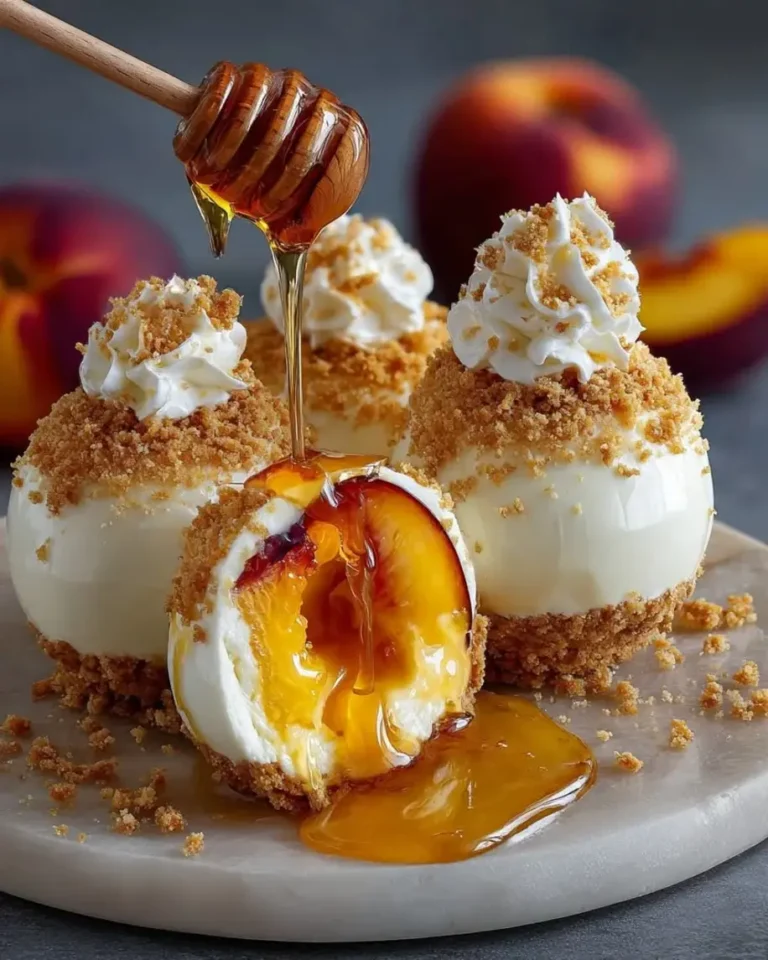
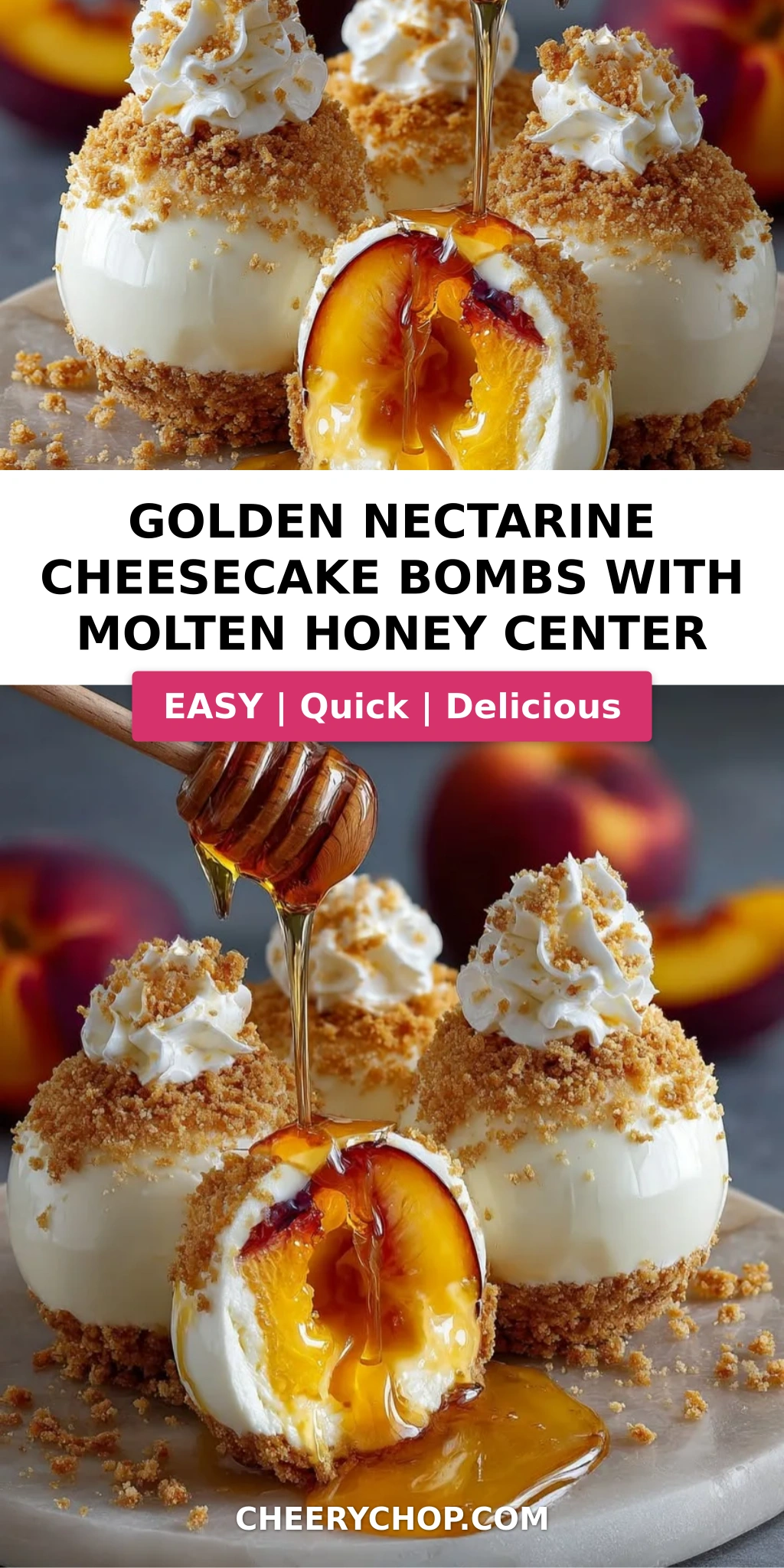
Let me describe what you’re getting into. The outer shell is a silky, stabilized cheesecake mousse — light as air, yet rich enough to feel indulgent. As you bite through it, you hit a layer of honey-sweetened nectarine jam that’s been cooked down until it’s jammy and concentrated, with just enough lemon to keep it bright. And then, right in the center, you find the molten honey core — a soft, almost fluid mixture of honey, butter, and cream that stays luscious and spoonable even after freezing. The contrast is everything: cold and creamy against warm and flowing, tangy nectarine against deep floral honey, all grounded by the salty-sweet crunch of the graham cracker base. The first time I tested this, I stood over my counter with a tiny spoon, trying to decide if I had made a dessert or a tiny edible miracle.
What makes my version different from other frozen cheesecake bites is the technique. I use a stabilized cheesecake mousse with gelatin, which means these domes hold their shape beautifully after freezing and don’t turn icy or grainy. The molten honey center is the real star — it’s a simple combination of honey, butter, cream, and a pinch of sea salt, and the trick is to cool it slightly before assembling so it stays thick enough to layer but soft enough to remain “molten” even after the bombs are frozen. Many home cooks worry about the honey center leaking out or becoming too hard, but I’ll show you exactly how to build the layers so every bomb delivers that liquid honey surprise. My Parisian chef used to say, “A good dessert has a hidden moment” — and this is it.
Why This Golden Nectarine Cheesecake Bombs Recipe Is the Best
The Flavor Secret. The combination of golden nectarines and honey is pure summertime magic, but I add a tiny pinch of sea salt to the molten honey center that deepens the sweetness and makes it taste almost caramelized. My mother used to drizzle warm honey over fresh cheese in Morocco, and that salty-sweet-creamy memory is exactly what I wanted to capture here. The nectarine filling is cooked with honey and lemon until it thickens into a jam-like consistency that doesn’t seep into the mousse, keeping each layer distinct.
Perfected Texture. The cheesecake mousse is stabilized with gelatin — a technique I learned at Le Cordon Bleu in Paris — which means it freezes firm but thaws to a silky, mousse-like texture within minutes of being served. No iciness, no graininess, just pure creamy mouthfeel. The molten honey center stays soft because of the butter and cream content, which prevents it from freezing solid. Every bite gives you creamy, jammy, and flowing textures in perfect sequence.
Foolproof & Fast. Despite the layered look, this recipe is surprisingly forgiving. You don’t need a deep fryer, you don’t need to bake, and you don’t need any special equipment beyond a silicone dome mold. I’ve tested this with beginner home cooks and experienced bakers alike, and the feedback is always the same: “I can’t believe I made something this beautiful at home.” The steps are clear, the timing is generous, and the result is always impressive.
Golden Nectarine Cheesecake Bombs Ingredients
Every time I shop for these ingredients, I feel like I’m gathering treasures from three different worlds. The cream cheese and heavy cream come from a dairy farm upstate that I discovered at the Greenmarket. The honey — always a local wildflower or orange blossom honey — I source from a small producer in Brooklyn who keeps hives on rooftops. And the nectarines, when they’re in season, I buy by the case from a farm in New Jersey. Even in winter, I reach for good-quality frozen nectarines, and the recipe works beautifully. Here is everything you need.
Ingredients List
- For the Cheesecake Mousse:
- 8 oz cream cheese, softened
- 1/2 cup powdered sugar
- 1 cup heavy cream
- 1 tsp vanilla extract
- 1 tbsp gelatin powder
- 3 tbsp warm water
- For the Nectarine Filling:
- 2 ripe nectarines, peeled and finely diced
- 2 tbsp honey
- 1 tbsp lemon juice
- 1 tsp cornstarch
- 1 tbsp water
- For the Molten Honey Center:
- 1/3 cup honey
- 1 tbsp unsalted butter
- 1 tbsp heavy cream
- 1/2 tsp vanilla extract
- Pinch of sea salt
- For the Cookie Base:
- 1 cup graham cracker crumbs
- 3 tbsp melted butter
- 1 tbsp granulated sugar
- Pinch of salt
- For Garnish (optional):
- Nectarine slices
- Honey drizzle
- Crushed graham crumbs
Ingredient Spotlight
Golden Nectarines. The star of the show. You want nectarines that are fragrant, slightly soft at the stem end, and golden-orange in color. White nectarines work too, but golden ones have a higher sugar-to-acid balance that pairs perfectly with honey. If nectarines aren’t in season, frozen unsweetened peach slices (drained and chopped) are an excellent substitute.
Honey. This recipe uses honey three ways, so choose one you love. A mild wildflower or orange blossom honey works best for the molten center because it doesn’t overpower the nectarine. For the filling, you can use the same honey or a slightly stronger one like acacia. Avoid honey with strong medicinal flavors (like manuka or buckwheat) as they can clash with the fruit.
Cream Cheese. Full-fat block cream cheese is non-negotiable here. The reduced-fat versions or spreadable tubs contain too much water and will make your mousse grainy. Let it come to room temperature before you start — about 45 minutes on the counter — or microwave it in 10-second bursts until soft but not warm.
Gelatin. This is what gives the mousse its structure so the domes hold their shape after freezing. I use powdered gelatin (Knox is my go-to), but sheet gelatin works too. If you’re vegetarian, you can use agar-agar, but the texture will be slightly firmer and less silky — I’ve tested it and it works, but I prefer the traditional gelatin version.
| Original Ingredient | Best Substitution | Flavor / Texture Impact |
|---|---|---|
| Golden nectarines (fresh) | Frozen peaches, thawed and chopped | Slightly softer texture; flavor still bright. Add 1/2 tsp extra lemon juice. |
| Honey (in molten center) | Maple syrup (grade A) | More woody, less floral. Molten center will be slightly thinner. |
| Graham cracker crumbs | Shortbread cookie crumbs or vanilla wafer crumbs | Sweeter, less salty base. Reduce sugar to 2 tsp. |
| Gelatin powder | Agar-agar powder (1 tsp) | Firmer set, less creamy mouthfeel. Requires heating to 185°F to activate. |
| Heavy cream | Full-fat coconut cream (chilled) | Coconut flavor comes through. Whips best when very cold. Slightly less stable. |
How to Make Golden Nectarine Cheesecake Bombs — Step-by-Step
Trust me when I say this: the process is much more straightforward than the elegant result suggests. You’re essentially making a no-bake cheesecake mousse, a quick stovetop jam, and a simple honey sauce — then layering them in a mold. I’ll walk you through every step so you feel confident from start to finish.
Step 1: Bloom the Gelatin
In a small bowl, sprinkle the gelatin powder over the warm water. Stir gently and let it sit for 5 to 7 minutes until it becomes a firm, jiggly mass. This is called “blooming” and it’s essential for dissolving gelatin evenly into the mousse without lumps. If you see any dry powder after 5 minutes, add 1 teaspoon more warm water and stir.
💡 Sara’s Pro Tip: Use warm water — not hot — around 90°F to 100°F. Hot water can weaken the gelatin’s setting power. I usually run the tap until it feels like a warm bath on my wrist.
Step 2: Cook the Nectarine Filling
In a small saucepan, combine the diced nectarines, honey, and lemon juice. In a separate tiny bowl, stir the cornstarch with 1 tablespoon of water to make a slurry. Cook the nectarine mixture over medium heat for 3 minutes, then stir in the cornstarch slurry. Continue cooking for another 2 to 3 minutes, stirring constantly, until the mixture thickens to a jam-like consistency. Remove from heat and let it cool completely — you can speed this up by spreading it on a small plate and popping it in the fridge.
⚠️ Common Mistake to Avoid: Don’t walk away from the pan! The cornstarch can cause the mixture to thicken suddenly and burn. Stir continuously and look for the moment when the bubbles become larger and the mixture starts to pull away from the sides of the pan.
Step 3: Make the Cheesecake Mousse
In a large bowl, beat the softened cream cheese and powdered sugar together with an electric mixer on medium speed until completely smooth — about 2 minutes. Scrape the bowl and beat for another 30 seconds. In a separate cold bowl, whip the heavy cream to soft peaks (when the cream holds a gentle curl but isn’t stiff). Fold the whipped cream into the cream cheese mixture in two additions, using a rubber spatula. Then, microwave the bloomed gelatin for 8 to 10 seconds until it liquefies, stir in the vanilla, and quickly fold it into the mousse until fully incorporated.
💡 Sara’s Pro Tip: If the gelatin seizes up or becomes lumpy when you add it, pause and microwave the entire mousse bowl for 5 seconds — just enough to loosen the gelatin — then whisk vigorously. This trick has saved me dozens of times in my Paris pastry days.
Step 4: Make the Molten Honey Center
In a small saucepan, combine the honey, butter, heavy cream, vanilla, and sea salt. Warm over low heat, stirring gently, until the butter is melted and the mixture is smooth and slightly thickened — about 3 minutes. Do not let it boil. Remove from heat and let it cool for 8 to 10 minutes. It should still be pourable but not hot. If it cools too much and thickens, just microwave it for 5 seconds to loosen it.
⚠️ Common Mistake to Avoid: Adding the honey center while it’s still hot will melt the cheesecake mousse and cause the layers to merge. Let it cool to a warm-pour consistency — think the texture of a thin caramel sauce, not hot soup.
Step 5: Assemble the Bombs
Have your silicone dome mold ready on a small baking sheet. Fill each dome cavity halfway with cheesecake mousse. Use the back of a small spoon to create a slight well in the center of each. Drop a small spoonful (about 1 teaspoon) of the cooled nectarine filling into the well, then drizzle about 1/2 teaspoon of the molten honey center on top of the nectarine filling. Cover with remaining cheesecake mousse, smoothing the tops with a small spatula. Tap the baking sheet gently on the counter to settle the layers and remove air pockets. Freeze for at least 4 hours, or overnight.
💡 Sara’s Pro Tip: For perfectly round domes, make sure the mousse is smoothed flush with the top of the mold cavity. Any overhang will freeze into a flat edge that you’ll have to trim later. I use an offset spatula for this — one of my most-used tools from culinary school.
Step 6: Make the Crust and Unmold
While the bombs are freezing, make the cookie bases. In a small bowl, combine the graham cracker crumbs, melted butter, sugar, and salt. Mix with a fork until the mixture resembles wet sand. Divide the mixture into 8 equal portions and press each firmly into a small round disc — about the size of a silver dollar — on a parchment-lined baking sheet. You can use a small ring mold or just shape them by hand. Chill these in the fridge until the bombs are ready.
To unmold the frozen domes, gently flex the silicone mold and pop each dome out. If they stick, let them sit at room temperature for 1 to 2 minutes to soften slightly. Place each dome onto a graham cracker base, flat side down. Return the assembled bombs to the freezer for 10 minutes to re-firm.
⚠️ Common Mistake to Avoid: Don’t force the domes out of the mold if they resist. Silicone needs to be flexed gently, not yanked. If a dome cracks, simply press it back together with your fingers — the mousse will “glue” itself as it re-freezes. I’ve fixed countless cracked domes this way!
Step 7: Garnish and Serve
Just before serving, garnish each bomb with a thin slice of fresh nectarine, a light drizzle of honey, and a sprinkle of crushed graham cracker crumbs. Let the bombs sit at room temperature for 10 to 15 minutes before serving — this softens the mousse to a velvety texture and allows the honey center to become molten again.
| Step | Action | Duration | Key Visual Cue |
|---|---|---|---|
| 1 | Bloom gelatin in warm water | 5–7 mins | Firm, jiggly, translucent mass |
| 2 | Cook nectarine filling with cornstarch | 5–6 mins | Thickened, jam-like, coats spoon |
| 3 | Beat cream cheese, fold in cream + gelatin | 4 mins | Smooth, thick, airy mousse |
| 4 | Warm honey, butter, cream, salt | 3 mins | Smooth, glossy, slightly thickened |
| 5 | Layer mousse, jam, honey, more mousse in molds | 5 mins | Layers visible, domes filled flush |
| 6 | Freeze bombs solid | 4+ hrs | Firm to touch, domes release from mold |
| 7 | Press graham crust, unmold, garnish | 10 mins | Domes sit neatly on crust, garnished |
Serving & Presentation
These Golden Nectarine Cheesecake Bombs deserve a beautiful stage. I like to serve them on a simple white plate or a slate board, with a tiny drizzle of honey swirled on the plate first like a painter’s stroke. Place the bomb in the center, top with a thin crescent of fresh nectarine, a few crushed graham crumbs, and maybe a tiny edible flower if I’m feeling fancy. The contrast of the golden nectarine, the deep amber honey, and the pale cream mousse is absolutely stunning.
The key is timing: let the bombs sit at room temperature for exactly 10 to 15 minutes before serving. Too soon and the mousse is too firm, too long and the honey center loses its molten magic. I usually set a timer the moment I pull them from the freezer. When you cut one open with a spoon, the honey should flow slowly — not run like water, but ooze like a warm caramel. That moment, right there, is the whole point of this dessert.
In my NYC apartment, I often serve these after a summer dinner party when the windows are open and the city sounds drift in. They feel both elegant and playful — the kind of dessert that makes people lean in and say, “Wait, how did you do that?” Pair them with a late-harvest Riesling or a cold glass of mint tea with honey — a nod to my Moroccan roots.
| Pairing Type | Suggestions | Why It Works |
|---|---|---|
| Side Dish | Fresh berries, light sorbet, candied nuts | Adds freshness and crunch without competing |
| Sauce / Dip | Extra honey drizzle, warm caramel sauce, raspberry coulis | Enhances the honey-nectarine theme |
| Beverage | Late-harvest Riesling, iced mint tea with honey, espresso | Acidity in tea/wine cuts richness; espresso contrasts sweetness |
| Garnish | Nectarine slices, honey drizzle, crushed graham crumbs, edible flowers | Adds color, texture, and a professional finish |
Make-Ahead, Storage & Reheating
One of the things I love most about this recipe is how well it fits into a busy schedule. As a New York City food blogger, my days are packed — so I almost always make these bombs a day or two ahead of time. They actually taste better after a full overnight freeze because the flavors meld and the texture becomes even more velvety. Here is everything you need to know about storing them, with my tested tips for keeping that molten honey center perfectly soft.
| Method | Container | Duration | Reheating Tip |
|---|---|---|---|
| Refrigerator | Airtight container, single layer | Up to 3 days | Serve straight from fridge; mousse softens in 5 mins |
| Freezer | Freezer-safe container, layers separated by parchment | Up to 2 months | Thaw at room temp for 12–15 mins; honey center will re-soften |
| Make-Ahead | Assemble in mold, cover with plastic wrap | Up to 2 days before serving | Unmold and add crust on day of serving for best texture |
A quick note on “reheating”: these are meant to be served semi-frozen or cold, not hot. The term “molten honey center” refers to the soft, flowing texture the honey achieves after the bombs sit at room temperature for a few minutes. If you’ve frozen them solid, simply let them sit out for 12 to 15 minutes and the honey center will become soft and luscious again. If you’re serving from the fridge, 5 minutes at room temperature is enough. Never microwave these — the mousse will melt and the layers will collapse.
I also recommend storing the graham cracker bases separately if you’re making these more than a day ahead. The moisture from the frozen mousse can soften the crust over time. Just keep the bases in an airtight container at room temperature and assemble them on the day you plan to serve. It takes 30 seconds per bomb and makes a huge difference in texture.
Variations & Easy Swaps
| Variation | Key Change | Best For | Difficulty Impact |
|---|---|---|---|
| Peach & Vanilla | Substitute nectarines with peaches; add 1/2 vanilla bean | Classic summer flavor, softer honey note | Same — easy swap |
| Lavender Honey | Use lavender-infused honey; add 1 tsp dried lavender to nectarine filling | Floral, elegant dinner party dessert | Same — infuse honey for 1 hr |
| Dairy-Free / Vegan | Use vegan cream cheese, coconut cream, and agar-agar | Dairy-free diets, vegan guests | Medium — requires agar technique |
Peach & Vanilla Variation
This is the most straightforward swap and one I make often when nectarines aren’t at their peak. Use ripe yellow peaches in place of the nectarines — no need to peel them if the skin is thin, though I do prefer peeled for a smoother jam. Add the seeds from half a vanilla bean (or 1 teaspoon of vanilla bean paste) to the nectarine filling as it cooks. The vanilla softens the acidity of the fruit and makes the honey center taste even more caramel-like. This version reminds me of the peach tarts we made at the pâtisserie in Paris during August.
Lavender Honey Variation
For a truly elegant twist, infuse your honey with dried lavender before making the molten center. Warm the honey with 1 tablespoon of dried culinary lavender over very low heat for 10 minutes, then strain out the buds. The floral notes pair beautifully with the golden nectarines and add a sophisticated layer that feels French countryside meets NYC rooftop. I also add a teaspoon of dried lavender to the nectarine filling while it cooks, then remove the buds before cooling. This variation is perfect for bridal showers or summer soirées.
Dairy-Free / Vegan Variation
I developed this version for a friend who is dairy-free, and honestly, it holds its own against the original. Use a high-quality vegan cream cheese (I like Miyoko’s or Violife), full-fat coconut cream whipped to stiff peaks, and agar-agar in place of gelatin. The key is to chill the coconut cream for at least 6 hours before whipping, and to dissolve the agar-agar in a small amount of warm water and bring it to 185°F before folding it in. The texture is slightly firmer and less silky than the original, but the flavor is fantastic — the coconut adds a background note that complements the honey and nectarine beautifully.
Frequently Asked Questions
Can I use canned or frozen nectarines instead of fresh golden nectarines in cheesecake bombs?
Yes, absolutely — and I do this all the time when nectarines are out of season. If using frozen nectarines, thaw them completely and drain off any excess liquid before dicing. You may need to cook the filling for an extra minute or two to thicken it because frozen fruit releases more moisture. If using canned nectarines (in juice, not syrup), drain them very well and pat them dry with a paper towel before dicing. Keep in mind that canned nectarines are softer and will break down more quickly during cooking, so the texture of your jam will be a little more spreadable than chunky. Both work beautifully, and the flavor will still be bright and honey-sweet.
How do you keep the honey center from leaking out during frying or baking?
Great question, and the answer is key to this recipe: these cheesecake bombs are not fried or baked — they are frozen and served semi-frozen. The honey center stays inside because the cheesecake mousse is stabilized with gelatin, which creates a firm shell around the liquid center when frozen. As long as you fully freeze the bombs for at least 4 hours (overnight is even better), the mousse will hold the honey in place. When you unmold and serve them, the honey center remains soft and “molten” because the butter and cream in the honey mixture prevent it from freezing solid. If you were to fry or bake these, the honey would indeed leak out — so this is a no-bake, no-fry recipe by design.
What is the best way to make these cheesecake bombs without a deep fryer?
No deep fryer is needed at all — this recipe is completely no-bake and no-fry. The bombs are set in silicone dome molds and frozen until solid, then unmolded and served chilled. The “molten” effect comes from the honey center, which is made with butter and cream to keep it soft at cold temperatures. If you are looking for a fried version, I would recommend a different recipe entirely, because the cheesecake mousse is not designed to hold up to heat. For this recipe, all you need is a freezer, a silicone dome mold, and a little patience. I’ve tested this dozens of times and it works perfectly without any special equipment.
Can I substitute the golden nectarines with another fruit for this dessert?
Absolutely. Peaches are the most natural substitute — they have a similar texture and acidity, and they pair just as well with honey. You can also use ripe mangoes for a tropical twist, which is especially lovely in the summer. If you want to try berries, I recommend raspberries or blackberries, but keep in mind that berries have more seeds and a higher water content, so you will need to cook the filling slightly longer to thicken it properly. Stone fruits like apricots or plums also work beautifully. Just adjust the sugar and lemon depending on the fruit’s natural sweetness. For the most similar result, stick with golden peaches or apricots.
How long do these cheesecake bombs need to freeze before serving?
You need at least 4 hours of freezing time for the bombs to set firmly enough to unmold and hold their shape. Overnight freezing is even better — the mousse becomes perfectly firm and the layers have time to meld together. If you are in a hurry, you can accelerate the process by placing the mold on a metal baking sheet in the coldest part of your freezer (usually the back) and making sure the mold cavities are not overcrowded. After 3 hours, check if the mousse is firm to the touch and the dome releases cleanly from the silicone. If it still feels soft, give it another hour. For the best texture and honey center consistency, I always recommend freezing overnight.
Can I make these cheesecake bombs ahead of time for a party?
Yes, and I actually recommend it. These bombs are perfect for make-ahead entertaining because they need to freeze anyway. You can fully assemble them in the molds up to 2 days in advance and keep them covered in the freezer. On the day of your party, simply unmold them, place them on the graham cracker bases, and garnish. I recommend adding the garnish no more than 1 hour before serving to keep the nectarine slices fresh and the graham crumbs crunchy. If you want to prepare even further ahead, freeze the bombs in the molds for up to 2 months, then unmold and add the crust on the day you serve them. Just make sure they are tightly covered to prevent freezer burn.
What type of honey works best for the molten honey center?
For the molten honey center, I recommend a mild, floral honey like orange blossom, wildflower, or acacia. These honeys are liquid enough to stay pourable when cooled, and their delicate floral notes complement the golden nectarines without overpowering them. Avoid thick, crystallized honeys unless you warm them first to restore their fluidity — clover honey and alfalfa honey are usually fine but can crystallize more quickly. Strong-flavored honeys like buckwheat or manuka have a bold, almost medicinal taste that can clash with the fruit. If you only have a stronger honey, use a little less of it and add a touch more butter and cream to balance the flavor. The pinch of sea salt in the recipe helps any honey taste more complex.
How do I properly bloom gelatin for the cheesecake mousse?
Blooming gelatin is easy once you know the technique. Sprinkle the gelatin powder evenly over the surface of the warm water — do not dump it all in one spot, or it will form clumps. Let it sit undisturbed for 5 to 7 minutes. The gelatin will absorb the water and turn into a firm, jiggly, translucent mass. If you see dry powder after 5 minutes, add 1 teaspoon more warm water and gently stir. To dissolve the bloomed gelatin, microwave it for 8 to 10 seconds or place the bowl in a pan of warm water and stir until it becomes liquid again. Never boil gelatin, as that destroys its setting power. Add the dissolved gelatin immediately to the mousse base and fold it in quickly so it disperses evenly before it starts to set.
Can I use a different type of crust instead of graham crackers?
Absolutely. The graham cracker crust is a classic choice because it is buttery, slightly sweet, and has a nice sandy texture that contrasts with the creamy mousse. But you can easily swap in other cookies. Shortbread cookies (like Lorna Doone or walkers) make a richer, more buttery crust. Vanilla wafers (like Nilla) create a sweeter, lighter base. Even crushed digestive biscuits work wonderfully if you can find them. For a gluten-free option, use gluten-free graham crackers or gluten-free shortbread cookies. If you want a nutty twist, replace half of the graham crumbs with finely ground toasted almonds or pecans. Whatever you choose, keep the butter-to-crumb ratio roughly the same — about 3 tablespoons of melted butter per cup of crumbs.
How should I store leftover cheesecake bombs?
If you have leftovers (which is rare in my kitchen!), store them in an airtight container in the freezer for up to 2 months. Place them in a single layer with parchment paper between layers so they don’t stick together. If they are already assembled on the graham cracker bases, the crust may soften slightly over time, so I recommend storing the bombs and bases separately if you plan to keep them more than 2 days. To serve from frozen, let the bombs sit at room temperature for 12 to 15 minutes. Leftovers stored in the refrigerator will keep for up to 3 days, but the texture is best when they are served semi-frozen. Do not refreeze once thawed, as the mousse can become grainy.
Share Your Version!
I truly love hearing how these Golden Nectarine Cheesecake Bombs turn out in your kitchen — every time someone tags me in a photo, it makes my day. Did the honey center flow the way you hoped? Did you try a fruit swap or add your own twist? Drop a star rating and a comment below — your feedback helps me refine recipes and helps other readers know what to expect. If you share a photo on Instagram or Pinterest, tag me @cheerychop so I can see your beautiful creation. I read every comment personally, and I’ll do my best to answer any questions you have. Now go forth and make something delicious!
From my NYC kitchen to yours — I hope this recipe brings as much warmth to your table as it does to mine. — Sara 🧡
Love This Recipe? Save It to Pinterest!
If you enjoyed this Golden Nectarine Cheesecake Bombs with Molten Honey Center recipe, don’t let it get lost in your browser tabs! 😄 Pin it now so you can find it again anytime — and explore hundreds more tried-and-tested recipes waiting for you on my Pinterest boards.
👉 Follow Sara on Pinterest @chefrecipes2
📌 Pin this recipe · 🔁 Re-pin your favorites · 💬 Tag me when you make it — I love seeing your creations!
Golden Nectarine Cheesecake Bombs with Molten Honey Center
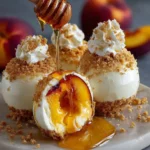
Golden Nectarine Cheesecake Bombs with Molten Honey Center are bite-sized, frozen cheesecake domes filled with a tangy nectarine jam and a warm honey center, set on a buttery graham cracker crust.
- Yield: 8 1x
Ingredients
- For the Cheesecake Mousse:
- 8 oz cream cheese, softened
- 1/2 cup powdered sugar
- 1 cup heavy cream
- 1 tsp vanilla extract
- 1 tbsp gelatin powder
- 3 tbsp warm water
- For the Nectarine Filling:
- 2 ripe nectarines, peeled and finely diced
- 2 tbsp honey
- 1 tbsp lemon juice
- 1 tsp cornstarch
- 1 tbsp water
- For the Molten Honey Center:
- 1/3 cup honey
- 1 tbsp unsalted butter
- 1 tbsp heavy cream
- 1/2 tsp vanilla extract
- Pinch of sea salt
- For the Cookie Base:
- 1 cup graham cracker crumbs
- 3 tbsp melted butter
- 1 tbsp granulated sugar
- Pinch of salt
- For Garnish (optional):
- Nectarine slices
- Honey drizzle
- Crushed graham crumbs
Instructions
- Bloom gelatin in warm water and let dissolve completely.
- Cook diced nectarines with honey, lemon juice, cornstarch, and water over medium heat for 4–5 minutes until thickened. Cool completely.
- In a bowl, beat cream cheese and powdered sugar until smooth.
- Whip heavy cream to soft peaks and fold into the cream cheese mixture.
- Stir in vanilla and dissolved gelatin until fully incorporated.
- In a small saucepan, warm honey, butter, cream, and salt until smooth and slightly thickened. Cool slightly but keep pourable.
- Fill silicone dome molds halfway with cheesecake mousse.
- Add a small spoon of nectarine filling to the center of each mold.
- Add a small drizzle of molten honey center.
- Cover with remaining mousse and freeze until fully set.
- Mix graham crumbs, melted butter, sugar, and salt, then press into small round bases.
- Unmold frozen domes and place onto prepared bases.
- Garnish with nectarine slices, honey drizzle, and crushed crumbs.
- Chill 10–15 minutes before serving.
Nutrition
- Calories: 420
- Sugar: 32 g
- Fat: 27 g
- Carbohydrates: 39 g
- Protein: 5 g
Tried This Recipe? Leave a Comment!
Did you make this recipe? I’d love to hear how it turned out! Please leave a comment and a rating below. Your feedback helps other home cooks and supports cheerychop.com!
For more delicious inspiration, follow me on Pinterest!