Table of Contents
Cosmic Blackberry Mirror Glaze Sphere Cakes – A Stellar Dessert Showstopper
I still remember the first time I saw a mirror glaze cake in a Parisian patisserie window — a perfect, glossy dome that reflected the afternoon light like a polished jewel. I was fifteen, fresh from Morocco and utterly starstruck. That shimmering orb stayed with me through culinary school, through years of testing and tweaking, and eventually became the inspiration behind these Cosmic Blackberry Mirror Glaze Sphere Cakes. This blackberry cheesecake mousse dessert is the intersection of everything I love: the bright, tangy fruit I grew up with in North African markets, the precision of French mirror glaze technique, and the bold, theatrical spirit of New York City dining. With every spoonful you get vanilla-kissed blackberry sponge, luscious cheesecake mousse, and that signature high-gloss cosmic mirror glaze.
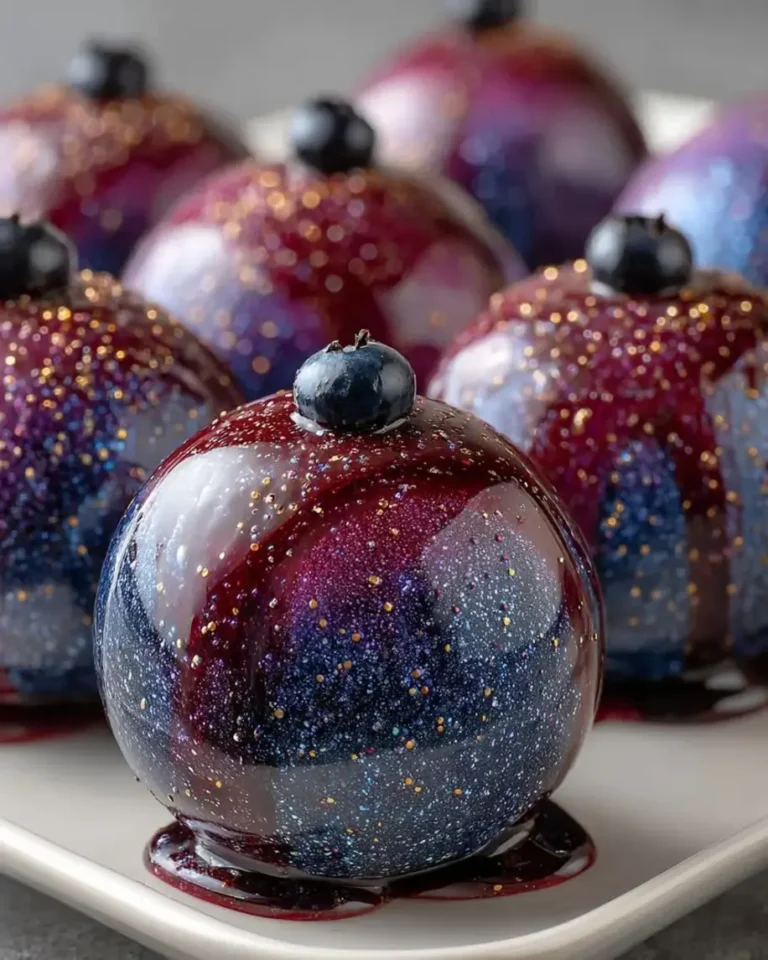
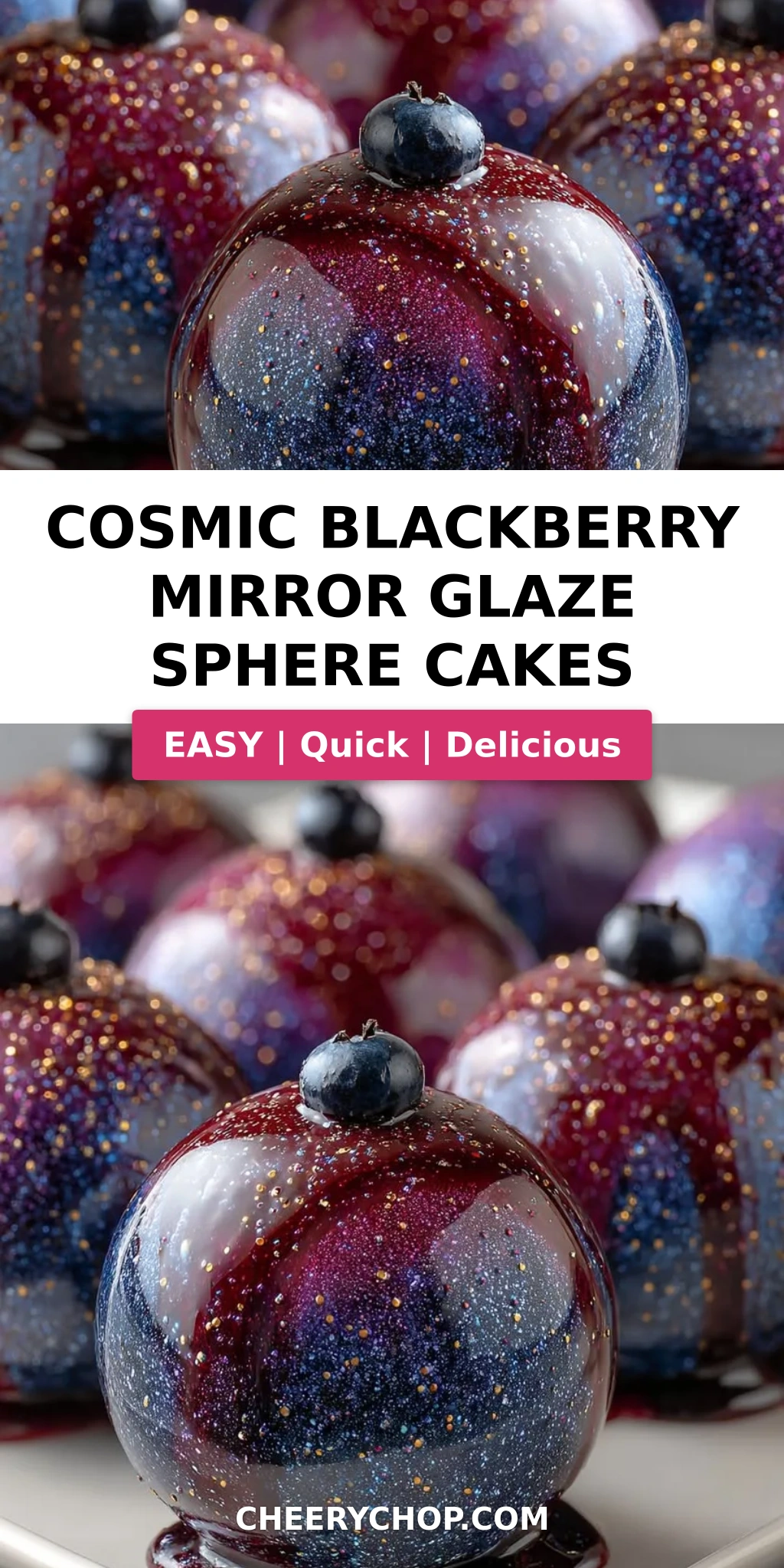
Let me paint you a picture: a deep violet-black mirror glaze rippled with swirls of purple and silver, so shiny you can check your reflection in it. You crack through the glossy shell with your spoon and sink into a cloud of blackberry cheesecake mousse, studded with tender vanilla blackberry sponge. The blackberry puree brings a tart brightness that cuts through the creamy richness, while the edible silver leaf catches the light like a constellation. It tastes like a fancy cake decorating idea that actually delivers — not just looks. The aroma alone — warm vanilla, tangy blackberries, and a whisper of sweet white chocolate — will transport you straight to a dreamy French patisserie in the heart of Manhattan.
I’ve tested this mirror glaze cake recipe dozens of times in my tiny NYC kitchen, and I’ve fine-tuned every detail so you can nail it at home. The secret is in the temperature of the glaze (90°F / 32°C is non-negotiable), the way you bloom the gelatin, and the order you swirl the colors. One common mistake home bakers make is pouring the glaze too warm or too cold, which leads to bubbles or a dull finish. I’ll show you exactly how to avoid that. Whether you’re prepping for a birthday, a dinner party, or just want to treat yourself to something spectacular, these cosmic spheres are your next showpiece. Let’s dive in.
Why This Cosmic Blackberry Mirror Glaze Sphere Cakes Recipe Is the Best
The Flavor Secret — I grew up eating blackberries fresh from the souks of Marrakech, their deep sweetness balanced by a natural tang that makes your lips pucker just enough. That memory inspired me to build a blackberry cheesecake mousse that uses both puree and cream cheese, creating a layer of flavor that’s bright, creamy, and complex. The vanilla blackberry sponge adds a soft, tender crumb that soaks up just a hint of the mousse without getting soggy. It’s a layered dessert that tastes as thoughtful as it looks — no one-hit-wonder here.
Perfected Texture — Achieving that cloud-like mousse and that glass-smooth mirror glaze takes a few precise techniques, but I’ve broken them down into foolproof steps. From blooming the gelatin properly to whipping the cream to soft peaks, every move is designed to give you a silky mousse that holds its shape and a glaze that flows like silk. The texture of the finished cake is nothing short of ethereal: a firm, glossy shell gives way to an airy, almost weightless interior. It’s the kind of texture you expect from a five-star pastry chef, but it’s absolutely achievable in your home kitchen.
Foolproof & Fast — I know mirror glaze can feel intimidating, but I promise this recipe is designed for bakers who want to impress without losing sleep. The components can be made across two days, and I’ve included visual cues and pro tips at every stage so you know exactly what to look for. Even if you’ve never worked with gelatin or edible silver leaf before, you’ll feel confident by the time you pour that glaze. Plus, the sphere molds do most of the shaping work for you — no carving or tricky assembly required. This is fancy cake decorating made accessible.
Mirror Glaze Cake Recipe Ingredients
Every Sunday morning I walk through the Union Square Greenmarket, and in late summer the blackberry displays are a deep, dusky purple that stop me in my tracks. I pick up two pints — one for eating out of hand (a habit from my childhood in Morocco, where we’d snack on berries straight from the vendor’s basket) and one for this recipe. The ingredients below are what I reach for when I’m building these Cosmic Blackberry Mirror Glaze Sphere Cakes in my own kitchen. Each one plays a critical role in the flavor, texture, and shine of the final dessert.
Ingredients List
- For the Vanilla Blackberry Sponge:
- 1 1/2 cups all-purpose flour
- 1 1/2 tsp baking powder
- 1/4 tsp salt
- 1/2 cup unsalted butter, softened
- 3/4 cup granulated sugar
- 2 large eggs
- 1 tsp vanilla extract
- 1/2 cup whole milk
- 1/2 cup blackberry puree
- For the Blackberry Cheesecake Mousse:
- 8 oz (225 g) cream cheese, softened
- 1/3 cup powdered sugar
- 1/2 cup blackberry puree
- 1 tsp vanilla extract
- 1 tsp unflavored gelatin
- 2 tbsp cold water
- 1 cup heavy whipping cream
- For the Cosmic Mirror Glaze:
- 1/2 cup sweetened condensed milk
- 7 oz (200 g) white chocolate, finely chopped
- 2 tsp powdered gelatin
- 1/4 cup cold water
- 1/2 cup granulated sugar
- 1/4 cup water
- Purple gel food coloring
- Black gel food coloring
- Silver edible shimmer dust
- For Garnish (optional):
- Fresh blackberries
- Edible silver leaf
- Micro mint leaves
Ingredient Spotlight
Blackberry Puree — This is the backbone of both the sponge and the mousse, so quality matters. I prefer to make my own by simmering fresh or frozen blackberries with a splash of lemon juice, then straining out the seeds. Frozen blackberries work beautifully — just thaw them first and save any juice that pools. One tested substitution is raspberry puree, which yields a slightly more tart, equally vibrant result. The color will shift toward a deeper red rather than purple, but the texture remains identical.
White Chocolate for the Glaze — Use a high-quality white chocolate with at least 30% cocoa butter. I like Valrhona or Callebaut for their smooth melt and clean flavor. Avoid white melting wafers or chips that contain stabilizers — they can make the glaze grainy or cause it to seize. A good substitution is high-quality white chocolate bars from the grocery store (like Ghirardelli), but avoid anything labeled “white morsels” or “baking chips.” The flavor impact is significant: better chocolate gives a creamier, glossier finish with a clean sweetness that lets the blackberry shine.
Gelatin — This is what gives both the mousse and the glaze their structure and that signature jiggly-smooth mirror finish. I use powdered Knox gelatin for consistency. One crucial detail: always bloom the gelatin in cold water for at least 5 minutes, then melt it gently in the microwave or over a double boiler. If you overheat it, the gelatin will lose its setting power. For a vegetarian alternative, you can use agar-agar, but note that the texture will be firmer and less silky, and the glaze may not achieve the same high-gloss clarity.
Edible Silver Leaf — This is your cosmic touch. It’s available at specialty baking stores, online, or at some high-end grocery stores. It’s incredibly delicate — use tweezers to handle it, and let a piece drift onto the glaze while it’s still slightly tacky so it adheres naturally. A good substitution is edible luster dust mixed with a drop of vodka, painted on with a brush. The visual impact is slightly less mirror-like but still gorgeous.
| Original Ingredient | Best Substitution | Flavor / Texture Impact |
|---|---|---|
| Blackberry Puree | Raspberry Puree | More tart, redder color, same texture |
| White Chocolate | High-quality white chocolate bar | Slightly less glossy, still creamy |
| Powdered Gelatin | Agar-Agar (vegetarian) | Firmer set, less silky glaze |
| Edible Silver Leaf | Edible Luster Dust + vodka | Less mirror-like, still shiny |
| Cream Cheese | Full-fat ricotta, blended smooth | Slightly grainy, less tangy |
How to Make Cosmic Blackberry Mirror Glaze Sphere Cakes — Step-by-Step
I’ve organized this recipe into five clear phases so you can work through it without feeling overwhelmed. The sponge and mousse come together quickly, and the glaze is the final flourish. Take your time with each step — especially the freezing and the glaze temperature — and you’ll be rewarded with a dessert that looks like it came from a Michelin-starred kitchen.
Step 1: Prepare the Vanilla Blackberry Sponge
Preheat your oven to 350°F (175°C) and grease an 8-inch cake pan, then line the bottom with parchment paper. In a medium bowl, whisk together 1 1/2 cups all-purpose flour, 1 1/2 tsp baking powder, and 1/4 tsp salt. In a separate large bowl, beat 1/2 cup softened unsalted butter with 3/4 cup granulated sugar until pale and fluffy — about 3 minutes with a hand mixer. Add 2 large eggs one at a time, beating well after each, then mix in 1 tsp vanilla extract. Alternate adding the dry ingredients with 1/2 cup whole milk, starting and ending with the dry mix. Finally, fold in 1/2 cup blackberry puree until just combined — streaks are fine. Pour the batter into the prepared pan and bake for 25–30 minutes, until a toothpick inserted in the center comes out clean. Cool in the pan for 10 minutes, then turn out onto a wire rack to cool completely. Once cool, use a 2-inch round cutter (or the size that fits your sphere molds) to stamp out circles. You’ll need 8 rounds total.
💡 Sara’s Pro Tip: Don’t overmix the batter once you add the blackberry puree — gentle folding keeps the sponge tender. If your blackberry puree is very thick, thin it with a teaspoon of water so it folds in evenly without deflating the batter.
Step 2: Make the Blackberry Cheesecake Mousse
In a small bowl, bloom 1 tsp unflavored gelatin in 2 tbsp cold water for 5 minutes. In a large bowl, beat 8 oz softened cream cheese with 1/3 cup powdered sugar, 1/2 cup blackberry puree, and 1 tsp vanilla extract until completely smooth — no lumps. Melt the bloomed gelatin in the microwave in 10-second bursts (or over a double boiler) until it’s liquid and warm, then stir it into the cream cheese mixture until fully incorporated. In a separate chilled bowl, whip 1 cup heavy whipping cream to soft peaks — the cream should hold a gentle curl when you lift the whisk. Gently fold the whipped cream into the cheesecake base in three additions, using a rubber spatula and a light hand. The mousse should be airy, thick, and uniform in color.
⚠️ Common Mistake to Avoid: Over-whipping the cream to stiff peaks can make the mousse grainy and dense. Stop at soft peaks — when the cream just holds its shape but still looks silky. If you go too far, add a tablespoon of fresh unwhipped cream and fold gently to loosen it back up.
Step 3: Assemble and Freeze the Spheres
Spoon the mousse into a piping bag or a zip-top bag with the corner snipped off. Fill your silicone sphere molds about halfway with mousse, then press one sponge round into each cavity — gently so it sinks slightly into the mousse. Pipe more mousse on top to cover the sponge completely, filling the mold to the brim. Use a small offset spatula to scrape the top flush with the rim of the mold. Place the filled molds on a baking sheet and freeze for at least 8 hours, or overnight. The spheres must be completely frozen solid before glazing.
💡 Sara’s Pro Tip: If your sponge rounds are slightly too large, trim them with scissors or a small knife. The sponge should fit inside the mousse without poking out — any exposed cake will soak up the glaze and ruin the smooth finish.
Step 4: Create the Cosmic Mirror Glaze
In a small bowl, bloom 2 tsp powdered gelatin in 1/4 cup cold water for 5 minutes. In a small saucepan, combine 1/2 cup granulated sugar and 1/4 cup water. Heat over medium, stirring until the sugar dissolves completely — do not let it boil vigorously. Once dissolved, remove from heat and stir in 1/2 cup sweetened condensed milk. Place 7 oz (200 g) finely chopped white chocolate in a heatproof bowl. Pour the hot condensed milk mixture over the chocolate and let sit for 1 minute, then stir gently until smooth. Add the bloomed gelatin (melt it first in the microwave for 10 seconds if it has solidified) and stir until fully incorporated. Divide the glaze into two or three bowls. Tint one portion with purple gel food coloring, another with black gel food coloring, and leave a small portion white. Stir silver edible shimmer dust into the purple portion for a cosmic sparkle. Let the glaze cool to 90°F (32°C) — use an instant-read thermometer for accuracy.
⚠️ Common Mistake to Avoid: Pouring the glaze when it’s too warm (above 95°F) will cause it to run off the frozen sphere and pool at the bottom, creating a thin, uneven coating. Too cold (below 85°F) and it will set before you can swirl the colors or achieve a smooth finish. Be patient and wait for that sweet spot at 90°F.
Step 5: Glaze and Garnish
Remove the frozen spheres from the molds and set them on a wire rack placed over a baking sheet (to catch drips). Working quickly, pour the purple and black glazes into one bowl in alternating stripes, then give them a single gentle swirl with a skewer — don’t overmix. Pour the glaze over one sphere at a time, starting from the top and letting it cascade down. Once covered, use a small offset spatula or your finger to smooth the bottom edge if needed. While the glaze is still tacky, place a small piece of edible silver leaf on top using tweezers, and arrange a fresh blackberry and a micro mint leaf beside it. Repeat with the remaining spheres. Allow the glaze to set for 2–3 minutes at room temperature before transferring to a serving plate. Serve immediately or keep refrigerated for up to 2 hours before serving.
💡 Sara’s Pro Tip: For the most dramatic cosmic effect, pour the glaze in a quick, confident motion — hesitation creates uneven coverage. If a bubble appears on the surface, pop it immediately with a toothpick before the glaze sets. The silver leaf should be applied within 30 seconds of glazing while the surface is still just slightly sticky.
| Step | Action | Duration | Key Visual Cue |
|---|---|---|---|
| 1 | Bake sponge | 25–30 min | Toothpick comes out clean |
| 2 | Make mousse | 15 min | Cream holds soft peaks, mousse is airy |
| 3 | Assemble & freeze | 8+ hrs | Spheres are rock solid |
| 4 | Make glaze | 20 min | Glaze is smooth, 90°F |
| 5 | Glaze & garnish | 5 min per sphere | Glaze flows evenly, silver leaf sticks |
Serving & Presentation
These Cosmic Blackberry Mirror Glaze Sphere Cakes are at their absolute best within 2 hours of glazing, when the mirror finish is still glossy and the interior is cold and creamy. Place each sphere on a white or dark slate plate — the contrast makes the silver leaf and purple-black glaze pop. I like to add a small quenelle of fresh whipped cream or a drizzle of blackberry coulis on the plate for an extra layer of color and flavor. A few fresh blackberries and tiny micro mint leaves around the base complete the constellation look.
When I serve these at dinner parties in my NYC apartment, I watch people’s faces shift from curiosity to wonder as they crack through the mirror shell. The combination of the glossy exterior and the soft, mousse-like interior is pure drama. For a truly elevated dessert course, pair each sphere with a small glass of blackberry liqueur or a late-harvest Riesling — the sweetness of the wine plays beautifully against the tangy blackberry and creamy cheesecake.
If you’re styling for photos, use natural light from a window and place the sphere slightly off-center on the plate. The silver leaf catches the light best when it’s not perfectly flat — let a corner curl up slightly. And remember: these cakes are best served chilled, not frozen. Let them sit at room temperature for 5–7 minutes after glazing so the mousse softens to a luscious, spoonable consistency.
| Pairing Type | Suggestions | Why It Works |
|---|---|---|
| Side Dish | Fresh whipped cream, blackberry coulis | Adds richness and a fruity counterpoint |
| Sauce / Dip | Warm chocolate sauce, caramel drizzle | Chocolate complements blackberry; caramel adds sweetness |
| Beverage | Late-harvest Riesling, blackberry liqueur, espresso | Sweet wine echoes fruit; espresso cuts richness |
| Garnish | Fresh blackberries, edible silver leaf, micro mint | Adds color, texture, and a cosmic shimmer |
Make-Ahead, Storage & Reheating
One of the best things about this blackberry cheesecake mousse dessert is how well it adapts to a busy schedule. I often prepare the sponge and mousse on a Friday evening, assemble and freeze the spheres overnight, then glaze them on Saturday afternoon before guests arrive. That 8-hour freeze is essential — it’s what gives the glaze that flawless, mirror-like finish. If you’re short on time, you can bake the sponge up to 3 days in advance and store it tightly wrapped at room temperature.
| Method | Container | Duration | Reheating Tip |
|---|---|---|---|
| Refrigerator | Airtight container, layered with parchment | Up to 2 days | Serve chilled; let sit 5 min at room temp |
| Freezer | Wrap each glazed sphere in plastic wrap, then foil | Up to 1 month | Thaw in fridge overnight; glaze may lose some shine |
| Make-Ahead | Freeze unglazed spheres in molds | Up to 2 weeks | Glaze directly from frozen — do not thaw first |
If you’re storing glazed spheres in the refrigerator, place them on a parchment-lined tray and cover loosely with plastic wrap — don’t let the wrap touch the glaze, or it will stick and ruin the finish. The glaze stays shiny for up to 2 days, though it will soften slightly. For longer storage, freeze the unglazed spheres and glaze them fresh the day you plan to serve. I’ve done this for holiday parties and it works like a dream: just pull the spheres from the freezer, whip up the glaze, and pour. Nobody will ever know you prepped them weeks ahead.
Variations & Easy Swaps
Over the years I’ve played with this recipe in all sorts of ways — swapping fruits, changing the sponge base, even turning it into a gluten-free version for my celiac friends. Here are three variations I love, each with its own personality. Whether you’re craving a tropical twist or a nutty crunch, there’s a version here for you.
| Variation | Key Change | Best For | Difficulty Impact |
|---|---|---|---|
| Tropical Mango-Passion Fruit | Replace blackberry puree with mango-passion fruit puree | Summer parties, tropical themes | Same difficulty |
| Gluten-Free Almond | Replace flour with almond flour + 1 tbsp cornstarch | Gluten-sensitive guests | Slightly trickier texture |
| Chocolate-Blackberry Decadence | Add 1/4 cup cocoa powder to sponge; use dark chocolate in glaze | Chocolate lovers, winter holidays | Same difficulty |
Tropical Mango-Passion Fruit Variation
This is my go-to for summer entertaining, when mangoes are at their peak at the Union Square Greenmarket. Replace the blackberry puree with an equal amount of mango puree in both the sponge and the mousse, and add 2 tablespoons of passion fruit pulp to the mousse for that signature tang. The glaze can be tinted yellow-orange with a touch of pink for a sunset effect. The flavor is bright, sunny, and utterly refreshing — like a vacation in a sphere. I like to garnish with a tiny edible orchid and a sliver of fresh mango.
Gluten-Free Almond Variation
For my gluten-free friends, I swap the all-purpose flour for 1 1/2 cups finely ground almond flour plus 1 tablespoon cornstarch. The sponge comes out slightly denser and more tender, with a lovely nutty aroma that pairs beautifully with the blackberry. Add 1/4 teaspoon almond extract alongside the vanilla for an extra layer of flavor. The mousse and glaze remain unchanged, so this variation is mostly about the sponge. Be sure to line your cake pan well, as almond flour sponges are more delicate to remove. Let the sponge cool completely in the pan before cutting.
Chocolate-Blackberry Decadence Variation
This version is pure indulgence. Add 1/4 cup unsweetened cocoa powder to the dry ingredients for the sponge, and reduce the flour by 2 tablespoons. For the glaze, substitute dark chocolate (at least 60% cacao) for the white chocolate — expect a deeper, less sweet finish that contrasts beautifully with the blackberry mousse. The glaze will be a rich, dark mahogany rather than a cosmic purple, so I recommend using gold luster dust instead of silver for a warm, luxurious shimmer. This version tastes like a black forest cake reimagined as a futuristic sphere.
How do you make a mirror glaze for blackberry sphere cakes without getting air bubbles?
The key to a bubble-free mirror glaze is all in the technique. First, make sure your white chocolate is very finely chopped so it melts evenly without needing excessive stirring. When you pour the hot condensed milk mixture over the chocolate, let it sit undisturbed for a full minute before you start stirring — this allows the heat to gently melt the chocolate from the bottom up. Stir slowly and deliberately in one direction to avoid incorporating air. After the glaze is smooth, strain it through a fine-mesh sieve into a clean bowl to catch any stray lumps or bubbles. Finally, let the glaze cool undisturbed to 90°F (32°C) — don’t whisk it as it cools, and don’t use an immersion blender unless you’re prepared to deal with microbubbles. If you do see surface bubbles just before pouring, pop them with a toothpick or a sharp skewer.
What can I use instead of blackberries for the Cosmic Blackberry Mirror Glaze Sphere Cakes?
Raspberries are the most direct substitute — they have a similar balance of sweetness and tartness, and they puree to a smooth consistency that works perfectly in both the sponge and the mousse. The color will shift from deep purple to a vivid crimson, which can look stunning with a pink or gold mirror glaze. Strawberries work too, but they’re milder in flavor, so you may want to add a squeeze of lemon juice to brighten them. For a tropical twist, mango puree is fantastic (see the variation section above). Avoid fruits with very high water content like watermelon or cucumber, as they’ll make the mousse too loose and the sponge soggy. Whatever fruit you choose, make sure to strain the puree thoroughly to remove seeds and fibers for a silky-smooth texture.
How far in advance can you prepare the mirror glaze sphere cakes?
You can prepare the components up to 3 days in advance. Bake the vanilla blackberry sponge, wrap it tightly in plastic wrap, and store it at room temperature. Make the blackberry cheesecake mousse, fill the sphere molds, and freeze them for at least 8 hours — they can stay frozen in the molds for up to 2 weeks if you cover them well with plastic wrap. The mirror glaze itself should be made fresh on the day you plan to serve, as it loses its shine after 24–48 hours in the refrigerator. For best results, glaze the frozen spheres within 2 hours of serving. If you need to prep further ahead, freeze the unglazed spheres and glaze them straight from the freezer when you’re ready — no thawing needed.
How do you get the shiny mirror glaze finish on these cosmic blackberry cakes?
The mirror-like shine comes from a combination of three factors: proper gelatin blooming, precise temperature control, and the right pouring technique. First, bloom the gelatin in cold water for exactly 5 minutes — this activates it evenly. Second, cool the finished glaze to exactly 90°F (32°C) — too warm and it will run off the frozen sphere, too cold and it will set before it can flow into a smooth layer. Use an instant-read thermometer for accuracy. Third, pour the glaze in a single confident motion over the frozen sphere, starting from the top center and letting it cascade down naturally. Don’t touch or smooth it with a spatula after pouring — gravity does the work. The frozen sphere instantly chills the glaze, causing it to set into that glass-like finish. Adding silver shimmer dust to the glaze enhances the reflective quality.
Can I use frozen blackberries for the puree in this mirror glaze cake recipe?
Absolutely — frozen blackberries are actually my go-to for this recipe, especially when fresh ones aren’t in season. Frozen berries are picked at peak ripeness and flash-frozen, so they often have more consistent flavor than out-of-season fresh berries. Thaw the frozen blackberries completely in a colander set over a bowl to catch the juice, then puree the berries with the collected juice. You may need to simmer the puree for 5–7 minutes to reduce it slightly if it’s thinner than fresh puree. Strain through a fine-mesh sieve to remove the seeds. One important note: frozen berries can vary in sweetness, so taste your puree and adjust the sugar in the mousse or sponge if needed. I usually add an extra tablespoon of sugar if the berries taste particularly tart.
What type of white chocolate works best for the mirror glaze?
For the most reliable mirror glaze, use a high-quality white chocolate that contains at least 30% cocoa butter. I recommend Valrhona Ivoire, Callebaut, or Green & Black’s — these melt smoothly and yield a glossy, fluid glaze that sets to a mirror finish. Grocery store white chocolate bars like Ghirardelli also work well. Avoid white chocolate chips or morsels, as they often contain added stabilizers and emulsifiers that prevent smooth melting and can make the glaze grainy or thick. Also avoid “white melting wafers” or candy melts — these are designed for coating and don’t contain real cocoa butter, so they won’t give you that high-gloss, sophisticated finish. If you can’t find good white chocolate, the best substitute is a high-quality bar from a well-stocked supermarket.
Do I need special sphere molds for this fancy cake decorating recipe?
Yes, silicone sphere molds are essential for achieving the perfect round shape. I use 2.5-inch or 3-inch half-sphere molds that create a full sphere when two halves are combined — or you can use individual cavity sphere molds. Look for food-grade silicone that’s flexible enough to unmold the frozen spheres easily. You can find them at baking supply stores, on Amazon, or at specialty kitchen shops. If you don’t have sphere molds, you can use a muffin tin lined with plastic wrap as a rough substitute — the shape will be more dome-like than spherical, but the flavor will be the same. For a truly cosmic presentation, I recommend investing in good-quality silicone sphere molds — they’re reusable and give you that professional, polished look every time.
Can I make this blackberry cheesecake mousse recipe without gelatin?
You can, but the texture will be noticeably different. Gelatin gives the mousse its structure and stability, allowing it to hold its shape when unmolded and providing a smooth, silky mouthfeel. Without gelatin, the mousse will be softer and more like a thick cream — it won’t freeze as solidly, which can make glazing difficult. For a vegetarian alternative, use agar-agar at a ratio of 1 teaspoon agar powder for every 1 teaspoon gelatin. Bloom the agar in the same amount of cold water, then bring it to a boil while stirring — agar needs to reach a boil to activate. The resulting mousse will be firmer and slightly less creamy, but it will still set beautifully. If you’re simply looking to avoid gelatin for texture reasons, you can add an extra 1/2 cup of heavy cream whipped to stiff peaks, but expect a much softer result.
How do I store leftover mirror glaze sphere cakes?
Store leftover glazed spheres in the refrigerator on a parchment-lined tray, loosely covered with plastic wrap — make sure the wrap doesn’t touch the glaze or it will stick and mar the finish. They’ll keep for up to 2 days, though the glaze will soften slightly and lose some of its mirror-like shine. For longer storage, freeze the unglazed spheres in their molds (well-wrapped) for up to 2 weeks, then glaze them fresh when you’re ready to serve. If you have already glazed spheres that you need to freeze, wrap each one individually in plastic wrap, then place them in an airtight container. To serve, thaw in the refrigerator overnight and let sit at room temperature for 5 minutes before plating. The glaze won’t be quite as glossy as fresh, but the flavor will still be incredible.
What’s the best way to apply edible silver leaf to the cosmic cakes?
Edible silver leaf is delicate, so handle it with care. I use a pair of clean tweezers to pick up a small piece of the leaf — it’s so thin that it will want to cling to everything. Wait until the mirror glaze has been poured and has set for about 15–20 seconds — the surface should be slightly tacky but no longer wet. Gently lay the silver leaf onto the surface of the sphere, letting it drift down rather than pressing it. The tacky glaze will hold it in place naturally. If you want a scattered, constellation-like effect, tear the leaf into small irregular pieces and place them in a few spots around the sphere. Avoid touching the silver leaf with your fingers, as the oils will cause it to tarnish or stick to your skin. If you don’t have silver leaf, you can mix a pinch of edible silver luster dust with a drop of vodka and paint it onto the glaze with a soft brush for a similar shimmer.
Share Your Version!
I absolutely love seeing how you make these Cosmic Blackberry Mirror Glaze Sphere Cakes your own. Did you try the tropical mango variation, or did you go all-in with the chocolate-blackberry decadence version? Maybe you came up with something entirely new — a swirl of gold and burgundy, a dusting of freeze-dried raspberry powder, or a completely different fruit combo. Drop a comment below and let me know how it turned out — and don’t forget to leave a star rating if you loved the recipe as much as I do.
Snap a photo of your cosmic creations and tag me on Instagram or Pinterest @cheerychop — I scroll through every single tag and I’ll feature my favorites in my stories. And if you have a question about any step in the recipe, just ask in the comments. I read every single one and I’ll answer personally. From my NYC kitchen to yours — I hope this recipe brings as much warmth to your table as it does to mine. — Sara 🧡
Love This Recipe? Save It to Pinterest!
If you enjoyed this Cosmic Blackberry Mirror Glaze Sphere Cakes recipe, don’t let it get lost in your browser tabs! 😄 Pin it now so you can find it again anytime — and explore hundreds more tried-and-tested recipes waiting for you on my Pinterest boards.
👉 Follow Sara on Pinterest @chefrecipes2
📌 Pin this recipe · 🔁 Re-pin your favorites · 💬 Tag me when you make it — I love seeing your creations!
🌟 Made this recipe? Let me know! 🌟
Drop a comment below, leave a ⭐⭐⭐⭐⭐ rating, and tag @cheerychop in your photo — I can’t wait to see your cosmic creations!
— Sara 🧡
Cosmic Blackberry Mirror Glaze Sphere Cakes
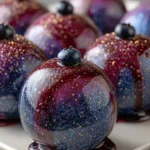
A stunning dessert featuring vanilla blackberry sponge, blackberry cheesecake mousse, and a cosmic mirror glaze decorated with silver shimmer.
- Yield: 8 1x
Ingredients
- For the Vanilla Blackberry Sponge:
- 1 1/2 cups all-purpose flour
- 1 1/2 tsp baking powder
- 1/4 tsp salt
- 1/2 cup unsalted butter, softened
- 3/4 cup granulated sugar
- 2 large eggs
- 1 tsp vanilla extract
- 1/2 cup whole milk
- 1/2 cup blackberry puree
- For the Blackberry Cheesecake Mousse:
- 8 oz (225 g) cream cheese, softened
- 1/3 cup powdered sugar
- 1/2 cup blackberry puree
- 1 tsp vanilla extract
- 1 tsp unflavored gelatin
- 2 tbsp cold water
- 1 cup heavy whipping cream
- For the Cosmic Mirror Glaze:
- 1/2 cup sweetened condensed milk
- 7 oz (200 g) white chocolate, finely chopped
- 2 tsp powdered gelatin
- 1/4 cup cold water
- 1/2 cup granulated sugar
- 1/4 cup water
- Purple gel food coloring
- Black gel food coloring
- Silver edible shimmer dust
- For Garnish (optional):
- Fresh blackberries
- Edible silver leaf
- Micro mint leaves
Instructions
- 1. Preheat the oven to 350°F (175°C). Grease and line an 8-inch cake pan.
- 2. Whisk together the flour, baking powder, and salt.
- 3. Beat the butter and sugar until light and fluffy. Add the eggs one at a time, then mix in the vanilla.
- 4. Alternate adding the dry ingredients with the milk, then fold in the blackberry puree.
- 5. Bake for 25–30 minutes. Cool completely and cut into circles to fit the sphere molds.
- 6. Bloom the gelatin in the cold water for 5 minutes.
- 7. Beat the cream cheese, powdered sugar, blackberry puree, and vanilla until smooth.
- 8. Melt the bloomed gelatin and stir it into the cheesecake mixture.
- 9. Whip the heavy cream to soft peaks and gently fold it into the mixture.
- 10. Fill silicone sphere molds halfway with mousse, insert a sponge cake round, cover with more mousse, and freeze for at least 8 hours.
- 11. For the glaze, bloom the gelatin in the cold water. Heat the sugar and water until dissolved, then stir in the condensed milk. Pour over the white chocolate, add the gelatin, and blend until smooth. Divide and tint with purple and black coloring, then swirl together with silver shimmer. Cool the glaze to about 90°F (32°C) and pour over the frozen spheres. Garnish with fresh blackberries, edible silver leaf, and micro mint before serving.
Nutrition
- Calories: 465
- Sugar: 36 g
- Fat: 28 g
- Carbohydrates: 47 g
- Protein: 7 g
Tried This Recipe? Leave a Comment!
Did you make this recipe? I’d love to hear how it turned out! Please leave a comment and a rating below. Your feedback helps other home cooks and supports cheerychop.com!
For more delicious inspiration, follow me on Pinterest!