Table of Contents
Golden Apricot Honey Cheesecake Domes with Glass Glaze – A Stunning Individual Dessert
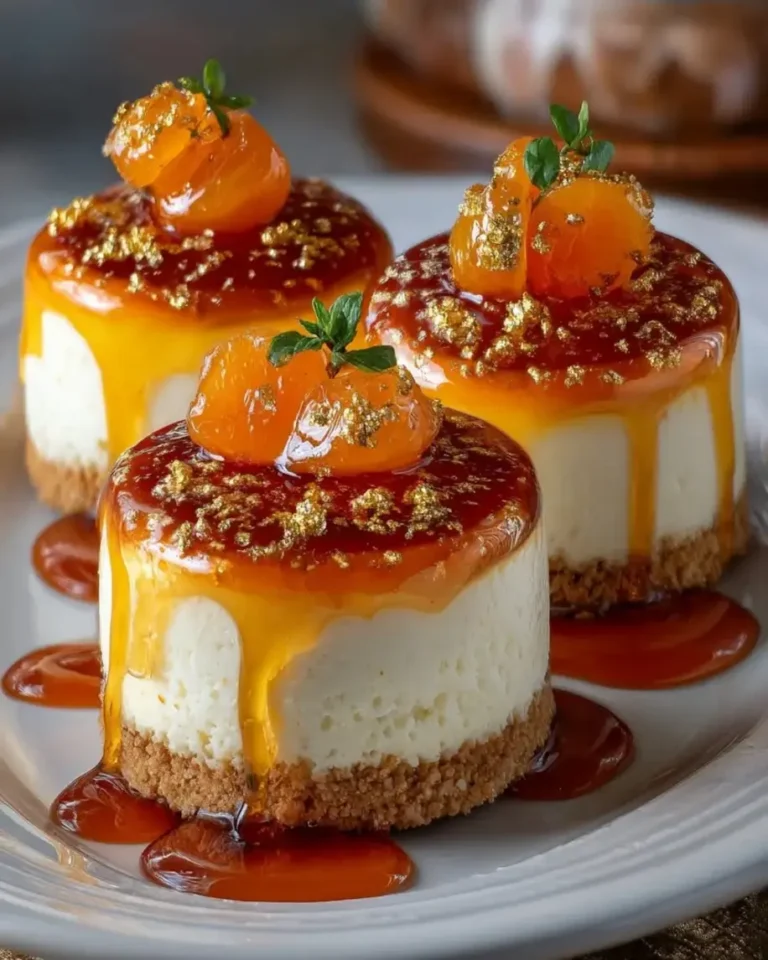
I remember the first time I tasted a perfect glass glaze in pastry school in Paris — that crackling, mirror-like shell that turns a simple dessert into a jewel. Years later, walking through the Union Square Greenmarket in New York City, I spotted the most gorgeous organic apricots and knew I had to create something that blended those French patisserie memories with the warmth of my Moroccan roots. That’s how these Golden Apricot Honey Cheesecake Domes with Glass Glaze were born — a dessert that combines a silky apricot-honey cheesecake mousse, a sweet-tart apricot center, and a shiny gold mirror glaze that catches the light like liquid gold. The unique angle here is the triple-layer texture: the creamy mousse, the fruity jammy core, and that crisp glaze shell over a buttery graham cracker base.
Close your eyes and imagine the first spoonful: the glass glaze cracks open with a satisfying snap, revealing a cloud-like cheesecake mousse infused with apricot puree and wildflower honey. Then you hit the concentrated apricot center — cooked down with lemon and honey until it’s like sunshine in a spoon. The whole thing sits on a salty-sweet graham cracker crust that gives just the right crunch. The aroma is pure summer: floral honey, ripe apricot, and a whisper of vanilla. The dome shape makes each serving feel like a personal gift, and the gold color is so stunning you might forget to eat it — but please don’t!
This isn’t just a pretty dessert — it’s a recipe I’ve perfected over dozens of tests in my NYC kitchen. The challenge with glass glazes is getting the temperature and consistency just right so it flows smoothly without dripping off. I’m going to share my exact technique, including a pro tip for preventing air bubbles and a common mistake that can ruin the shine. Whether you’re a seasoned baker or a confident home cook, these domes are totally achievable — and they’ll make you feel like a pastry chef. Let’s dive in.
Why This Golden Apricot Honey Cheesecake Domes Recipe Is the Best
The Flavor Secret – Growing up in Morocco, my mother would simmer dried apricots with honey and a pinch of saffron for festive pastries. I’ve taken that same flavor principle — sweet and floral — and translated it into a modern French dessert. The apricot puree in the mousse is bright and fruity, while the honey adds a woodsy depth that balances the tang of cream cheese. The glass glaze isn’t just for looks; it’s made with white chocolate and condensed milk, giving a creamy sweetness that ties everything together.
Perfected Texture – The trick to a mousse that’s light but holds its shape? Bloomed gelatin and whipped cream folded in with a light hand. I learned this technique at Le Cordon Bleu in Paris — using gelatin properly ensures the domes unmold cleanly and the mousse stays airy. The apricot center is cooked with cornstarch to a thick, spreadable consistency that won’t run into the mousse. And the glass glaze? It sets to a firm, shiny shell that cracks when you tap it, but stays thin enough to coat without pooling.
Foolproof & Fast – Don’t let the “advanced” difficulty scare you — if you can bloom gelatin and melt white chocolate, you can nail this. I’ve broken down every step with visual cues and timing, and the domes actually benefit from being made ahead. You can do all the prep in under an hour, then let the freezer do the work. Plus, the ingredients are easy to find in any US grocery store — no specialty items needed. This is a showstopper that won’t stress you out.
Golden Apricot Honey Cheesecake Domes Ingredients
I source my cream cheese from a local dairy in upstate New York and my honey from a beekeeper at the Grand Army Plaza farmers market — the wildflower variety has a floral note that sings with apricot. For the apricots, I always reach for California dried apricots: they’re sweet, tender, and easy to chop. And the white chocolate? I use a good-quality Belgian brand (Callebaut or Valrhona) for the smoothest glaze. Here’s everything you’ll need:
Ingredients List
- For the Apricot Honey Cheesecake Mousse:
- 8 oz cream cheese, softened
- 1/2 cup powdered sugar
- 1 cup heavy cream
- 3/4 cup apricot puree (from fresh or canned apricots, or blended dried apricots with water)
- 2 tbsp honey (preferably wildflower or orange blossom)
- 1 tsp vanilla extract
- 1 tbsp gelatin powder
- 3 tbsp warm water
- For the Apricot Center:
- 1 cup dried apricots, finely chopped (about 6 oz)
- 2 tbsp honey
- 1 tbsp lemon juice
- 2 tbsp water
- 1 tsp cornstarch
- For the Golden Glass Glaze:
- 1 cup white chocolate, finely chopped (about 6 oz)
- 1/2 cup sweetened condensed milk
- 1 tbsp gelatin powder
- 3 tbsp warm water
- Gold food coloring (gel or oil-based, to desired shade)
- For the Cookie Base:
- 1 cup graham cracker crumbs (about 8–9 full sheets)
- 3 tbsp melted butter
- 1 tbsp granulated sugar
- Pinch of salt
- For Garnish (optional):
- Thin apricot slices (fresh or rehydrated dried)
- Honey drizzle
- Edible gold flakes (optional, for extra sparkle)
Ingredient Spotlight
Cream Cheese: The backbone of the mousse. Use full-fat block cream cheese (not the spreadable kind) — it gives the best structure. Let it soften to room temperature for a smooth, lump-free base. Substitution: Mascarpone for an extra-rich mousse (skip the powdered sugar if using mascarpone, as it’s already sweet).
Apricot Puree: I prefer to make my own by blending 1 cup of dried apricots (soaked in hot water for 30 minutes) with 1/4 cup of the soaking liquid — it’s intensely fruity. Canned apricot puree (in syrup) works too, but reduce the honey slightly. Fresh apricot puree is lovely in season, but remember to cook it down to concentrate flavor.
Honey: Wildflower honey is my top pick for its floral complexity. Orange blossom honey will add a citrus note that plays beautifully with apricot. Avoid super strong honeys like buckwheat — they can overpower the delicate mousse. If you’re vegan, use agave nectar (the mousse will be slightly less stable).
White Chocolate: Must be a good quality couverture (high cocoa butter content) for the smoothest glaze. Chips work, but they often have stabilizers that can make the glaze grainy. Chop the chocolate finely so it melts evenly. Substitution: Use pale yellow candy melts if you want a more opaque gold color, but the taste will be sweeter.
Gelatin Powder: This is non-negotiable for both the mousse and glaze. I use Knox gelatin (every US grocery store carries it). Always bloom it in cool/cold water for 5 minutes before dissolving in warm liquid. Overheating gelatin kills its gelling power — keep the water warm, not hot.
| Original Ingredient | Best Substitution | Flavor / Texture Impact |
|---|---|---|
| Cream cheese (8 oz) | Mascarpone (8 oz) + 2 tbsp powdered sugar less | Richer, slightly looser mousse; more decadent |
| Dried apricots for center | Fresh apricots (4 medium, diced + 1 tsp more cornstarch) | Lighter, less concentrated flavor; adjust sweetness |
| White chocolate | Pale yellow candy melts | More opaque color, sweeter, slightly waxy finish |
| Graham cracker crumbs | Shortbread or vanilla wafer crumbs | Butterier or sweeter base; similar crunch |
How to Make Golden Apricot Honey Cheesecake Domes — Step-by-Step
I’ve designed these steps to flow like a professional kitchen: prep all components, then assemble and chill. Read through once before you start — you’ve got this!
Step 1: Bloom the Gelatins
Place the gelatin for the mousse (1 tbsp) in a small bowl with 3 tbsp warm water. Do the same for the glaze (1 tbsp + 3 tbsp warm water) in a separate bowl. Let both stand for 5 minutes until they become spongy. Don’t skip this — blooming is essential for smooth dissolution.
⚠️ Common Mistake to Avoid: Using hot water instead of warm will kill the gelatin’s setting power. Aim for water that feels like a warm bath (around 110°F).
Step 2: Make the Apricot Center
In a small saucepan, combine finely chopped dried apricots, 2 tbsp honey, 1 tbsp lemon juice, 2 tbsp water, and 1 tsp cornstarch. Cook over medium heat, stirring constantly, for 4–5 minutes until the mixture thickens and the apricots are plump and jammy. Remove from heat and let cool completely. You’ll have about ½ cup of filling.
💡 Sara’s Pro Tip: To speed cooling, spread the apricot filling on a plate and pop it in the fridge for 10 minutes. It needs to be fully cold before adding to the mousse, or it will melt through.
Step 3: Make the Cheesecake Mousse
In a large bowl, beat softened cream cheese and powdered sugar with an electric mixer until smooth and fluffy — about 2 minutes. Mix in apricot puree, 2 tbsp honey, and vanilla extract until fully incorporated. In a separate bowl, whip the heavy cream to soft peaks (when you lift the whisk, the cream holds a gentle peak that folds over).
Now, warm the bloomed mousse gelatin gently — you can microwave for 10 seconds or set the bowl in a pan of warm water until it becomes liquid. Stir it into the cream cheese mixture. Then, fold in the whipped cream with a rubber spatula in three additions, using a gentle figure-eight motion until no streaks remain.
💡 Sara’s Pro Tip: When folding, scrape the bottom of the bowl often. The gelatin tends to sink. Also, if the mousse starts to thicken too much, it’s fine — just work quickly.
Step 4: Assemble the Domes
Fill silicone dome molds (each about 3 inches in diameter) halfway with the cheesecake mousse. Spoon about 1 tablespoon of the cooled apricot filling into the center of each. Cover with remaining mousse, using a small offset spatula to level the tops. Tap the molds gently on the counter to release air bubbles. Freeze for at least 6 hours, preferably overnight, until completely solid.
⚠️ Common Mistake to Avoid: Don’t overfill the molds. Leave a tiny gap at the top — the mousse expands slightly as it freezes. Overfilled domes will look bumpy when unmolded.
Step 5: Make the Golden Glass Glaze
About 30 minutes before glazing, warm the bloomed glaze gelatin until liquid (same method as before). In a heatproof bowl over simmering water, melt the chopped white chocolate with the sweetened condensed milk, stirring occasionally. Once smooth and warm (110°F), stir in the dissolved gelatin and gold food coloring until the glaze is an even, shimmering gold. Let it cool to 90–95°F — it should be fluid but not hot.
💡 Sara’s Pro Tip: To test the consistency, dip a spoon: the glaze should coat the back heavily and drip off in a steady stream. Too thick? Add a teaspoon of warm water. Too thin? Let it cool a bit longer.
Step 6: Glaze and Assemble
Remove the frozen domes from the molds and place them on a wire rack set over a baking sheet (to catch drips). Pour the glass glaze evenly over each dome, letting it run down the sides. Immediately lift the rack and tap it gently to encourage even coverage. Let the glaze set for 2–3 minutes — it will start to harden. Meanwhile, combine graham cracker crumbs, melted butter, sugar, and salt. Press into 8 small round bases (about 2½ inches diameter) using a ring mold or a small jar lid as a guide.
Using an offset spatula, transfer each glazed dome onto a base. Garnish with thin apricot slices, a drizzle of honey, and edible gold flakes if using. Chill for 15 minutes before serving to allow the base to set and the mousse to soften slightly.
⚠️ Common Mistake to Avoid: Don’t pour the glaze over domes that are still frozen solid with no excess — they’ll be too cold and the glaze will set instantly, creating thick patches. Let them sit at room temperature for 5 minutes after unmolding before glazing.
| Step | Action | Duration | Key Visual Cue |
|---|---|---|---|
| 1 | Bloom gelatin | 5 min | Spongy, no dry powder |
| 2 | Cook apricot center | 4–5 min | Thick, jammy, coats spoon |
| 3 | Make mousse | 10 min | Smooth, no lumps, holds soft peaks |
| 4 | Fill molds & freeze | 6+ hours | Firm to touch, comes out cleanly |
| 5 | Make glaze | 15 min | Shiny, fluid at 90–95°F |
| 6 | Glaze & assemble | 10 min | Even gold coating, no bare spots |
Serving & Presentation
These golden domes are designed to impress. Place each one on a small white plate or a slate board to make the gold pop. Before serving, let them sit at room temperature for about 10 minutes — the mousse softens to a silky texture while the glaze stays crackly. I love to add a final touch: a tiny pinch of fleur de sel on top of the glaze — that salty sweet contrast is pure magic. In my NYC apartment, I serve these with a flourish after a dinner party; everyone gasps when the glaze shatters.
For a truly stunning presentation, arrange the domes on a large mirror or marble slab, garnished with fresh mint and extra apricot slices. Drizzle a little honey around the plate in a swoosh pattern. If you’re feeling extra Moroccan, sprinkle a pinch of ground pistachios for color and crunch — a trick my mother uses on her sweet pastries.
| Pairing Type | Suggestions | Why It Works |
|---|---|---|
| Side Dish | Fresh berries, candied ginger, or a small green salad with citrus vinaigrette | Berries add tartness; ginger complements honey; salad cuts richness |
| Sauce / Dip | Warm honey-saffron sauce, apricot coulis, or a drizzle of extra-virgin olive oil | Extra layer of flavor; olive oil with honey is a classic combo |
| Beverage | Sparkling wine, white tea with honey, or a Moroccan mint tea | Tea echoes the honey; sparkling wine cleanses the palate |
| Garnish | Edible gold flakes, thin apricot slices, micro mint, or crushed pistachios | Visual appeal and textural contrast |
Make-Ahead, Storage & Reheating
In my busy NYC life, I love that these domes can be made almost entirely in advance. I usually prepare the mousse and fill the molds two days before a party, then glaze and assemble the morning of serving. Here’s the complete storage guide:
| Method | Container | Duration | Reheating Tip |
|---|---|---|---|
| Refrigerator | Airtight container | Up to 3 days (glazed and assembled) | Not needed — serve chilled. Let sit 10 min at room temp. |
| Freezer | Freezer-safe, wrap each dome in plastic wrap after unmolding | Up to 1 month (unglazed) | Glaze straight from frozen (after 5 min at room temp). Do not thaw completely. |
| Make-Ahead | Fill molds, cover with plastic wrap; freeze | 2–3 days before glazing | Store glaze separately in fridge; rewarm to 90°F before using |
If you’re storing glazed domes in the fridge, condensation can dull the shine. To avoid that, place them in an airtight container with a paper towel at the bottom to absorb moisture. They’ll stay glossy for up to two days. Never microwave a finished dome — the glaze will melt and turn sticky. Instead, let it come to temperature slowly.
Variations & Easy Swaps
Every time I make these domes, I think about the endless possibilities — a memory from Paris, a spice from Morocco, a fruit from the NYC market. Here are three of my favorite twists:
| Variation | Key Change | Best For | Difficulty Impact |
|---|---|---|---|
| Moroccan Rose & Honey | Add 1 tsp rose water to mousse; use rose petals on garnish | Romantic occasions, Middle Eastern flair | Same — easy substitution |
| Gluten-Free Base | Use gluten-free graham crackers or almond flour + butter crust | Gluten-sensitive guests | Same — almond crust is slightly softer |
| Mango Passionfruit | Replace apricot puree with mango pulp; use passionfruit seeds in center | Tropical summer entertaining | Same — adjust sweetness as mango is sweeter |
Moroccan Rose & Honey Variation
This is a nod to my childhood — my mother would infuse honey with rose petals for special occasions. Simply add 1 teaspoon of rose water (not extract) to the cream cheese mixture when you add the honey. For the glaze, you can even add a drop of pink food coloring for a blush tone instead of gold. Garnish with dried edible rose petals and an extra drizzle of honey. The floral notes pair beautifully with apricot and make this dessert extra romantic.
Gluten-Free & Dairy-Free Variation
To make this gluten-free, use certified gluten-free graham crackers or make a base from almond flour: 1 cup almond flour, 2 tbsp coconut oil, 1 tbsp maple syrup, pinch of salt. Press into bases and bake at 350°F for 8 minutes — cool completely. For dairy-free, substitute the cream cheese with a high-quality vegan cream cheese (like Miyoko’s), use coconut cream instead of heavy cream (chilled and whipped), and choose a dairy-free white chocolate for the glaze (such as Enjoy Life). The texture will be slightly less rich but still delicious. The gelatin is fine for most diets, but if you need it fully vegan, use agar-agar (1 tsp agar powder for each tbsp gelatin — follow package instructions). Note: agar sets firmer and doesn’t melt in the mouth as smoothly.
Mango Passionfruit Twist
When I’m feeling tropical — especially after a visit to the Union Square market where mangoes are abundant in summer — I swap the apricot puree for mango pulp (use canned Alphonso mango pulp for the best flavor). For the center, instead of dried apricots, make a passionfruit curd: whisk together 1/2 cup passionfruit pulp, 2 eggs, 1/4 cup sugar, 2 tbsp butter, and cook until thickened. Chill before using. The glaze can stay gold, or you can tint it yellow. The result is bright, tangy, and utterly refreshing. It’s a good reminder that this base recipe is incredibly versatile.
What is the best way to achieve a smooth glass glaze for cheesecake domes?
The key to a flawless glass glaze is temperature control. First, make sure your gelatin is properly bloomed in cool water and then dissolved gently — never boil it. When melting the white chocolate and condensed milk, use a double boiler and stir until just smooth; overheating can cause the mixture to seize. Let the glaze cool to 90–95°F (use a thermometer) before pouring. Too hot and it will run off; too cool and it will be thick and lumpy. Also, your domes should be frozen solid but allowed to sit at room temperature for 5 minutes before glazing — if they’re too cold, the glaze will set too quickly and appear uneven. Finally, pour the glaze in a continuous stream over the center of each dome, letting it naturally flow down the sides. Tap the rack gently to release any air bubbles.
Can I substitute fresh apricots for dried apricots in this cheesecake recipe?
Yes, you can use fresh apricots, but expect some differences. Fresh apricots have higher water content, so the center filling will be looser and less intensely flavored. To compensate, dice 4 medium fresh apricots (about 1 cup) and cook them with an extra teaspoon of cornstarch dissolved in 1 tablespoon of water. Cook until thickened — about 6–8 minutes. You may also need to add a little more honey if the fresh apricots are tart. For the mousse, if you want to use fresh apricot puree, blanch and peel the apricots, then blend them; you’ll need about 3/4 cup. The flavor will be lighter and brighter than dried apricot puree — delicious, but different. In-season fresh apricots are amazing, but dried apricots give a more concentrated, jammy sweetness that many people love for this type of dessert.
How far in advance can I make golden apricot honey cheesecake domes?
You can make these domes up to 3 days ahead if stored properly in the refrigerator after glazing and assembling. For the best texture, I recommend making the mousse and filling the molds up to 2 days before serving, and then glazing and assembling on the day you plan to serve. Unglazed frozen domes can be stored in the freezer (well-wrapped) for up to 1 month — just glaze them straight from the freezer after a 5-minute rest at room temperature. If you want to prep the components even further in advance, the apricot center can be made up to a week ahead and refrigerated, and the graham cracker base can be prepared and stored in an airtight container for several days. The glaze is best made fresh on the day of glazing, but you can store it in the fridge for up to 2 days and gently rewarm it to 90°F (use a water bath, not a microwave).
What type of honey works best for the cheesecake filling and glaze?
I recommend a mild, floral honey such as wildflower, orange blossom, or clover honey for this recipe. These varieties complement the apricot without overpowering it. Orange blossom honey adds a subtle citrus note that enhances the apricot’s natural flavor. Wildflower honey is slightly more complex and pairs beautifully with the white chocolate glaze. Avoid very strong honeys like buckwheat or manuka — their intense, malty flavors can clash with the delicate cheesecake mousse. If you’re using a very dark honey, reduce the amount slightly and taste as you go. Also, make sure the honey is liquid and not crystallized; if it’s crystallized, gently warm the jar in a bowl of hot water until it becomes liquid again.
Why did my glass glaze crack or become dull after setting?
There are a few common reasons for a dull or cracked glaze. First, if the glaze is poured too thin, it will not self-level and can look patchy. Make sure your glaze is thick enough to coat the back of a spoon. If it cracks after setting, it’s often because the domes were too cold when glazed — the glaze contracts quickly and cracks. Always let frozen domes sit at room temperature for about 5 minutes before glazing. Another culprit is using gelatin that is past its expiration date or not fully dissolved. Finally, condensation can cause dullness — if you move glazed domes from the fridge to a warm room too quickly, moisture forms on the surface. Store them in an airtight container and let them come to temperature slowly. For a rescue trick: if the glaze looks dull, you can gently warm the surface with a hair dryer on low heat for a few seconds to re-melt and refresh the shine.
Can I make this recipe without gelatin?
Gelatin is essential for the structure of both the mousse and the glass glaze in this recipe. It provides the stability needed for the domes to hold their shape when unmolded and for the glaze to set into a firm, shiny shell. Without gelatin, the mousse will be too soft to unmold cleanly, and the glaze will not set properly — it will remain sticky and won’t develop that signature crack. If you need a vegetarian alternative, you can use agar-agar powder (a seaweed-derived gelling agent). For the mousse: substitute 1 teaspoon of agar powder for the 1 tablespoon of gelatin, but note that agar sets much firmer and creates a less creamy texture. For the glaze: agar can work, but the setting time is different and the result may be less glossy. I’ve tested this recipe with agar and the results are acceptable for the mousse, but the glaze loses some shine. If you’re vegetarian or vegan, consider a different dessert that doesn’t rely on gelatin for its signature look and feel.
How do I prevent air bubbles in the cheesecake mousse?
Air bubbles in the mousse can happen when you overmix or incorporate too much air during folding. To avoid them: First, make sure the cream cheese mixture is smooth and lump-free before adding the whipped cream — any lumps can trap air. When folding in the whipped cream, use a light hand and a figure-eight motion, scraping the bottom of the bowl to ensure even distribution. Don’t overfold; stop as soon as you no longer see white streaks. Another culprit is the gelatin: if it’s not fully dissolved, small gelatin granules can create pockets of air. Always ensure the bloomed gelatin is completely liquefied (warm it gently) before stirring into the cream cheese mixture. Finally, when filling the dome molds, tap them gently on the counter a few times to release any trapped bubbles. If you see a surface bubble, pop it with a toothpick before freezing.
Can I use a different fruit instead of apricot?
Absolutely — this recipe is very adaptable. The key is to maintain the right consistency and sweetness. For the mousse, you can substitute an equal amount of any fruit puree that isn’t too watery (peach, mango, or nectarine work beautifully). Avoid citrus-heavy purees like orange or grapefruit as they can curdle the cream cheese. For the center, choose a dried fruit that can be cooked into a jammy texture — dried mango, dried peach, or even dried figs (which will be less sweet, so add more honey). If using fresh fruit for the center, you’ll need to cook it down with extra cornstarch to thicken it. The glass glaze can stay the same color, or you can tint it to match your fruit (pink for strawberry, green for apple, etc.). Just remember that the glaze’s flavor is white chocolate and condensed milk, so it’s neutral enough to pair with many fruits. My Moroccan-inspired version uses dried figs and a touch of orange blossom water — absolutely divine.
What should I do if my glass glaze is too thick or too thin?
If your glaze is too thick, it will not flow smoothly over the domes and will leave thick patches. To thin it, gently reheat the glaze in a double boiler, stirring constantly, and add a teaspoon of warm water or additional sweetened condensed milk (a tablespoon at a time) until it reaches a pourable consistency. Be careful not to add too much liquid or the glaze may not set properly. If your glaze is too thin — it runs off the domes and leaves a thin, transparent coating — let it cool slightly to thicken, or add a small amount of melted white chocolate to increase the solids. The ideal consistency at 90–95°F is like heavy cream: it should coat the back of a spoon and drip off in a steady ribbon. Always test on one dome first. If the test dome doesn’t look perfect, adjust the glaze and then continue with the rest. Remember that the glaze will firm up as it cools, so slightly thin is better than slightly thick — you can always add a second coat if needed.
How do I get the gold color in the glass glaze without using artificial coloring?
If you prefer natural alternatives to food coloring, achieving a true metallic gold shine without artificial color is challenging because the gold effect usually relies on reflective pigments. However, you can get a beautiful warm yellow-gold hue using natural ingredients. Try adding a pinch of turmeric or saffron dissolved in a teaspoon of warm water; both will give a golden yellow tint, though the finish will be less mirror-like and more translucent. For a more intense color, gold luster dust (edible) can be mixed into the glaze — it’s not artificial; it’s made from mica and approved for food use. Another option: warm a small amount of honey (1 tablespoon) and stir it into the white chocolate mixture — it adds a golden hue along with a deeper honey flavor. The glaze will be slightly darker and not as bright as with food coloring, but it’s a natural choice. If you’re okay with a very pale gold, simply omit the gold coloring; the glaze will be a warm ivory from the white chocolate and condensed milk.
Share Your Version!
I hope you’re feeling inspired to make these Golden Apricot Honey Cheesecake Domes with Glass Glaze! They’re the kind of dessert that turns any meal into a celebration. I’d love to hear how they turn out for you — every kitchen and every hand is different, and your version will be uniquely yours. Did you try the Moroccan rose variation? Or maybe you used fresh apricots from your local farmers market? Drop a comment below with your experience, a star rating, or any questions you have.
And please, share your creations on Instagram or Pinterest and tag @cheerychop — I love seeing your photos and will often feature them in my stories! A specific question for you: what’s the one flavor twist you’re most excited to try? I always get great ideas from my readers, and I might feature your variation in a future post. From my NYC kitchen to yours — I hope this recipe brings as much warmth to your table as it does to mine. — Sara 🧡
Love This Recipe? Save It to Pinterest!
If you enjoyed this Golden Apricot Honey Cheesecake Domes with Glass Glaze recipe, don’t let it get lost in your browser tabs! 😄 Pin it now so you can find it again anytime — and explore hundreds more tried-and-tested recipes waiting for you on my Pinterest boards.
👉 Follow Sara on Pinterest @chefrecipes2
📌 Pin this recipe · 🔁 Re-pin your favorites · 💬 Tag me when you make it — I love seeing your creations!
Did you make this recipe? I’d love to hear how it went — leave a comment below or tag me on social media! Your feedback helps other bakers too.
Golden Apricot Honey Cheesecake Domes with Glass Glaze
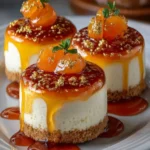
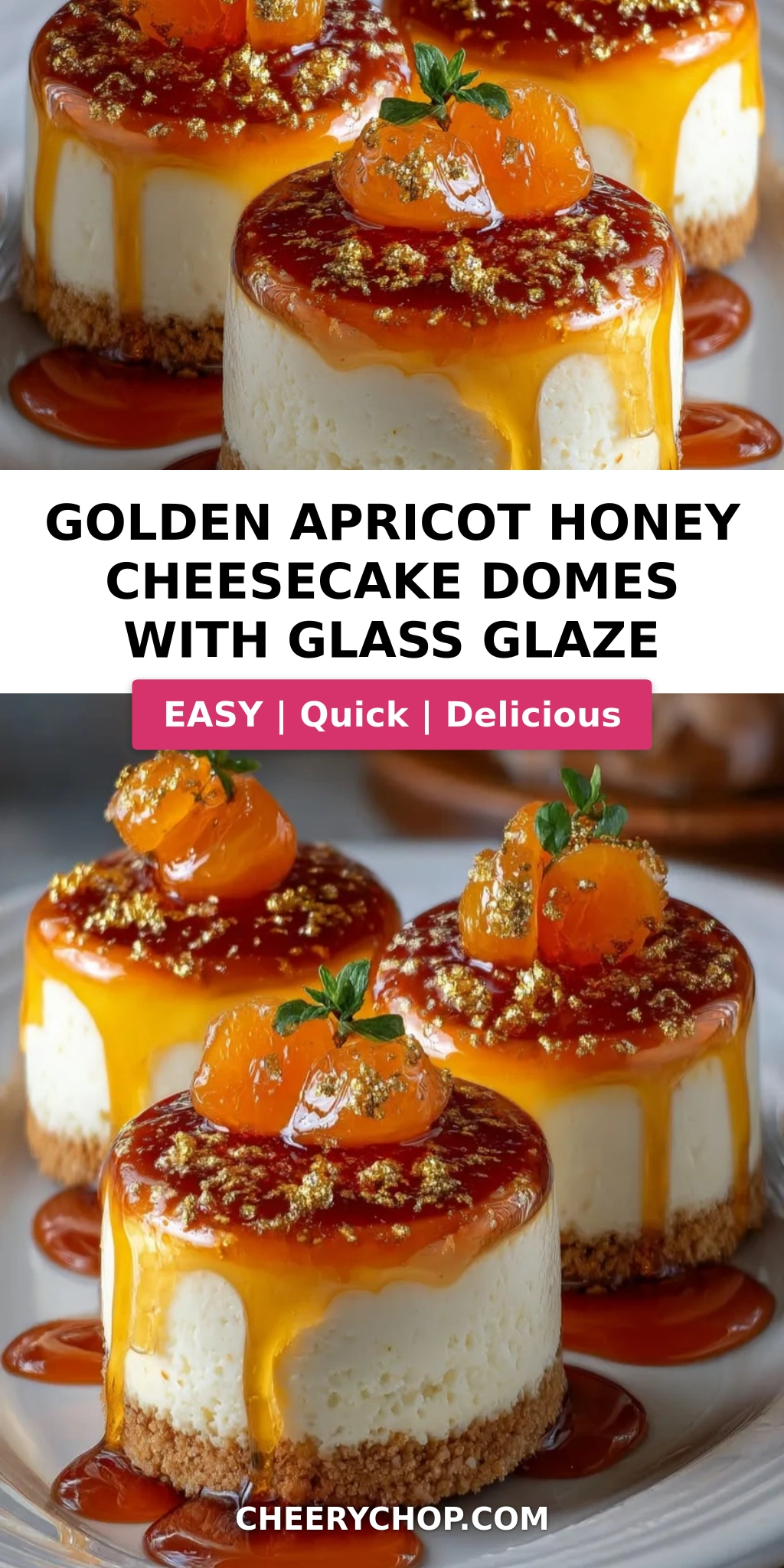
A stunning individual dessert featuring layers of apricot honey cheesecake mousse, a sweet apricot center, and a shiny golden glass glaze, served on a graham cracker base.
- Yield: 8 1x
Ingredients
- For the Apricot Honey Cheesecake Mousse:
- 8 oz cream cheese, softened
- 1/2 cup powdered sugar
- 1 cup heavy cream
- 3/4 cup apricot puree
- 2 tbsp honey
- 1 tsp vanilla extract
- 1 tbsp gelatin powder
- 3 tbsp warm water
- For the Apricot Center:
- 1 cup dried apricots, finely chopped
- 2 tbsp honey
- 1 tbsp lemon juice
- 2 tbsp water
- 1 tsp cornstarch
- For the Golden Glass Glaze:
- 1 cup white chocolate, finely chopped
- 1/2 cup sweetened condensed milk
- 1 tbsp gelatin powder
- 3 tbsp warm water
- Gold food coloring, as needed
- For the Cookie Base:
- 1 cup graham cracker crumbs
- 3 tbsp melted butter
- 1 tbsp granulated sugar
- Pinch of salt
- For Garnish (optional):
- Thin apricot slices
- Honey drizzle
- Edible gold flakes
Instructions
- Bloom gelatin in warm water and let stand for 5 minutes.
- In a saucepan, combine chopped apricots, honey, lemon juice, water, and cornstarch.
- Cook over medium heat for 4–5 minutes until thickened. Cool completely.
- Beat cream cheese and powdered sugar until smooth.
- Mix in apricot puree, honey, and vanilla extract.
- Whip heavy cream to soft peaks and fold into the cheesecake mixture.
- Stir in dissolved gelatin until fully incorporated.
- Fill silicone dome molds halfway with the cheesecake mousse.
- Add a spoonful of apricot filling to the center of each mold.
- Cover with remaining mousse and freeze until completely firm.
- Mix white chocolate, condensed milk, dissolved gelatin, and gold coloring until smooth and glossy.
- Unmold the frozen domes and place on a wire rack.
- Pour the golden glass glaze evenly over each dome.
- Combine graham cracker crumbs, melted butter, sugar, and salt, then press into small round bases.
- Place each glazed dome onto a prepared base.
- Garnish with apricot slices, honey drizzle, and edible gold flakes.
- Chill for 15 minutes before serving.
Nutrition
- Calories: 430
- Sugar: 34 g
- Fat: 28 g
- Carbohydrates: 40 g
- Protein: 6 g
Tried This Recipe? Leave a Comment!
Did you make this recipe? I’d love to hear how it turned out! Please leave a comment and a rating below. Your feedback helps other home cooks and supports cheerychop.com!
For more delicious inspiration, follow me on Pinterest!