Table of Contents
Raspberry Rose Crystal Domes with White Chocolate Core – A Crystal Glaze Dessert That Steals the Show
I still remember the first time I made these raspberry rose crystal domes. It was a rainy Saturday in my tiny Paris apartment, and I had just returned from the marché with a basket of the most fragrant raspberries I had ever held. I was a student at Le Cordon Bleu then, and we were learning about mirror glazes and frozen entremets. That evening, I called my mother in Morocco and told her about the dessert I was dreaming up — she laughed and said, “You’re putting rose water in a French dessert?” And I said, “Maman, trust me.” That crossroad — between the floral warmth of my childhood kitchen in Marrakech and the precision of a French pastry kitchen — is exactly where this raspberry rose crystal domes recipe was born. Every time I make these crystal glaze dessert domes, I feel that beautiful blend of two worlds on my tongue. And now, from my NYC kitchen, I am so excited to share this rose and raspberry dessert with you.
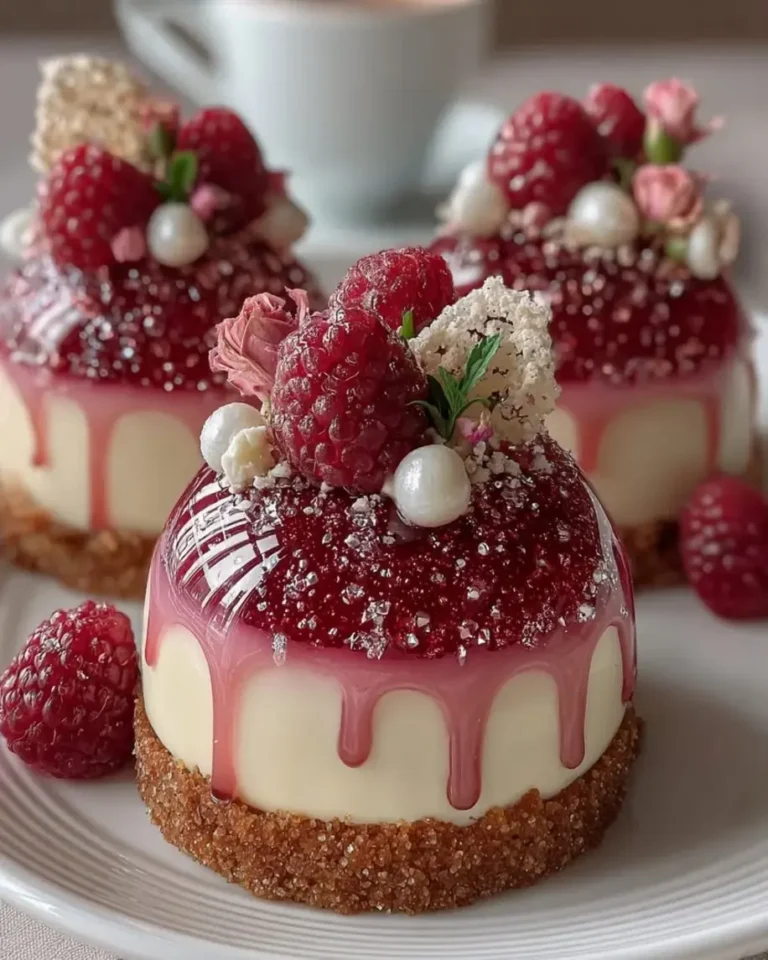
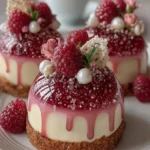
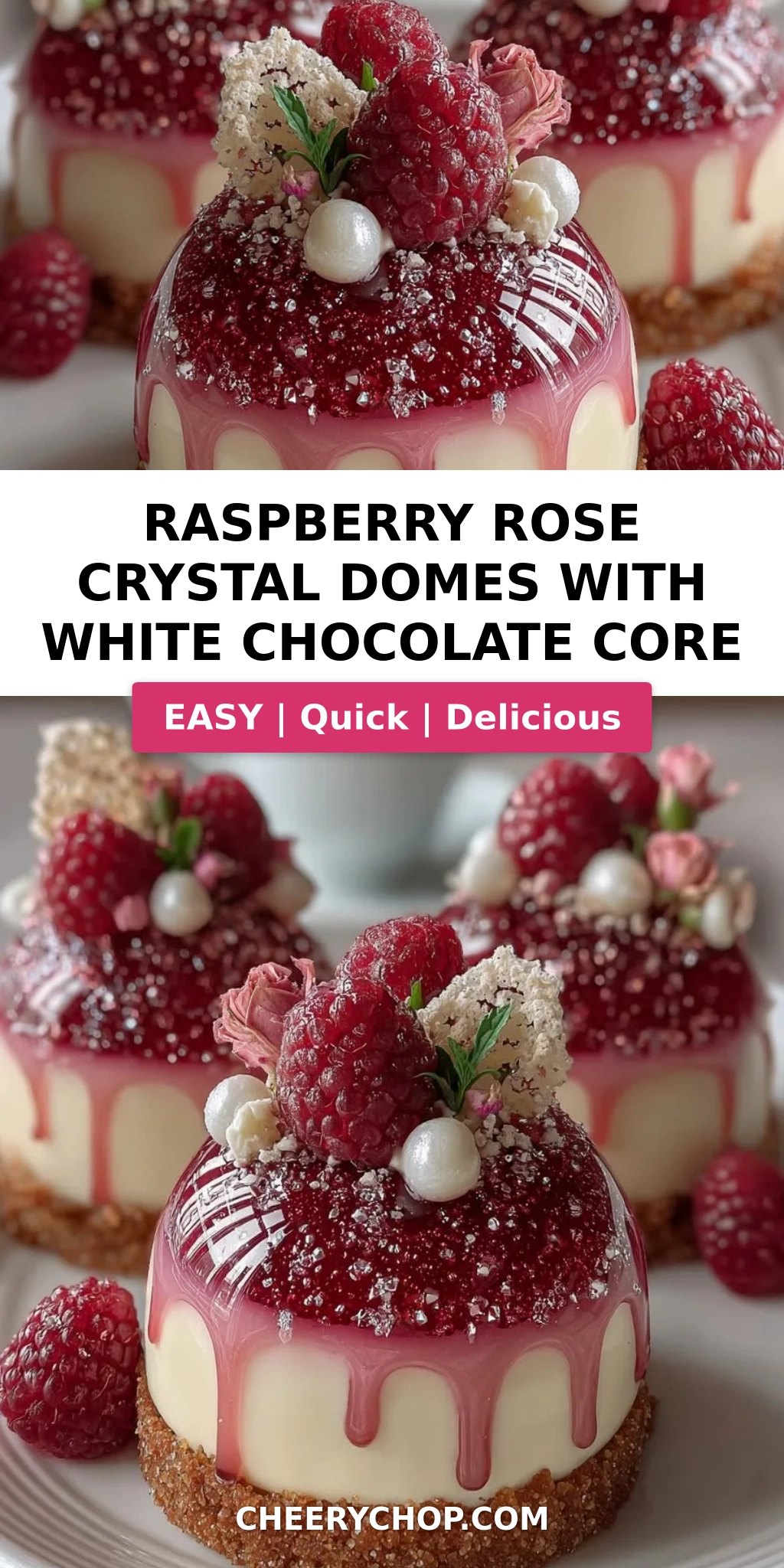
Let me paint a picture for you. The very first thing you notice is that shell — a shiny, jewel-toned crystal glaze that shatters just slightly when you tap it with your spoon. It’s translucent and pink, catching the light like a stained-glass ornament. Beneath that lies an impossibly silky raspberry rose mousse, creamy and light, with tiny seeds of raspberry studded throughout. And then, right in the center, hiding like a treasure, is a core of creamy white chocolate — soft, sweet, and almost molten in texture. The biscuit base on the bottom is buttery and slightly salty, giving just enough crunch to contrast all that silkiness. The rose water doesn’t scream — it whispers, lifting the raspberry into something elegant and surprising. It’s the kind of dessert that makes people stop mid-conversation and just stare at their plate for a second before taking another spoonful.
This isn’t just another raspberry mousse recipe. What makes this version truly special — and what I want you to take away today — is the crystal glaze technique and that hidden white chocolate core that stays perfectly suspended inside the dome. I have tested this recipe dozens of times in my own kitchen to make sure it’s not only dazzling but also doable for a home cook who loves a challenge. Yes, there are a few steps. Yes, there is gelatin involved. But I have broken everything down so that each stage feels manageable, and I’ve included every single pro tip I wish someone had given me during my Paris days. By the end of this post, you’ll know exactly how to make the white chocolate core stay centered, how to achieve that crystal-clear glaze, and how to avoid the most common pitfalls that trip people up with frozen dome desserts. Let’s make something beautiful together.
Why This Raspberry Rose Crystal Domes Recipe Is the Best
The Flavor Secret: Most raspberry mousse desserts rely solely on raspberry, which can taste one-note or overly tart. My Moroccan-French training taught me that florals and berries are soulmates. The rose water in this raspberry rose crystal domes recipe does not overpower — it lifts the raspberry into something almost nostalgic, like a Moroccan tea garden meets a Parisian pâtisserie. I add just enough cream cheese to the mousse to give it a gentle tang that balances the sweetness of the white chocolate core and the sugar in the glaze. Every layer has a purpose, and every flavor has a counterpart.
Perfected Texture: The three textures in this dessert — the crunchy biscuit base, the airy mousse, and the glossy, firm crystal glaze — are designed to play off each other. The key technique I want you to trust is the gelatin management. I bloom gelatin in cold water for exactly 5 minutes, then dissolve it into a warm (not hot) liquid. This ensures the mousse sets firmly enough to hold the white chocolate core in place, while still remaining silky on the palate. The crystal glaze is poured at exactly 90°F — any hotter and it will melt the mousse; any cooler and it will be too thick to coat evenly. I learned this the hard way in a Paris kitchen, and now I’m passing that exact temperature wisdom to you.
Foolproof & Fast (for an advanced dessert): I know this recipe has multiple components, but I have designed it so that each component can be made in sequence without rushing. The white chocolate core freezes in about 30 minutes. The mousse comes together in one bowl. The glaze takes 10 minutes on the stove. The most time-consuming part is the freezing — but that’s passive time. If you read through the steps once, prep your ingredients, and trust the process, I promise you will end up with a dessert that looks like it came from a high-end NYC pastry shop. I’ve even included a complete step-by-step table below so you can track your progress like a chef.
Raspberry Rose Crystal Domes Recipe Ingredients
Whenever I make these crystal glaze dessert domes, I start by visiting my favorite fruit stand at the Union Square Greenmarket in NYC. There’s a farmer named Rosa who brings the most incredible raspberries in early summer — they are tiny, intensely flavored, and practically glow. For the rose water, I source mine from a little Middle Eastern grocery on Atlantic Avenue in Brooklyn. It makes all the difference. In Morocco, my mother used to make her own rose water by steeping rose petals in spring water under the sun — and while I don’t expect you to do that, I do ask you to use a high-quality culinary rose water. It will transform your rose and raspberry dessert from good to unforgettable.
Ingredients List
- For the Raspberry Rose Mousse: 1 cup raspberry puree, 8 oz cream cheese (softened), 1 cup heavy cream, 1/2 cup granulated sugar, 1 tsp rosewater, 1 tsp vanilla extract, 2 tsp powdered gelatin, 3 tbsp cold water
- For the White Chocolate Core: 4 oz white chocolate (melted), 1/4 cup heavy cream, 1 tbsp powdered sugar
- For the Biscuit Base: 1 cup digestive biscuits (finely crushed), 3 tbsp melted butter
- For the Crystal Glaze: 1 cup granulated sugar, 1/2 cup water, 1/2 cup sweetened condensed milk, 1 cup white chocolate (finely chopped), 1 tbsp powdered gelatin, 3 tbsp cold water, 1 tsp clear vanilla extract, 1 tsp edible pearl luster dust, 1 drop pink food coloring (gel preferred)
- For Garnish (optional): Fresh raspberries, dried rose petals, edible silver flakes
Ingredient Spotlight
Raspberry Puree: This is the backbone of your mousse. I highly recommend using high-quality frozen raspberries and making your own puree — simply thaw, blend, and strain out the seeds. The store-bought puree often has added sugar and a duller color. If using fresh, look for deep red, fragrant berries. Substitution: You can use freeze-dried raspberry powder (1/4 cup) blended with 3/4 cup water for a more intense, tart flavor — but note that the color will be slightly less vibrant.
Rose Water: Please do not use rose extract or rose syrup — they are too sweet and artificial. Culinary rose water is subtle, floral, and clean. I buy mine from a Middle Eastern grocer or online. One teaspoon is enough here; it should whisper, not shout. Substitution: Orange blossom water is a beautiful alternative — use 1/2 teaspoon, as it is stronger. You can also omit the floral element entirely and add 1 extra teaspoon of vanilla extract for a simpler but still delicious white chocolate raspberry mousse dome.
White Chocolate (for the core and glaze): This is not the time for bargain white chocolate. Use a good couverture or a high-quality bar (like Valrhona or Callebaut). White chocolate chips often contain stabilizers that prevent smooth melting. The white chocolate core needs to be creamy and soft when frozen, so the quality matters. Substitution: For a dairy-free version, use a high-quality dairy-free white chocolate. The texture will be slightly softer, so freeze the cores for an additional 15 minutes.
| Original Ingredient | Best Substitution | Flavor / Texture Impact |
|---|---|---|
| Raspberry Puree | Freeze-dried raspberry powder + water | More intense tartness, slightly less vibrant color |
| Rose Water | Orange blossom water (use 1/2 tsp) | More citrus-forward floral, still elegant |
| White Chocolate | Dairy-free white chocolate | Slightly softer core, freeze 15 min longer |
| Digestive Biscuits | Graham crackers or shortbread cookies | Slightly sweeter base, still crunchy |
How to Make Raspberry Rose Crystal Domes — Step-by-Step
Trust me when I say that this white chocolate raspberry mousse domes recipe is one of the most rewarding desserts you will ever make. I have broken it down into clear phases — base, core, mousse, and glaze — so you can move through it like a chef in a professional kitchen. Take a deep breath, read each step once, and then dive in. You’ve got this.
Step 1: Prepare the Biscuit Base
In a small bowl, combine 1 cup of finely crushed digestive biscuits with 3 tablespoons of melted butter. Stir until every crumb is coated — the mixture should look like wet sand. Press a thin, even layer of this mixture into the bottom of each dome mold. Use the back of a small spoon or a flat-bottomed glass to compact it firmly. Chill the molds in the refrigerator for 15 minutes while you prepare the next component.
💡 Sara’s Pro Tip: Press the biscuit base very firmly — if it’s too loose, it will crumble when you unmold the domes. I use the bottom of a spice jar to get an even, tight layer.
Step 2: Make the White Chocolate Core
Melt 4 oz of white chocolate in a heatproof bowl over simmering water (or in the microwave in 20-second bursts). Once smooth, stir in 1/4 cup heavy cream and 1 tablespoon powdered sugar until completely combined. The mixture will be thick and glossy. Spoon it into small silicone inserts — the kind used for making half-sphere candies, or simply use a mini ice cube tray. Each core should be about 1 teaspoon in size. Freeze for at least 30 minutes, or until rock solid.
⚠️ Common Mistake to Avoid: Do not skip freezing the cores until they are completely firm. If they are even slightly soft, they will sink to the bottom of the mousse instead of staying centered.
Step 3: Bloom Gelatin for the Mousse
In a small bowl, sprinkle 2 teaspoons of powdered gelatin over 3 tablespoons of cold water. Do not stir — let it sit undisturbed for 5 minutes. This process, called blooming, hydrates the gelatin so it dissolves evenly later. While the gelatin blooms, move on to the next step.
💡 Sara’s Pro Tip: Always use cold water for blooming gelatin. Warm water will partially dissolve the granules and create lumps. Think of it like rehydrating dried fruit — patience is key.
Step 4: Make the Raspberry Rose Mousse Base
In a large mixing bowl, beat 8 oz of softened cream cheese until smooth and fluffy. Add 1 cup raspberry puree, 1/2 cup granulated sugar, 1 teaspoon rosewater, and 1 teaspoon vanilla extract. Beat again until everything is fully incorporated and the mixture is a uniform pink color. In a small saucepan, warm about 3 tablespoons of the heavy cream (take it from the 1 cup total) over low heat — just until it’s warm to the touch, not hot. Remove from heat, add the bloomed gelatin, and stir until completely dissolved. Pour this gelatin mixture into the raspberry-cream cheese base and mix well.
⚠️ Common Mistake to Avoid: If the cream is too hot, it will seize the cream cheese and create a grainy texture. Warm it only until you feel gentle warmth with your fingertip — about 90°F.
Step 5: Whip and Fold the Cream
In a separate bowl, whip the remaining heavy cream (about 3/4 cup) to soft peaks. This means the cream should hold a gentle shape when you lift the whisk, but the peak should flop over slightly. Do not overwhip — if it turns into butter, the mousse will be dense. Gently fold the whipped cream into the raspberry mixture in three additions, using a spatula. Fold just until no white streaks remain. Over-folding will deflate the mousse.
💡 Sara’s Pro Tip: Use a large, soft silicone spatula and cut through the center of the mixture, then sweep around the edge of the bowl. Turn the bowl as you go. This technique keeps the air in the cream, giving you a lighter mousse.
Step 6: Assemble the Domes
Remove the chilled molds from the refrigerator. Spoon or pipe the mousse into each mold until it is about halfway full. Take a frozen white chocolate core and gently press it into the center of the mousse — it should sit suspended, not touching the sides or the bottom. Spoon or pipe the remaining mousse over the core, filling the mold to the top. Use an offset spatula or the back of a knife to smooth the top (the flat part that will become the bottom of the dome).
⚠️ Common Mistake to Avoid: If the mousse is too runny at this stage, the core will float or sink. Your mousse should be thick and creamy — if it’s too thin, refrigerate it for 10 minutes before assembling.
Step 7: Freeze the Domes
Place the filled molds onto a baking sheet and transfer them to the freezer. Freeze for at least 6 hours — overnight is even better. The domes must be completely frozen solid before you unmold and glaze them. This is the most important step for achieving a clean, beautiful finish.
💡 Sara’s Pro Tip: Cover the baking sheet loosely with plastic wrap after 2 hours to prevent freezer odors from affecting the mousse. Also, if your freezer has an auto-defrost cycle, place the domes in the coldest part (usually the back).
Step 8: Bloom Gelatin for the Glaze
About 30 minutes before you are ready to glaze, bloom 1 tablespoon of powdered gelatin in 3 tablespoons of cold water. Let it sit for 5 minutes until spongy. Set it aside while you prepare the glaze base.
⚠️ Common Mistake to Avoid: Forgetting to bloom the gelatin before starting the glaze. Once the sugar mixture is hot, you need to add the gelatin immediately — you won’t have time to wait 5 minutes. Do this step first.
Step 9: Make the Crystal Glaze
In a medium saucepan, combine 1 cup granulated sugar, 1/2 cup water, and 1/2 cup sweetened condensed milk. Heat over medium heat, stirring gently, until the mixture is steaming and the sugar has completely dissolved (about 3–4 minutes). Do not let it boil vigorously. Remove from heat and add the bloomed gelatin, stirring until dissolved. Then add 1 cup of finely chopped white chocolate and stir until smooth and fully melted. Add 1 teaspoon clear vanilla extract, 1 teaspoon edible pearl luster dust, and 1 drop of pink food coloring (gel is best). Use an immersion blender or a regular whisk to blend the glaze until it is completely smooth, glossy, and uniform in color.
💡 Sara’s Pro Tip: The immersion blender is your best friend here. It removes any tiny air bubbles and gives you a mirror-like finish. Blend the glaze for about 30 seconds, tilting the blender to incorporate air from the surface.
Step 10: Cool the Glaze
Let the glaze cool to about 90°F (32°C). This is crucial — if the glaze is too hot, it will melt the frozen mousse. If it’s too cool, it will thicken and won’t coat evenly. Use an instant-read thermometer to check the temperature. If you don’t have one, test by dipping a clean finger into the glaze — it should feel warm but not hot, like a comfortable bath.
⚠️ Common Mistake to Avoid: Do not guess the temperature. A difference of 10°F can make or break the glaze. A glaze that is too hot will slide off the dome, taking the mousse with it. A glaze that is too cold will clump and look patchy.
Step 11: Unmold and Glaze
Remove the frozen domes from the freezer. If they are in silicone molds, gently flex the mold to release each dome. If they are in metal molds, briefly dip the bottom in warm water (3–5 seconds) to loosen. Place each dome on a wire rack set over a baking sheet (to catch drips). Working one dome at a time, pour the crystal glaze evenly over the top, letting it cascade down the sides. Allow any excess to drip off. Use a small offset spatula to gently smooth the bottom edge if needed.
💡 Sara’s Pro Tip: For the most even coverage, pour the glaze in a steady stream starting from the top center and moving outward in a spiral. Do not pour too slowly or the glaze will set in lines.
Step 12: Chill and Garnish
Transfer the glazed domes to a clean baking sheet and refrigerate for at least 30 minutes. This allows the glaze to set into a firm, shiny shell. Before serving, garnish each dome with a fresh raspberry, a sprinkle of dried rose petals, and a few edible silver flakes. Serve chilled.
⚠️ Common Mistake to Avoid: Do not skip the 30-minute chill in the refrigerator. The glaze needs time to fully set before you plate or transport the domes. If you serve them too soon, the glaze will be soft and tacky.
| Step | Action | Duration | Key Visual Cue |
|---|---|---|---|
| 1 | Prepare biscuit base | 15 min chill | Firm, compacted crumb layer |
| 2 | Make white chocolate core | 30 min freeze | Rock solid, easily pops from mold |
| 3 | Bloom gelatin for mousse | 5 min | Spongy, hydrated gelatin block |
| 4 | Make mousse base | 10 min | Smooth, pink, well-combined |
| 5 | Whip and fold cream | 5 min | Soft peaks, no white streaks |
| 6 | Assemble domes | 10 min | Core centered, mousse smooth on top |
| 7 | Freeze domes | 6+ hours | Completely solid to the touch |
| 8 | Bloom gelatin for glaze | 5 min | Spongy gelatin block |
| 9 | Make crystal glaze | 10 min | Glossy, smooth, pink, no lumps |
| 10 | Cool glaze | 15–20 min | 90°F on thermometer |
| 11 | Unmold and glaze | 10 min | Even, shiny coating, no bald spots |
| 12 | Chill and garnish | 30 min | Firm, glossy shell; garnishes set |
Serving & Presentation
These raspberry rose crystal domes are a showstopper, and they deserve a beautiful presentation. I like to serve each dome on a small, minimalist white plate — the contrast between the glossy pink shell and the white ceramic is stunning. Place a dollop of lightly sweetened crème fraîche or a quenelle of vanilla ice cream on the side for extra richness. Garnish with a fresh raspberry, a few dried rose petals, and a sprinkle of edible silver flakes. In the summer, I sometimes add a tiny sprig of mint for a pop of green.
When I make these for dinner parties here in NYC, I always plate them just before my guests sit down. The glaze has a mesmerizing shine that catches the candlelight, and everyone always gasps a little when they see it. If you’re serving these for a special occasion — Valentine’s Day, an anniversary, a birthday — I highly recommend pairing them with a glass of chilled rosé or a floral cocktail. The rose and raspberry notes will sing together.
| Pairing Type | Suggestions | Why It Works |
|---|---|---|
| Side Dish | Lightly sweetened crème fraîche, vanilla ice cream, fresh berries | Adds creamy tang or cool sweetness to balance the glaze |
| Sauce / Dip | Raspberry coulis, white chocolate sauce, honey drizzle | Reinforces the raspberry and white chocolate layers |
| Beverage | Chilled rosé, floral cocktail (rose or elderflower), mint tea | Floral and fruity notes complement without overpowering |
| Garnish | Fresh raspberries, dried rose petals, edible silver flakes, mint sprig | Adds color, texture, and an elegant finishing touch |
Make-Ahead, Storage & Reheating
One of the best things about this raspberry rose crystal domes recipe is how well it works for make-ahead entertaining. I frequently prepare the domes up to the point of glazing, freeze them, and then glaze them the day I plan to serve them. For my busy NYC lifestyle, this is a lifesaver. Here is everything you need to know about storing these crystal glaze dessert domes and keeping that beautiful shine intact.
| Method | Container | Duration | Reheating Tip |
|---|---|---|---|
| Refrigerator | Airtight container, single layer | Up to 2 days (glazed) | Serve directly from fridge — do not reheat |
| Freezer | Airtight container, wrap each dome in plastic | Up to 2 months (unglazed) | Thaw in fridge 2 hours, then glaze |
| Make-Ahead | Freeze unglazed domes, glaze day of serving | Up to 1 week (unglazed in freezer) | Glaze directly from frozen — do not thaw before glazing |
If you are storing glazed domes in the refrigerator, place them in a single layer inside an airtight container and handle them gently — the glaze is firm but can crack if bumped. Do not stack them. To keep the shine, avoid covering them with plastic wrap directly on the surface; instead, use a lid or a sheet of parchment paper resting loosely on top. If you notice the glaze looking a little dull after refrigeration, you can gently warm a small amount of fresh glaze and brush a thin layer over the top — this restores the mirror shine beautifully. From my experience, the domes taste best when served within 24 hours of glazing, but they will still be delicious for up to two days.
Variations & Easy Swaps
One of the things I love most about this white chocolate raspberry mousse domes recipe is how adaptable it is. Over the years, I have experimented with different fruits, florals, and flavor combinations — and each time, the crystal glaze technique remains the star. Here are three of my favorite variations, each tested and perfected in my NYC kitchen.
| Variation | Key Change | Best For | Difficulty Impact |
|---|---|---|---|
| Mango Passionfruit | Replace raspberry puree with mango puree + passionfruit pulp, omit rose water | Summer entertaining, tropical theme | Same difficulty |
| Chocolate Hazelnut | Use chocolate hazelnut spread as the core instead of white chocolate, omit rose water | Rich, decadent dessert for chocolate lovers | Same difficulty |
| Berry Lavender | Replace rose water with 1/2 tsp culinary lavender extract, use mixed berry puree | Floral, calming flavor — beautiful for spring | Same difficulty |
Variation 1: Mango Passionfruit Crystal Domes
For a tropical twist that reminds me of the fruit markets in Marrakech (yes, they have incredible mangoes there too!), replace the raspberry puree with 1 cup of mango puree and add 2 tablespoons of passionfruit pulp (seeds and all). Omit the rose water and use 1 teaspoon of vanilla extract instead. The white chocolate core balances the tartness of the passionfruit beautifully, and the crystal glaze can be tinted a sunny yellow-orange with a drop of yellow and a tiny bit of red food coloring. The passionfruit seeds add a delightful crunch that contrasts with the smooth mousse. This variation is perfect for summer pool parties or tropical-themed dinner parties.
Variation 2: Dairy-Free Coconut Raspberry Domes
To make this recipe entirely dairy-free, use a high-quality dairy-free cream cheese (I love the one from Kite Hill) and full-fat coconut cream in place of heavy cream. For the white chocolate core, use a dairy-free white chocolate bar — it will be slightly softer, so freeze the cores for an additional 15 minutes. The biscuit base can be made with dairy-free butter or coconut oil. The coconut flavor pairs wonderfully with raspberry and rose, adding a subtle tropical layer. The crystal glaze works beautifully with dairy-free white chocolate — just make sure it’s finely chopped for smooth melting. This variation is so good that even my dairy-loving friends ask for it.
Variation 3: Strawberry Basil Crystal Domes
When I find gorgeous strawberries at the Union Square market in late spring, I love making a strawberry basil version. Replace the raspberry puree with 1 cup of strawberry puree (strained). Add 2 tablespoons of finely chopped fresh basil to the mousse base along with the sugar, and omit the rose water. The basil adds a fresh, peppery note that cuts through the sweetness of the white chocolate core and the glaze. Garnish with a small basil leaf and a slice of fresh strawberry. This variation tastes like a garden in summer — it’s unexpected, elegant, and absolutely delicious.
How do you make the white chocolate core stay centered inside the raspberry rose crystal dome?
This is one of the most common questions I get, and the answer comes down to three things: the temperature of the core, the consistency of the mousse, and the assembly technique. First, the white chocolate core must be frozen completely solid — at least 30 minutes in the freezer, preferably longer. If it’s even slightly soft, it will sink or float. Second, your mousse should be thick and creamy before you assemble — not runny. If your mousse is too thin, refrigerate it for 10 to 15 minutes to let it firm up slightly. Third, when you place the frozen core into the mousse, gently press it down just until it is suspended in the center, not touching the bottom or the sides. Then immediately cover it with more mousse. The combination of a solid frozen core and a thick mousse will hold everything in place beautifully.
What can I use instead of rose water or raspberry puree in this recipe?
If you don’t have rose water or prefer not to use it, you have several excellent options. For the floral element, orange blossom water is the best substitute — use just 1/2 teaspoon, as it is more potent than rose water. Alternatively, you can use 1 teaspoon of vanilla extract or 1/2 teaspoon of almond extract for a completely different but still lovely flavor profile. For the raspberry puree, you can use strawberry puree, mango puree, or even a high-quality seedless blackberry puree. If using frozen fruit, thaw it first, blend it, and strain out the seeds. The texture of the mousse will remain the same as long as the puree is thick and not overly watery. I have tested all of these substitutions, and each one yields a delicious result — just adjust the sugar slightly depending on the sweetness of your fruit.
How long do raspberry rose crystal domes need to set in the freezer before unmolding?
These domes need to freeze for at least 6 hours before you unmold them. Overnight is even better — I often freeze them for 12 to 24 hours. The reason is that the mousse needs to be completely solid all the way through. If you unmold them too early, the center will still be soft, and the dome will lose its shape or collapse when you glaze it. To test if they are ready, gently press the top of the dome (through the mold) — it should feel rock hard with no give. If they are solid, they are ready to unmold and glaze. I always advise making these a day ahead and freezing them overnight. That way, you can glaze them the next day with full confidence that they will hold their shape perfectly.
Can I make these domes ahead of time, and how should I store them to keep the shine?
Absolutely — these raspberry rose crystal domes are actually ideal for make-ahead entertaining. The best approach is to freeze the unglazed domes for up to 1 week, then glaze them on the day you plan to serve. Once glazed, store them in an airtight container in the refrigerator for up to 2 days. To keep that beautiful glossy shine, do not cover them directly with plastic wrap — use a lid or a sheet of parchment paper resting loosely on top. If the glaze looks a little dull after refrigeration, you can gently warm a small amount of fresh glaze and brush a thin layer over the top to restore the mirror finish. Alternatively, you can freeze the fully glazed domes for up to 1 month — just wrap each dome individually in plastic wrap and place them in an airtight container. Thaw in the refrigerator for 2 hours before serving.
What is crystal glaze, and why does it make the domes so shiny?
Crystal glaze is a type of mirror glaze that uses gelatin, sugar, condensed milk, and white chocolate to create a glossy, translucent coating that hardens into a smooth, shiny shell. The science behind it is simple: the gelatin provides structure and elasticity, the sugar and condensed milk add sweetness and body, and the white chocolate gives the glaze a creamy opacity and a beautiful sheen. The key to achieving that mirror-like finish is blending the glaze with an immersion blender to remove all air bubbles, then pouring it at exactly 90°F over a frozen surface. The cold dome causes the glaze to set instantly in a smooth, even layer, trapping the shine. Unlike regular buttercream or ganache, crystal glaze has a gel-like consistency that hardens without becoming brittle, giving it that signature glass-like appearance.
Can I use fresh raspberries instead of raspberry puree for the mousse?
Yes, but I recommend making a puree from fresh raspberries rather than adding whole berries directly to the mousse. Fresh raspberries contain a lot of water and seeds, which can make the mousse watery and affect its texture. To make raspberry puree, simply blend fresh raspberries in a food processor or blender until smooth, then press the mixture through a fine-mesh sieve to remove the seeds. You will need about 1 1/2 cups of fresh raspberries to yield 1 cup of puree. If you want to add whole raspberries to the mousse for texture, fold in a few at the very end, just before filling the molds. I sometimes do this for extra bursts of fruit, but I always reduce the puree slightly to compensate for the added moisture.
Why did my crystal glaze crack or look dull after refrigeration?
A cracked or dull glaze is usually caused by one of three issues: the glaze was too cold when poured, the domes were not frozen solid enough, or the glaze was applied too thickly. If the glaze is below 85°F when poured, it will be too thick and won’t flow evenly, leading to a patchy, dull finish. Always use a thermometer and aim for exactly 90°F. If the domes are not completely frozen, the glaze will warm the outer layer of the mousse, causing it to melt slightly and create an uneven surface that cracks as it sets. Make sure your domes have been frozen for at least 6 hours. Finally, apply the glaze in one smooth, even pour — if you apply too much, the weight can cause cracking. A thin, even layer is all you need for a perfect mirror finish.
Can I use gelatin sheets instead of powdered gelatin for this recipe?
Yes, absolutely — I actually prefer gelatin sheets for their consistent setting power and clarity. To substitute, use the same weight of gelatin sheets as the powdered gelatin called for. One teaspoon of powdered gelatin is approximately equal to one sheet of gold-strength gelatin (about 2 grams). So for the mousse (2 teaspoons), you would need 2 gold sheets. For the glaze (1 tablespoon, or 3 teaspoons), you would need 3 gold sheets. To use sheets, soak them in a bowl of cold water for 5 to 7 minutes until softened, then gently squeeze out the excess water before dissolving them into your warm liquid. The result is a cleaner, more translucent gel with no risk of lumps. This is actually the method we used in Paris, and I still use it at home whenever I can find good-quality sheet gelatin.
What type of dome mold should I use for this dessert?
I recommend using silicone dome molds — they make unmolding so much easier and give you a perfectly smooth surface for the glaze. Look for half-sphere molds that are about 2.5 to 3 inches in diameter, which will yield a generous individual serving. Silicone is flexible, so you can gently push the domes out without damaging the mousse. If you only have metal dome molds, you can still use them — just line each cavity with a strip of plastic wrap for easy removal, or briefly dip the bottom in warm water for 3 to 5 seconds before unmolding. I have also made these in small silicone muffin cups and even in paper cups (the kind used for chocolate bombs). The shape will be slightly different, but the taste and texture will be just as wonderful. Just make sure whatever mold you use has a smooth interior surface so the glaze looks flawless.
Is it possible to make this recipe without gelatin for a vegetarian version?
Yes, you can make a vegetarian version using agar-agar, a plant-based gelling agent derived from seaweed. However, the texture and handling will be different. For the mousse, use 1 1/2 teaspoons of agar-agar powder in place of the 2 teaspoons of powdered gelatin. Dissolve the agar-agar in the warm cream and bring it to a gentle boil for 1 to 2 minutes to activate it fully — agar-agar requires boiling to set, unlike gelatin. For the crystal glaze, use 2 teaspoons of agar-agar powder instead of 1 tablespoon of gelatin, and boil the glaze mixture for 2 minutes. The glaze will set more firmly and at a higher temperature, so work quickly when pouring it. The final texture will be slightly less silky than the gelatin version — more like a firm jelly — but it will still be delicious and beautifully shiny. I have made this version for vegetarian friends, and it was a hit.
Share Your Version!
I absolutely love seeing how you put your own spin on my recipes. If you make these raspberry rose crystal domes with white chocolate core, please leave a star rating and a comment below — let me know how they turned out and if you tried any of the variations. Did you use a different fruit? Did you add a special garnish? I want to hear it all. And if you share a photo on Instagram or Pinterest, don’t forget to tag me @cheerychop — I always save and share my favorites in my stories.
Here is a question for you: what is the most ambitious dessert you have ever made at home? For me, these crystal glaze dessert domes were that milestone — the one that made me feel like a real pastry chef. I hope making them gives you that same incredible feeling of accomplishment. From my NYC kitchen to yours — I hope this recipe brings as much warmth to your table as it does to mine. — Sara 🧡
Love This Recipe? Save It to Pinterest!
If you enjoyed this Raspberry Rose Crystal Domes with White Chocolate Core recipe, don’t let it get lost in your browser tabs! 😄 Pin it now so you can find it again anytime — and explore hundreds more tried-and-tested recipes waiting for you on my Pinterest boards.
👉 Follow Sara on Pinterest @chefrecipes2
📌 Pin this recipe · 🔁 Re-pin your favorites · 💬 Tag me when you make it — I love seeing your creations!
💬 I would love to hear from you! Have you made these crystal glaze dessert domes? Drop a comment below, rate the recipe, and tag me in your photos on Instagram @cheerychop. Your feedback means the world to me, and it helps other readers trust this recipe too. Happy cooking! — Sara 🧡
Raspberry Rose Crystal Domes with White Chocolate Core
- Yield: 8 1x
Ingredients
- For the Raspberry Rose Mousse:
- 1 cup raspberry puree
- 8 oz cream cheese, softened
- 1 cup heavy cream
- 1/2 cup granulated sugar
- 1 tsp rosewater
- 1 tsp vanilla extract
- 2 tsp powdered gelatin
- 3 tbsp cold water
- For the White Chocolate Core:
- 4 oz white chocolate, melted
- 1/4 cup heavy cream
- 1 tbsp powdered sugar
- For the Biscuit Base:
- 1 cup digestive biscuits, finely crushed
- 3 tbsp melted butter
- For the Crystal Glaze:
- 1 cup granulated sugar
- 1/2 cup water
- 1/2 cup sweetened condensed milk
- 1 cup white chocolate, finely chopped
- 1 tbsp powdered gelatin
- 3 tbsp cold water
- 1 tsp clear vanilla extract
- 1 tsp edible pearl luster dust
- 1 drop pink food coloring
- For Garnish (optional):
- Fresh raspberries
- Dried rose petals
- Edible silver flakes
Instructions
- 1. Mix crushed biscuits with melted butter and press into dome molds as a thin base layer. Chill for 15 minutes.
- 2. Stir melted white chocolate, heavy cream, and powdered sugar until smooth.
- 3. Spoon into small silicone inserts and freeze until firm.
- 4. Bloom gelatin for the mousse in cold water for 5 minutes.
- 5. Beat cream cheese, raspberry puree, sugar, rosewater, and vanilla extract until smooth.
- 6. Warm a small portion of the cream and dissolve gelatin, then mix into the raspberry mixture.
- 7. Whip the remaining cream to soft peaks and fold into the mixture.
- 8. Fill dome molds halfway with mousse.
- 9. Place a frozen white chocolate core into the center of each mold.
- 10. Cover with remaining mousse and smooth the tops.
- 11. Freeze for at least 6 hours or until completely firm.
- 12. Bloom gelatin for the glaze in cold water.
- 13. Heat sugar, water, and condensed milk until steaming.
- 14. Remove from heat and stir in gelatin and white chocolate until smooth.
- 15. Add vanilla extract, pearl luster dust, and pink food coloring.
- 16. Blend until glossy and smooth.
- 17. Cool glaze to about 90°F (32°C).
- 18. Unmold frozen domes and place on a wire rack.
- 19. Pour the crystal glaze evenly over each dome until fully coated.
- 20. Refrigerate for 30 minutes before serving.
- 21. Garnish with fresh raspberries, dried rose petals, and edible silver flakes.
Nutrition
- Calories: 355
- Sugar: 35g
- Fat: 20g
- Carbohydrates: 40g
- Protein: 4g
Tried This Recipe? Leave a Comment!
Did you make this recipe? I’d love to hear how it turned out! Please leave a comment and a rating below. Your feedback helps other home cooks and supports cheerychop.com!
For more delicious inspiration, follow me on Pinterest!