Table of Contents
Saffron Mango Coconut Clouds – A Paris-Meets-Marrakech Tropical Dream
I still remember the first time I tasted saffron in a dessert — I was a little girl in my mother’s kitchen in Marrakech, watching her steep those crimson threads in warm milk for a sweet rice pudding. She told me, “Sara, saffron is the gold of our land — a little goes a long way, but when you use it right, it turns ordinary into magic.” Decades later, after training at Le Cordon Bleu in Paris and settling into my NYC kitchen, I created this saffron mango coconut clouds recipe as a tribute to that memory. This mango coconut dessert is what happens when Moroccan warmth meets French pastry precision — a truly show-stopping exotic fruit dessert that tastes as beautiful as it looks.
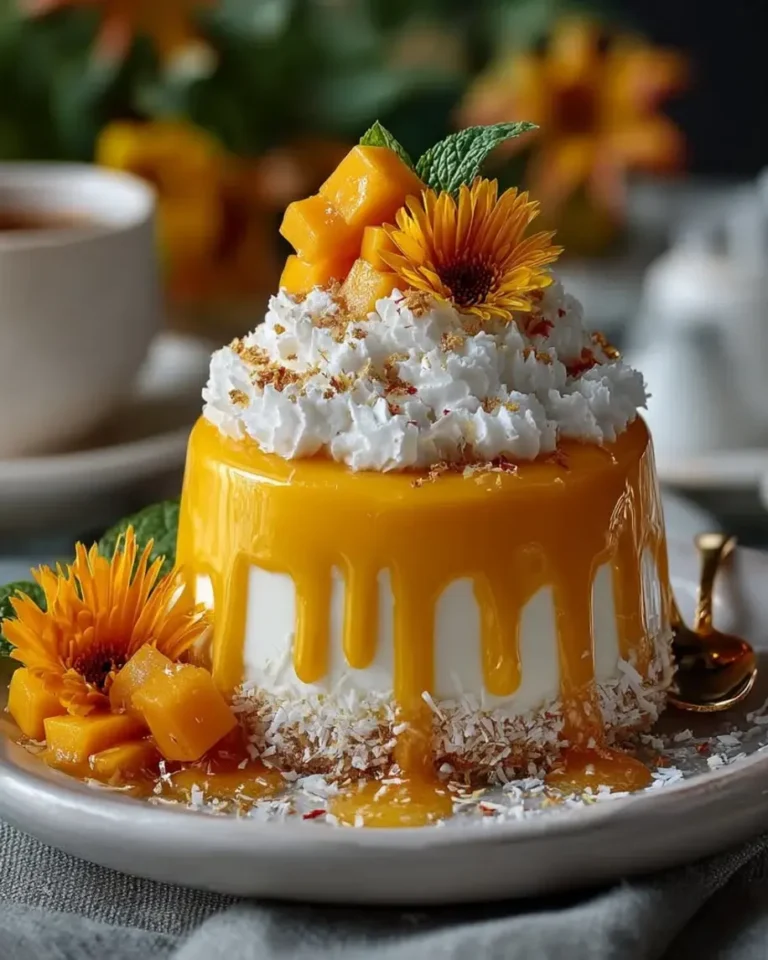
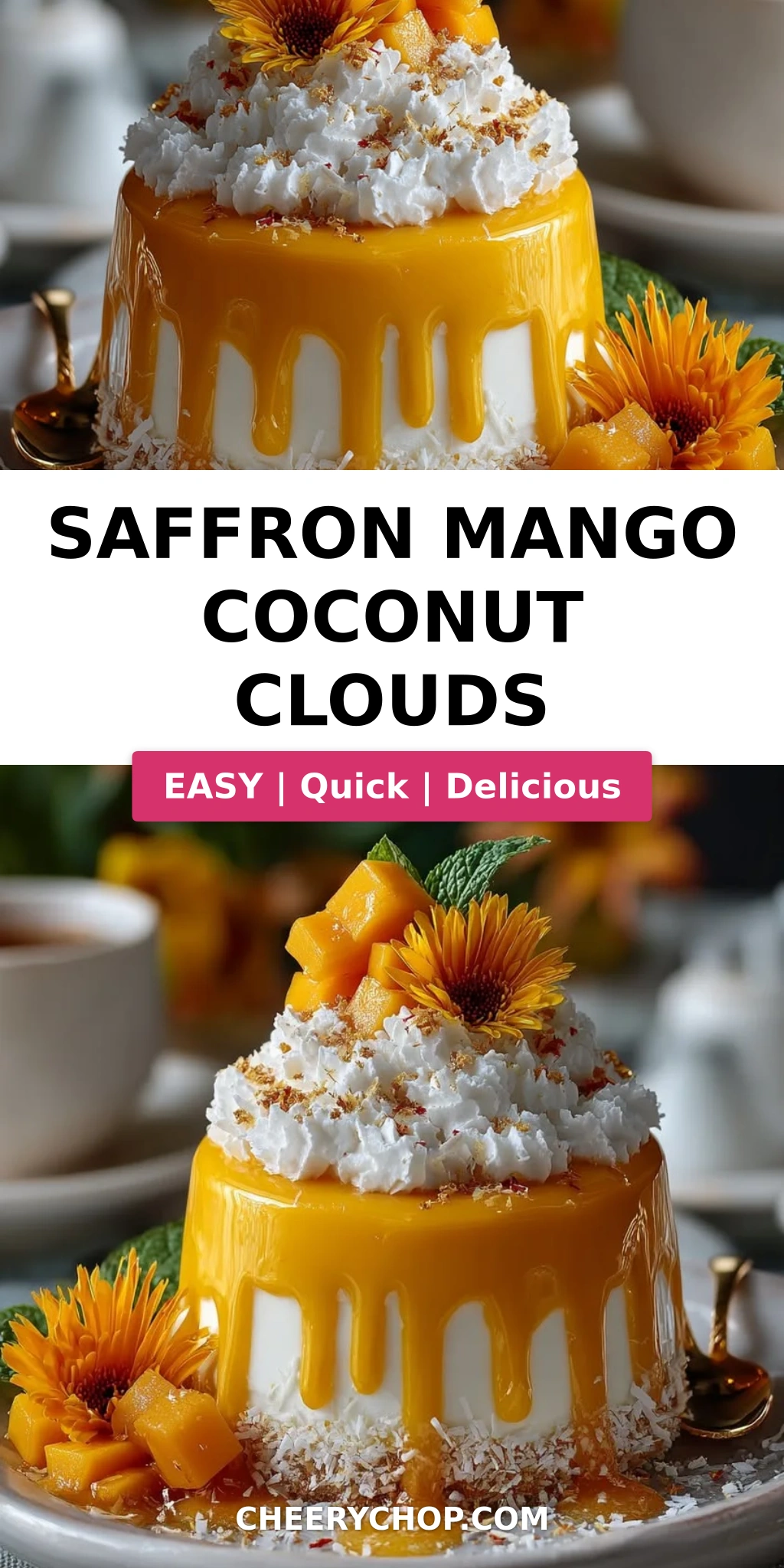
Imagine this: a light-as-air mango mousse, delicately scented with saffron and vanilla, wrapped around a luscious coconut cream center. It all sits on a buttery coconut biscuit base, and then comes the crowning glory — a shimmering golden saffron glaze that cascades over every dome like liquid amber. The first bite is ethereal: the mousse practically dissolves on your tongue, the coconut cream offers a cool, velvety contrast, and the glaze adds a gentle, honeyed sweetness with the faintest floral whisper from the saffron. The texture is what I call “cloud-meets-custard” — airy yet indulgent, light yet completely satisfying. It’s the kind of dessert that makes everyone at the table go quiet for a moment, then erupt in questions.
What I love most about this saffron dessert recipe is how approachable it is once you understand a few key techniques. I’ve tested this for you in my NYC apartment kitchen more times than I can count — from the way you bloom saffron to unlock its full color and aroma, to the gentle folding method that keeps your coconut mousse recipe perfectly aerated. One common mistake home cooks make is rushing the gelatin bloom, which can leave you with a grainy mousse instead of a silky cloud. But don’t worry — I’ll walk you through every step, including a pro tip that guarantees a flawless, glossy glaze every time. Whether you’re hosting a dinner party or treating yourself to something extraordinary, these Saffron Mango Coconut Clouds are your ticket to a dessert that feels both luxurious and doable.
Why This Saffron Mango Coconut Clouds Recipe Is the Best
The Flavor Secret: The magic starts with the saffron — and I don’t just sprinkle it in. I steep the threads in warm water to create a deep, honeyed infusion that permeates every bite of the mango mousse. Growing up in Morocco, I learned that saffron needs patience, not heat, to release its full personality. Paired with Alphonso mango puree (the most fragrant variety, which I hunt down at the Union Square Greenmarket in peak season), the result is a flavor combination that’s both exotic and familiar — floral, fruity, and impossibly elegant. This isn’t just another exotic fruit dessert; it’s a conversation between my Moroccan roots and my Parisian pastry training.
Perfected Texture: The real art of this coconut mousse recipe lies in the fold. In Paris, my chef taught me that a mousse should be “a sigh, not a statement” — light enough to feel indulgent but structured enough to hold its shape. Here, I whip the heavy cream to soft peaks and fold it into the mango-saffron mixture with a gentle hand, creating a cloud-like texture that’s almost ethereal. The coconut cream layer, enriched with mascarpone and honey, provides a dense, velvety counterpoint that makes every spoonful a study in contrasts. And the glaze? It sets to a glossy, mirror-like finish that slicks over the dome in the most satisfying way.
Foolproof & Fast: Even with its elegant layers, this saffron mango coconut clouds recipe is designed for the home cook. I’ve streamlined the process so you can make it in stages — the biscuit base one day, the mousse the next, and the glaze the morning of your dinner. The silicone dome molds do most of the shaping work for you, and my tested gelatin ratios guarantee a clean release every time. I’ve also included swaps for every key ingredient, so you can adapt this to what you have on hand without sacrificing texture or flavor. Trust me — if I can make this work in my tiny NYC galley kitchen, you can absolutely nail it in yours.
Saffron Mango Coconut Clouds Recipe Ingredients
Every ingredient in this recipe was chosen with intention — from the saffron I source from a spice shop in the East Village that imports directly from Morocco, to the coconut biscuits I discovered at a little British import shop in Brooklyn. When I make this mango coconut dessert, I always think about how these flavors carry memories: the mango reminds me of my mother’s market trips, the coconut cream takes me back to a pastry internship in Marseille, and the gold shimmer dust feels like a wink from the Parisian pâtissiers I once trained alongside. Here’s everything you’ll need to create your own edible cloud.
Ingredients List
- For the Mango Saffron Clouds: 2 cups mango puree (preferably Alphonso or Kent), 1 cup heavy cream, 1/3 cup powdered sugar, 1/4 tsp saffron threads, 1 tsp vanilla extract, 1 tsp unflavored gelatin, 2 tbsp warm water
- For the Coconut Cream Layer: 3/4 cup coconut cream (full-fat, from a can — not coconut milk!), 1/4 cup mascarpone cheese, 2 tbsp honey, 1 tbsp toasted coconut flakes
- For the Coconut Biscuit Base: 1 cup crushed coconut biscuits (McVitie’s or any buttery coconut cookie), 3 tbsp melted butter, 1 tbsp brown sugar, pinch of sea salt
- For the Golden Saffron Glaze: 1/2 cup white chocolate, chopped, 1/3 cup sweetened condensed milk, 1/4 cup water, 1 tbsp gelatin powder, 2 tbsp warm water, pinch of saffron threads, gold shimmer dust
- For Garnish (optional): Fresh mango cubes, toasted coconut flakes, edible gold leaf
Ingredient Spotlight
Mango Puree: The heart of this exotic fruit dessert. I recommend using Alphonso mangoes when they’re in season (March–July) — they’re intensely sweet, aromatic, and have a fiberless flesh that purees to a velvet-smooth consistency. In the off-season, frozen Alphonso puree (available at Indian grocery stores) works beautifully. Avoid canned mango pulp that contains added sugar or citric acid, as it can throw off the balance of the recipe. If you use fresh mangoes, look for fruit that yields slightly to the touch and smells floral at the stem end.
Saffron: This is where the “gold” in your clouds comes from — both in color and flavor. Real saffron threads (never powdered!) should be a deep crimson-orange with a slightly earthy, honey-like aroma. I buy mine from a spice shop in the East Village called “Sahara Spices” that imports directly from Morocco. The key is to bloom the threads in warm water (not hot — that kills the delicate compounds) for at least 5 minutes before using. This step unlocks the full spectrum of flavor and gives you that gorgeous golden hue. A good substitution is a pinch of turmeric mixed with a drop of rose water, but honestly, there’s no true replacement for the real thing in this saffron dessert recipe.
Coconut Cream: Not to be confused with coconut milk! Coconut cream is the thick, rich, fatty layer that separates and rises to the top of a can of full-fat coconut milk. I use the brand Aroy-D or Chaokoh (both available at most US grocery stores) because they have a high fat content that whips beautifully. The cream adds a luxurious, velvety texture to the filling without any dairy heaviness. If you can’t find coconut cream, chill a can of full-fat coconut milk overnight and scoop off the solidified top layer — that’s your coconut cream. This swap works perfectly in this coconut mousse recipe.
| Original Ingredient | Best Substitution | Flavor / Texture Impact |
|---|---|---|
| Mango Puree (fresh Alphonso) | Frozen Alphonso puree or Ataulfo mangoes | Slightly less aromatic but still sweet and smooth |
| Saffron Threads | Pinch of turmeric + drop of rose water | Color will be similar but lacks saffron’s honeyed floral depth |
| Coconut Cream | Chilled full-fat coconut milk (solid top layer) | Slightly thinner but still rich; whipping will be slightly less stable |
| Mascarpone Cheese | Full-fat cream cheese (softened) or Greek yogurt (strained) | Cream cheese adds tang; yogurt makes it lighter but less stable |
| Coconut Biscuits | Butter shortbread + 2 tbsp toasted shredded coconut | Works perfectly; just pulse the coconut in with the cookies |
How to Make Saffron Mango Coconut Clouds — Step-by-Step
Take a deep breath and read through the steps once before you begin — this recipe has several components, but each one is straightforward when you tackle it in order. I’ve organized this so you can work efficiently, and I’ll be right here with a pro tip (and a common mistake to avoid) at every stage.
Step 1: Bloom the Saffron
Place 1/4 teaspoon of saffron threads in a small bowl and add 1 tablespoon of warm water (about 110°F — think baby bottle warm, not hot tea). Let it sit for 5 minutes undisturbed. You’ll see the water turn a deep golden-orange and the threads will soften. This step is non-negotiable for unlocking the saffron’s full color and floral-honey notes in your saffron dessert recipe.
💡 Sara’s Pro Tip: If your saffron water isn’t turning golden after 5 minutes, your threads might be old or low quality. Real saffron should release color immediately. I store mine in a dark, airtight jar in the pantry — never in the fridge, where moisture can degrade it.
Step 2: Bloom the Gelatin
In a small bowl, sprinkle 1 teaspoon of unflavored gelatin over 2 tablespoons of cool water. Let it sit for 5–7 minutes until it becomes a firm, jiggly mass. This process, called “blooming,” ensures the gelatin dissolves evenly when heated and gives your mousse a smooth, silky texture with no lumps.
⚠️ Common Mistake to Avoid: Adding gelatin directly to hot liquid without blooming first will result in a grainy, stringy mousse. Trust the process — that 5-minute wait is what makes your coconut mousse recipe cloud-like instead of clumpy.
Step 3: Make the Mango Mousse
In a blender, combine 2 cups mango puree, 1/3 cup powdered sugar, 1 teaspoon vanilla extract, and the saffron infusion (threads and all). Blend until smooth, about 20 seconds. Gently melt the bloomed gelatin in the microwave for 5–8 seconds (or in a small saucepan over low heat) until it turns liquid — do not boil! Stir the melted gelatin into the mango mixture until fully incorporated.
💡 Sara’s Pro Tip: For the lightest texture, chill the mango mixture in the fridge for 10 minutes before folding in the cream. A cold base traps more air when you fold, giving you a fluffier mousse. This is a trick I learned from a pastry chef in Paris who made the most incredible fruit mousses I’ve ever tasted.
Step 4: Whip and Fold
In a large bowl, whip 1 cup heavy cream to soft peaks — you want it thick enough to hold a gentle ribbon when you lift the whisk, but not stiff. Fold one-third of the whipped cream into the mango mixture to lighten it, then gently fold in the remaining cream until no streaks remain. The result should be a billowy, airy mousse that feels like a cloud in your bowl.
⚠️ Common Mistake to Avoid: Over-folding deflates all the air you just whipped in. Fold with a rubber spatula using a “cut and scoop” motion — cut through the center, scoop from the bottom, and turn the bowl. Stop as soon as it looks uniform, even if you see a few tiny white streaks. They’ll disappear as the mousse sets.
Step 5: Make the Coconut Cream Filling
In a medium bowl, combine 3/4 cup coconut cream, 1/4 cup mascarpone cheese, 2 tablespoons honey, and 1 tablespoon toasted coconut flakes. Whisk until smooth and thick — this should be a dense, spreadable consistency that contrasts beautifully with the airy mousse. Set aside at room temperature while you prepare the molds.
💡 Sara’s Pro Tip: Taste your coconut cream before using. Some brands are sweeter than others. If yours is very sweet, reduce the honey to 1 tablespoon. This coconut mousse recipe relies on a balance of flavors — you want the cream layer to be rich but not cloying, so it lets the saffron-mango shine.
Step 6: Assemble the Clouds
Fill each cavity of a 6-cavity silicone dome mold (about 2.5 inches in diameter) halfway with the mango mousse. Drop a generous teaspoon of the coconut cream filling into the center of each, then cover completely with the remaining mousse, smoothing the tops with an offset spatula. Tap the mold gently on the counter to release any air bubbles. Freeze for at least 6 hours or overnight until fully firm to the touch.
⚠️ Common Mistake to Avoid: If your coconut cream sinks to the bottom of the mousse during freezing, it means the mousse was too thin. Make sure your gelatin is fully bloomed and melted, and that the cream is whipped to soft peaks — not liquid. A properly set mousse will suspend the filling right in the center of your exotic fruit dessert.
Step 7: Make the Biscuit Base
While the mousse freezes, make the bases. In a food processor, pulse 1 cup crushed coconut biscuits into fine crumbs. Add 3 tablespoons melted butter, 1 tablespoon brown sugar, and a pinch of sea salt. Pulse 8–10 times until the mixture clumps when pressed between your fingers. Divide the mixture among 6 small round molds (or press into rings on a parchment-lined tray) and chill for at least 30 minutes to set.
💡 Sara’s Pro Tip: For a cleaner look, I use 2.5-inch metal ring molds on a parchment-lined baking sheet. Press the crumb mixture firmly with the back of a spoon, about 1/4 inch thick. The salt is key here — it cuts the sweetness and gives the base a savory edge that makes the saffron mango coconut clouds recipe more complex.
Step 8: Make the Saffron Glaze
Bloom 1 tablespoon gelatin powder in 2 tablespoons warm water for 5 minutes. In a small saucepan, heat 1/4 cup water and 1/3 cup sweetened condensed milk until warm (not boiling). Pour this over 1/2 cup chopped white chocolate in a heatproof bowl. Stir until the chocolate is fully melted and smooth. Add the bloomed gelatin, a pinch of saffron threads, and a pinch of gold shimmer dust. Whisk until glossy and slightly cooled, about 5 minutes. The glaze should be fluid but not watery — it should coat the back of a spoon evenly.
⚠️ Common Mistake to Avoid: If your glaze is too thick, it won’t flow smoothly over the domes. If it’s too thin, it will slide right off. The perfect consistency is like thick maple syrup — it should flow slowly off the spoon in a ribbon. Adjust by adding warm water 1 teaspoon at a time if it’s too thick, or chilling it for 2 minutes if it’s too thin.
Step 9: Glaze and Plate
Remove the frozen mousse domes from the molds and place them on a wire rack set over a parchment-lined tray. Pour the saffron glaze evenly over each dome, letting it cascade down the sides. The cold mousse will set the glaze almost instantly, creating a mirror-like finish. Let any excess drip off for 30 seconds, then carefully transfer each glazed cloud onto a coconut biscuit base. Garnish immediately with fresh mango cubes, toasted coconut flakes, and edible gold leaf.
💡 Sara’s Pro Tip: Work quickly — the glaze will set within 2 minutes on the frozen mousse. If you’re making these for a party, freeze the glazed clouds for up to 2 hours, then transfer to the fridge 20 minutes before serving. The texture will be like a semi-freddo — creamy and sliceable. This is my favorite way to serve this saffron dessert recipe because it’s impressive and stress-free.
| Step | Action | Duration | Key Visual Cue |
|---|---|---|---|
| 1 | Bloom saffron | 5 mins | Water turns deep golden-orange |
| 2 | Bloom gelatin | 5–7 mins | Gelatin is firm, jiggly, and translucent |
| 3 | Blend mango mousse | 20 secs | Smooth, vibrant golden-orange puree |
| 4 | Whip cream + fold | 5 mins | Soft peaks hold a gentle ribbon; mousse is billowy |
| 5 | Make coconut cream | 5 mins | Thick, spreadable, and smooth |
| 6 | Assemble and freeze | 6+ hrs | Domes are firm to the touch and release cleanly |
| 7 | Make biscuit base | 10 mins + chill | Clumps hold together when pressed |
| 8 | Make saffron glaze | 10 mins | Glossy, golden, coats a spoon in a ribbon |
| 9 | Glaze and garnish | 5 mins | Glaze sets instantly to a mirror finish |
Serving & Presentation
These Saffron Mango Coconut Clouds are a showpiece — and they deserve a beautiful plate. I like to serve each cloud on a small white or blush-toned plate with a swoosh of extra mango puree or a drizzle of coconut cream across the bottom. The contrast of the golden dome against the white plate is pure elegance. For garnish, fresh mango cubes add a bright, juicy pop, toasted coconut flakes bring a nutty crunch, and a single piece of edible gold leaf on top makes it feel like a Michelin-star dessert. I always add a tiny pinch of flaky sea salt over the plate — it balances the sweetness and makes the saffron flavor sing even more.
When I serve these at dinner parties in my NYC apartment, I plate them right before the guests sit down — the semi-frozen texture (after about 20 minutes at room temperature) is ideal: creamy like a mousse but firm enough to hold its shape. Pair them with a small glass of Sauternes or a honey-sweetened mint tea for a nod to my Moroccan roots. For a non-alcoholic option, a chilled coconut water with a splash of lime is refreshing and echoes the tropical notes. If you’re serving a crowd, you can arrange all six clouds on a large wooden board with fresh berries and mint sprigs for a stunning centerpiece that invites sharing (though your guests may not want to share!).
| Pairing Type | Suggestions | Why It Works |
|---|---|---|
| Side Dish | Fresh berries, mango slices, mint sprigs | Adds freshness and color contrast to the rich mousse |
| Sauce / Dip | Extra mango coulis, coconut cream drizzle, honey | Enhances the fruit and coconut layers without overpowering |
| Beverage | Sauternes, mint tea, coconut water with lime | Sauternes echoes the honeyed saffron; mint tea is a nod to Morocco |
| Garnish | Edible gold leaf, toasted coconut, flaky sea salt | Gold for elegance, salt for balance, coconut for texture |
Make-Ahead, Storage & Reheating
One of the best things about this saffron mango coconut clouds recipe is that it’s practically designed for make-ahead entertaining. As a busy NYC food blogger, I rely on recipes that let me do the hard work in advance — and this one is a star. The mousse domes freeze beautifully for up to two weeks, the biscuit base can be made three days ahead, and the glaze is best applied the day you serve. Here’s my complete breakdown for storing and planning.
| Method | Container | Duration | Reheating Tip |
|---|---|---|---|
| Refrigerator | Airtight container, single layer | Up to 2 days | Serve cold; no reheating needed |
| Freezer | Sealed freezer bag or airtight container with parchment layers | Up to 2 weeks | Thaw in fridge 30 mins before serving for semi-freddo texture |
| Make-Ahead | Biscuit base: sealed container. Mousse domes: frozen in mold | Base: 3 days. Domes: 2 weeks | Glaze the day of serving for the freshest look |
A note on texture: If you refrigerate the assembled, glazed clouds for more than 24 hours, the biscuit base can soften slightly from the moisture of the mousse. To avoid this, I recommend storing the bases and glazed domes separately in the fridge, then assembling right before serving. For the best texture experience — with a creamy, semi-frozen center and a snappy biscuit base — let the assembled clouds sit at room temperature for about 15 minutes after taking them out of the freezer. That’s the sweet spot where the coconut mousse recipe becomes perfectly luscious.
💡 Sara’s Pro Tip: If you’re planning to freeze the glazed domes for more than a day, place them on a parchment-lined tray in a single layer and cover loosely with plastic wrap. Once they’re fully frozen (about 2 hours), transfer them to a freezer bag. This prevents the glaze from sticking or getting smudged. When you’re ready to serve, put them on the biscuit bases and let them rest for exactly 20 minutes — no longer, or the biscuit will start to absorb moisture. This timing hack is my secret weapon for stress-free entertaining!
Variations & Easy Swaps
One of the joys of being a cook in New York City is the endless inspiration from the markets, the seasons, and the incredible melting pot of flavors around me. Over the years, I’ve played with many twists on this exotic fruit dessert — and each one has become its own little love letter to a different cuisine or dietary need. Here are three of my favorite variations, each tested and perfected in my own kitchen.
| Variation | Key Change | Best For | Difficulty Impact |
|---|---|---|---|
| Cardamom-Rose Cloud | Add 1/4 tsp cardamom + 1 tsp rose water to mousse | Middle Eastern flavor lovers; special occasions | Easy — same method |
| Dairy-Free / Vegan Cloud | Sub heavy cream with coconut cream (whipped), mascarpone with cashew cream, gelatin with agar-agar | Dairy-free and vegan diets | Medium — agar-agar sets differently than gelatin |
| Passion Fruit-Mango Cloud | Replace 1/2 cup mango puree with passion fruit pulp | Tropical tartness lovers; summer entertaining | Easy — same method, more tangy |
Cardamom-Rose Cloud Variation
This variation is my love letter to the Middle Eastern flavors that permeate Moroccan cooking. Simply add 1/4 teaspoon of freshly ground cardamom and 1 teaspoon of rose water to the mango-saffron mixture before blending. The cardamom adds a warm, slightly citrusy undertone that pairs beautifully with the saffron, while the rose water brings a floral elegance that feels incredibly romantic. For the garnish, swap the mango cubes for fresh pomegranate arils and a few dried rose petals — it makes the dessert look like something from a Persian poetry book. I serve this version at my annual New Year’s Eve dinner, and my guests always say it feels like “a thousand and one nights on a plate.”
Dairy-Free / Vegan Cloud Variation
I developed this version for a friend who is dairy-free, and it’s become one of the most requested variations on my blog. To replace the heavy cream, chill two cans of full-fat coconut cream overnight, then whip the solidified top layer with 2 tablespoons of powdered sugar until light and fluffy (it won’t get as stiff as dairy cream, but it will hold soft peaks). For the mascarpone, blend 1/4 cup raw cashews (soaked for 4 hours and drained) with 2 tablespoons of coconut cream and a drizzle of honey until smooth — it’s remarkably close in taste and texture. The trickiest swap is the gelatin: use 1 teaspoon of agar-agar powder (not flakes) dissolved in the mango puree over low heat, then cooled slightly before folding. Agar sets at room temperature, so you’ll need to work quickly. The result is a slightly firmer, less jiggly mousse, but it’s still incredibly delicious and entirely plant-based.
Passion Fruit-Mango Cloud Variation
When I find passion fruits at the Union Square Greenmarket in late summer, I snap up as many as I can carry. For this tangy twist, I replace half the mango puree with fresh passion fruit pulp (about 1/2 cup of pulp from 6 fruits). The passion fruit’s sharp, citrusy notes cut through the richness of the coconut cream and the sweetness of the glaze, creating a more complex, adult exotic fruit dessert. I also reduce the powdered sugar to 1/4 cup since passion fruit is naturally tart and you want that edge to shine. The glaze gets an extra pinch of gold shimmer dust and a few passion fruit seeds scattered on top for a pop of crunchy texture. This version pairs beautifully with a dry sparkling wine or a citrusy gin cocktail — a perfect warm-weather showstopper.
What is the best way to bloom saffron for Saffron Mango Coconut Clouds?
The best way to bloom saffron is to place the threads in warm water — about 110°F, or roughly the temperature of a baby’s bottle — for 5 to 10 minutes. Use 1 tablespoon of water for every 1/4 teaspoon of saffron. Do not use boiling water, as high heat destroys the delicate volatile compounds that give saffron its floral, honey-like aroma and deep golden color. I like to gently press the threads against the side of the bowl with the back of a spoon halfway through to encourage the color to release. You’ll know the saffron is properly bloomed when the water turns a rich golden-orange and the threads have softened and expanded slightly. For this recipe, I add both the liquid and the threads to the mango puree to maximize both color and flavor.
Can I use frozen mango instead of fresh for this recipe?
Absolutely — and honestly, frozen mango is often better than out-of-season fresh mango for this recipe. Frozen Alphonso mango puree (available at Indian or international grocery stores) is flash-frozen at peak ripeness, so it’s intensely sweet and aromatic. If you’re using frozen mango chunks, thaw them completely and drain off any excess liquid before pureeing, as too much water can thin out the mousse and affect the set. I recommend defrosting the mango in the fridge overnight in a fine-mesh strainer set over a bowl. One thing to note: frozen mango can sometimes be more fibrous than fresh, so give the puree an extra 10 seconds in the blender and strain it through a fine-mesh sieve if you want an ultra-smooth texture for your mousse.
How long do Saffron Mango Coconut Clouds need to set in the fridge?
The mousse domes need to freeze for at least 6 hours to set firmly enough to release cleanly from the silicone molds and hold their shape under the glaze. However, if you’re planning to serve them as a semi-freddo-style dessert (my favorite way), I recommend freezing them overnight for a full 8 to 12 hours. Once glazed, they can be kept in the freezer for up to 2 weeks, or in the refrigerator for up to 2 days. If you refrigerate them, the texture will be more like a traditional mousse — creamy and soft — rather than the semi-frozen, cloud-like texture you get when serving them straight from the freezer with a short rest at room temperature. Both are delicious; it just depends on your preference.
What can I substitute for coconut cream in Saffron Mango Coconut Clouds?
The best substitute for coconut cream is the solidified top layer from a can of full-fat coconut milk. Simply refrigerate the can overnight, open it without shaking, and scoop off the thick, white cream that has risen to the top. This will give you a very similar texture and fat content. If you need a non-coconut option, you can use heavy cream mixed with a small amount of coconut extract (about 1/4 teaspoon per cup) to mimic the flavor, though the texture will be slightly less rich. For a dairy-free alternative, cashew cream (blended soaked cashews with a little water) works beautifully — it’s neutral in flavor and has a velvety consistency that’s close to coconut cream. Just be aware that each swap will change the flavor profile: removing the coconut will make the dessert less tropical, so I’d suggest doubling down on the toasted coconut garnish to bring back that element.
Can I make this recipe without gelatin? What are the alternatives?
Yes, you can replace gelatin with agar-agar powder for a vegetarian or vegan-friendly version. Use 1 teaspoon of agar-agar powder for every 1 teaspoon of gelatin called for. The key difference is that agar-agar needs to be dissolved in hot liquid — whisk it into the mango puree and bring it to a gentle simmer for 2 minutes, stirring constantly, until fully dissolved. Unlike gelatin, which sets in the fridge, agar sets at room temperature, so you’ll need to work quickly when filling the molds. The texture will be slightly firmer and less jiggly than a gelatin-set mousse, but it’s still lovely and holds its shape beautifully under the glaze. Another alternative is to use 2 teaspoons of cornstarch mixed with 2 tablespoons of cold water, whisked into the mango puree and heated until thickened — though this creates a pudding-like texture rather than a light mousse, so it’s better suited for a different style of dessert.
How do I get a perfectly smooth, mirror-like glaze on these clouds?
The secret to a flawless mirror glaze is all in the temperature and consistency. First, make sure your mousse domes are completely frozen — the colder they are, the faster the glaze will set, which gives you that smooth, mirror finish. The glaze itself should be fluid but not watery: it should coat the back of a spoon in a thick ribbon and slowly flow off. If it’s too thick, warm it gently in a double boiler or microwave (5-second bursts) and stir in warm water 1 teaspoon at a time. If it’s too thin, chill it for 2 minutes and stir. When you pour, hold the dome close to the pouring vessel and pour the glaze in a steady stream over the center of the dome, letting it cascade down naturally. Do not touch the dome with the glaze vessel, and do not tilt the dome — gravity will do the work. Let the excess drip off for about 30 seconds on the wire rack, then transfer with a thin spatula. One final tip from my Paris training: warm your metal spatula slightly before lifting the glazed domes — it prevents the glaze from cracking.
Can I use white chocolate chips instead of chopped chocolate for the glaze?
Yes, you can use white chocolate chips, but there’s an important caveat: many white chocolate chips contain stabilizers that prevent them from melting as smoothly as a high-quality white chocolate bar. If you use chips, look for a brand that uses real cocoa butter (like Ghirardelli or Guittard) and avoid “white morsels” that are primarily oil and sugar. To ensure a silky glaze, I recommend chopping a high-quality white chocolate bar (like Valrhona Ivoire or Callebaut) for the best results. The smoother the chocolate melts, the glossier your glaze will be. If you do use chips, add 1 tablespoon of coconut oil or cocoa butter to the glaze to help it flow more smoothly. This little trick has saved many a batch of glaze in my NYC kitchen!
What silicone dome mold size should I use for this recipe?
I recommend using a 2.5-inch diameter silicone dome mold, which gives you a generous individual serving that’s about 3 to 4 ounces in volume. This size fits perfectly on a dessert plate and allows the glaze to cascade beautifully. You can find these molds at most baking supply stores, on Amazon, or at specialty cookware shops like Sur La Table or Williams Sonoma. If you only have smaller molds (about 2 inches), you’ll get 8 to 9 domes instead of 6 — just reduce the freezing time slightly to 4 hours since they’re smaller. For larger molds (3 inches), you’ll get 4 to 5 domes, and you’ll need to extend the freezing time to 8 hours minimum. Whatever size you use, make sure the mold is made of food-grade silicone and is completely dry before filling to ensure a clean release.
How far in advance can I prepare Saffron Mango Coconut Clouds for a party?
This recipe is perfect for party planning because you can prepare almost everything in advance. My recommended timeline is: make the biscuit bases up to 3 days ahead and store them in an airtight container at room temperature. Prepare the mousse domes and freeze them in the silicone molds up to 2 weeks ahead. The day before your party, unmold the frozen domes and apply the glaze, then return the glazed domes to the freezer on a parchment-lined tray. On the day of your party, place the glazed domes onto the biscuit bases about 30 minutes before serving, then let them rest at room temperature for exactly 20 minutes before plating and garnishing. This timeline gives you a stress-free schedule where you’re only doing the final assembly and garnishing on the day of your event — exactly the kind of low-stress entertaining I love in my own home.
Can I use a different fruit instead of mango for this coconut mousse recipe?
Absolutely — mango is the star here, but you can absolutely swap in other fruits for a different flavor profile. The key is to use a fruit puree with a similar consistency to mango — thick, smooth, and naturally sweet. My favorite variations include: pureed roasted strawberries (reduce the sugar slightly since strawberries are less sweet than mango), passion fruit pulp (use 1 cup passion fruit + 1 cup mango for balance, as passion fruit is very tart), or fresh peach puree (blanched and peeled, then blended until smooth). For a tropical twist, you can use papaya or guava puree — both have a similar body to mango and pair beautifully with the coconut cream layer. Whatever fruit you choose, make sure it’s at room temperature before adding the gelatin, and taste for sweetness: you may need to adjust the powdered sugar by a tablespoon or two. The saffron pairs best with fruits that have some natural acidity and floral notes — so berries, stone fruits, and tropical fruits are all excellent choices.
Share Your Version!
I poured my heart — and my training — into this saffron mango coconut clouds recipe, and I’d be over the moon to see how it turns out in your kitchen. Whether you stick to the original or try one of my variations (or invent your own!), I want to hear about it. Please leave a star rating and a comment below sharing one thing: what moment did this dessert create at your table? Did someone gasp? Did someone ask for the recipe? That’s the kind of story that keeps me cooking and sharing, day after day in my NYC kitchen.
And if you’re on Instagram or Pinterest, tag @cheerychop in your photos — I personally look at every single one, and I love re-sharing your creations on my stories. Got a question about the glaze consistency or a swap that worked perfectly? Drop it in the comments — I read every comment and I’ll always answer. From my NYC kitchen to yours — I hope this recipe brings as much warmth to your table as it does to mine. — Sara 🧡
Loved This Recipe? Let Me Know!
Did you make these Saffron Mango Coconut Clouds? I’d love to hear how they turned out! ⭐ Leave a star rating below, 📸 share a photo with @cheerychop, or 💬 tell me in the comments — what’s your favorite exotic fruit dessert? Your feedback helps me create more recipes you’ll love!
Love This Recipe? Save It to Pinterest!
If you enjoyed this Saffron Mango Coconut Clouds recipe, don’t let it get lost in your browser tabs! 😄 Pin it now so you can find it again anytime — and explore hundreds more tried-and-tested recipes waiting for you on my Pinterest boards.
👉 Follow Sara on Pinterest @chefrecipes2
📌 Pin this recipe · 🔁 Re-pin your favorites · 💬 Tag me when you make it — I love seeing your creations!
Saffron Mango Coconut Clouds

A luxurious dessert combining mango mousse, coconut cream, and a golden saffron glaze on a coconut biscuit base.
- Yield: 6 1x
- Method: Dessert
Ingredients
- For the Mango Saffron Clouds:
- 2 cups mango puree
- 1 cup heavy cream
- 1/3 cup powdered sugar
- 1/4 tsp saffron threads
- 1 tsp vanilla extract
- 1 tsp unflavored gelatin
- 2 tbsp warm water
- For the Coconut Cream Layer:
- 3/4 cup coconut cream
- 1/4 cup mascarpone cheese
- 2 tbsp honey
- 1 tbsp toasted coconut flakes
- For the Coconut Biscuit Base:
- 1 cup crushed coconut biscuits
- 3 tbsp melted butter
- 1 tbsp brown sugar
- Pinch of sea salt
- For the Golden Saffron Glaze:
- 1/2 cup white chocolate, chopped
- 1/3 cup sweetened condensed milk
- 1/4 cup water
- 1 tbsp gelatin powder
- 2 tbsp warm water
- Pinch of saffron threads
- Gold shimmer dust
- For Garnish (optional):
- Fresh mango cubes
- Toasted coconut flakes
- Edible gold leaf
Instructions
- 1. Soak saffron threads in 1 tablespoon warm water for 5 minutes.
- 2. Dissolve gelatin in warm water and let bloom for 5 minutes.
- 3. Blend mango puree, powdered sugar, vanilla extract, and saffron infusion until smooth.
- 4. Melt the bloomed gelatin gently and stir into the mango mixture.
- 5. Whip heavy cream to soft peaks and fold into the mango mixture until light and airy.
- 6. In a separate bowl, combine coconut cream, mascarpone cheese, honey, and toasted coconut flakes until smooth.
- 7. Fill silicone dome molds halfway with mango mousse. Add a spoonful of coconut cream filling in the center and cover with remaining mousse.
- 8. Freeze for at least 6 hours until fully firm.
- 9. Mix crushed coconut biscuits with melted butter, brown sugar, and sea salt. Press into small rounds and chill.
- 10. Bloom gelatin for the glaze in warm water for 5 minutes.
- 11. Heat water and condensed milk until warm. Pour over white chocolate and stir until smooth.
- 12. Add bloomed gelatin, saffron threads, and gold shimmer dust. Blend until glossy and slightly cooled.
- 13. Remove frozen mousse domes from molds and place on a wire rack.
- 14. Pour the saffron glaze evenly over each cloud dome.
- 15. Transfer onto the coconut biscuit bases and garnish with mango cubes, toasted coconut flakes, and edible gold leaf before serving.
Nutrition
- Calories: 425
- Sugar: 29g
- Fat: 29g
- Carbohydrates: 39g
- Protein: 5g
Tried This Recipe? Leave a Comment!
Did you make this recipe? I’d love to hear how it turned out! Please leave a comment and a rating below. Your feedback helps other home cooks and supports cheerychop.com!
For more delicious inspiration, follow me on Pinterest!